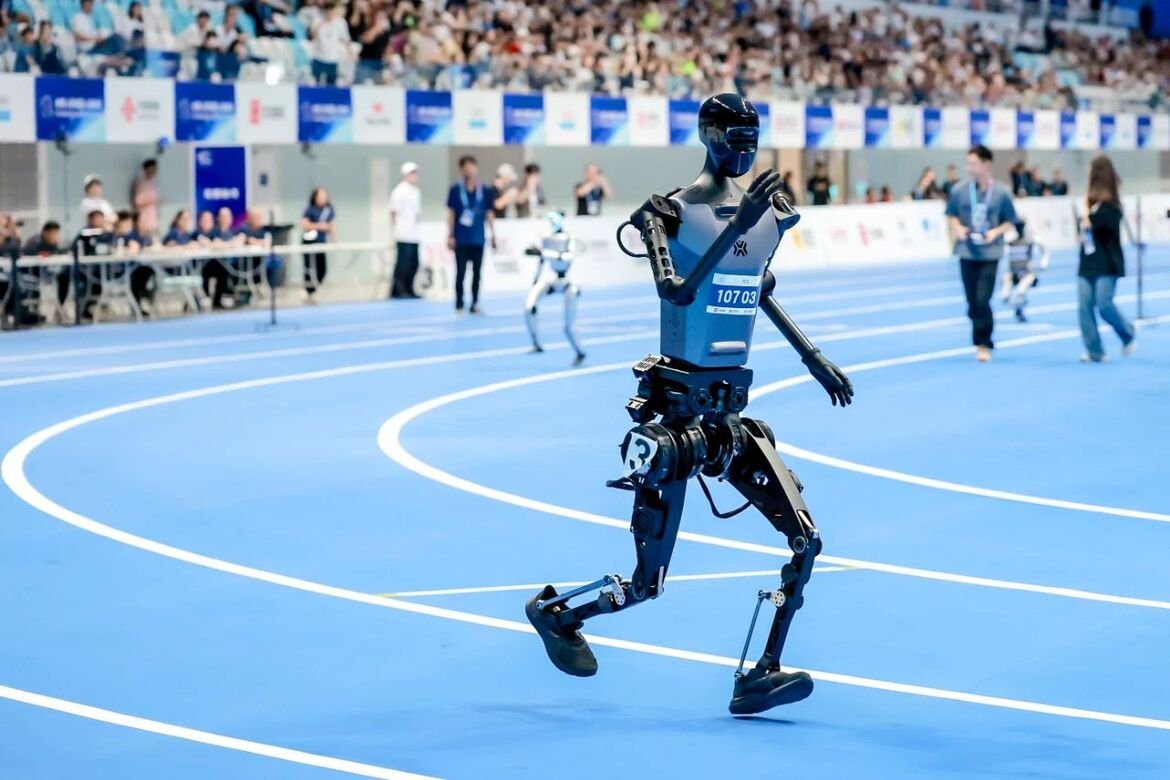
More than 300 humanoid robots are expected to line up alongside human runners in Beijing next month for what organizers say will be the largest robotics endurance race ever held.
The 2026 Beijing E-Town Half Marathon and Humanoid Robot Half Marathon, scheduled for April 19, will feature robots developed by companies, universities, and research institutions from across China. Organizers say 76 teams representing 13 provincial-level regions have registered for the event.
The race marks a major expansion compared with the inaugural competition last year and reflects how quickly humanoid robotics development is accelerating in the country.
According to officials from the Beijing Bureau of Economy and Information Technology, the number of participating teams has increased nearly fivefold since the first race, while the diversity of participants now spans corporate labs, academic institutions, and training programs.
From Robotics Demo to National Testbed
The event will feature 26 robot brands and more than 300 humanoid machines attempting to complete the half marathon course.
While the competition has a public spectacle element, organizers frame it primarily as a technical proving ground for robotics systems.
Running long distances forces developers to address multiple engineering challenges simultaneously: locomotion stability, energy efficiency, heat management, mechanical durability, and motion control.
Unlike short demonstrations in laboratories or trade shows, endurance races expose weaknesses that may only appear after sustained operation.
For robotics developers, these competitions can reveal how well machines perform under continuous real-world stress.
Autonomy Takes Center Stage
One of the most significant shifts in this year’s event is the growing emphasis on autonomous navigation.
Organizers say roughly 38 percent of participating teams will deploy robots capable of navigating the course independently using onboard perception systems and mapping technology.
Last year, many robots relied on human assistance, remote control, or pacing guidance to stay on track.
Autonomous navigation introduces a much higher level of complexity. Robots must perceive their environment, interpret terrain changes, plan routes, and make real-time adjustments to maintain balance and speed.
These capabilities are central to the broader goal of deploying humanoid robots outside controlled environments.
A Rapidly Growing Ecosystem
University participation has surged as well. Twenty universities will enter robots into the race – ten times more than during the inaugural event.
This growth highlights the increasingly close relationship between academic robotics research and industrial development.
Humanoid robotics in China has seen significant momentum over the past year, fueled by advances in mechanical design, control systems, and AI-based motion planning.
The marathon event provides a rare opportunity to evaluate these technologies in a shared, competitive setting.
Beyond the Finish Line
While humanoid robots remain far from matching elite human athletes in endurance running, events like Beijing’s android marathon serve a different purpose.
They are designed to stress-test robotic systems under conditions that resemble real-world deployment – continuous movement, changing terrain, and unpredictable conditions.
The lessons learned from such competitions can influence future applications ranging from logistics and industrial work to search-and-rescue operations and infrastructure inspection.
As humanoid robots move from laboratory prototypes toward practical machines, endurance tests like the Beijing race may increasingly become benchmarks for measuring progress in embodied AI.