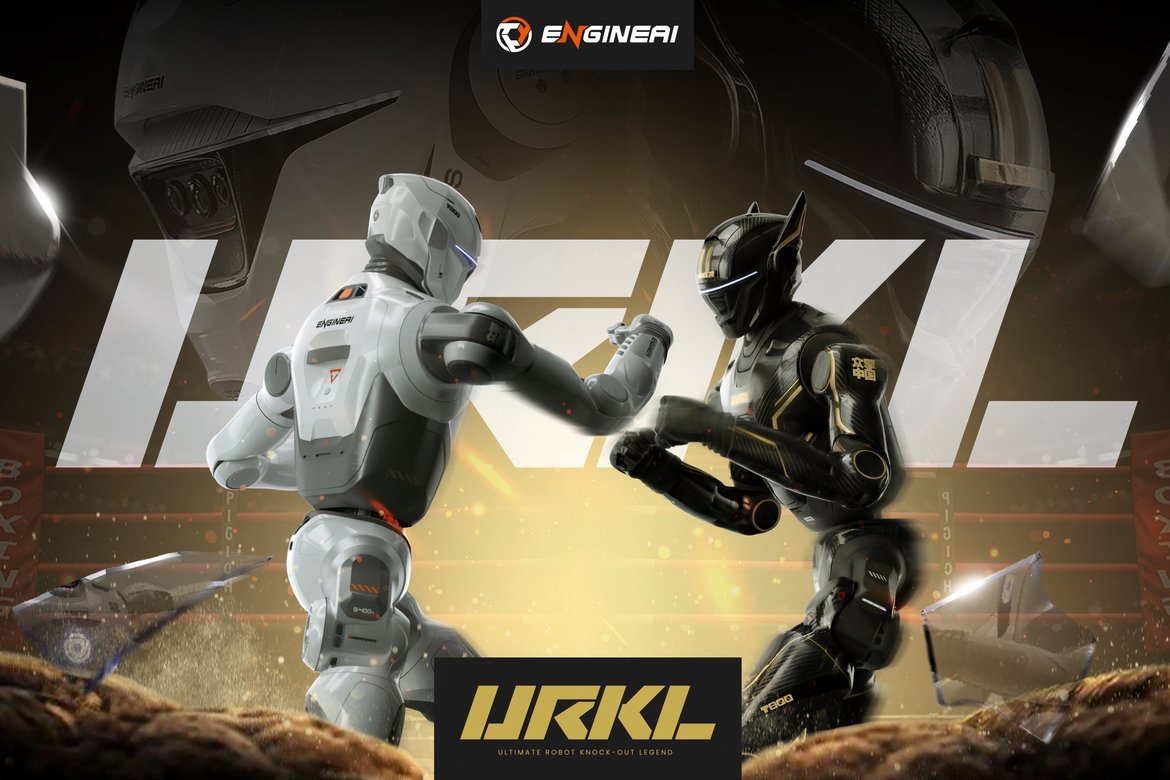
China has taken another step in turning humanoid robotics from laboratory experiments into public spectacle and industrial validation. On February 9, the world’s first humanoid robot free combat league officially opened in Shenzhen, positioning competitive robot fighting as both entertainment and a stress test for embodied artificial intelligence.
The league, known as the Ultimate Robot Knockout Legend (URKL), will run through the end of 2026 and award a championship belt valued at 10 million yuan, or roughly $1.4 million. Organized by EngineAI, the competition brings together development teams from across China and provides each participant with a standardized humanoid robot platform, removing hardware barriers and shifting the focus toward software, control systems, and real-world performance.
Combat as a Testbed for Embodied AI
At the center of the league is EngineAI’s T800 humanoid robot, a full-size platform capable of executing complex martial movements such as aerial rotations, kicks, and rapid directional changes. While the visual appeal is undeniable, organizers and analysts emphasize that the event is designed less as a stunt and more as a proving ground for robotics technology under extreme conditions.
Combat scenarios place unusual demands on humanoid systems, including dynamic balance, motion planning under impact, actuator durability, and rapid decision-making. According to industry observers, these high-stress environments expose weaknesses that may remain hidden in controlled factory or laboratory settings, accelerating iteration cycles and hardware-software integration.
Experts note that robot combat also serves an important cultural function. By framing humanoid robots within a familiar and dramatic format inspired by martial arts, the league challenges public perceptions of robots as purely industrial tools and introduces them as expressive, adaptable machines. This visibility, particularly among younger audiences, may help build long-term talent pipelines into robotics and AI research.
Opportunity and Limits of Robot Fighting
Analysts caution, however, that combat performance does not automatically translate into commercial readiness. Optimizing robots for short bursts of high-impact activity can divert attention from the requirements of industrial, service, or household deployment, where endurance, safety, and cost efficiency matter far more than spectacle.
Even so, supporters argue that entertainment-focused trials can play a meaningful role in early-stage technology development. Real-world combat provides data that simulations struggle to replicate, especially around mechanical stress, failure modes, and system resilience. Some estimates suggest that such environments can shorten development cycles by more than 30 percent.
The league arrives as China’s humanoid robotics sector accelerates rapidly. Industry projections estimate the domestic humanoid robot market could approach 870 billion yuan by 2030, driven by advances in embodied intelligence and growing interest in both industrial automation and consumer-facing robots.
For now, the combat league is less about harvesting immediate commercial products and more about planting ideas. In Shenzhen, humanoid robots are no longer just walking, lifting, or performing demos. They are fighting, failing, adapting, and learning in public – offering a glimpse into how embodied AI might evolve beyond the lab and into everyday life.