A live warehouse trial involving SAP, robotics firm Humanoid, and automotive supplier Martur Fompak is offering a clearer view of how enterprise software systems may begin to directly control physical labor. The project connects SAP’s AI agent framework with a mobile humanoid robot, enabling task execution that originates from business logic rather than pre-programmed robotic routines.
The result is less about a single robot completing a task and more about a shift in system architecture. For decades, enterprise software has optimized operations in the digital layer, while robots have executed fixed workflows on the factory floor. This trial suggests those layers are beginning to merge.
From Enterprise Decisions to Physical Actions
At the center of the integration is a connection between SAP’s Joule AI agent and Humanoid’s KinetIQ robotics stack. In the proof of concept, a cloud-based software agent generated instructions based on operational needs and dispatched them directly to a physical robot.
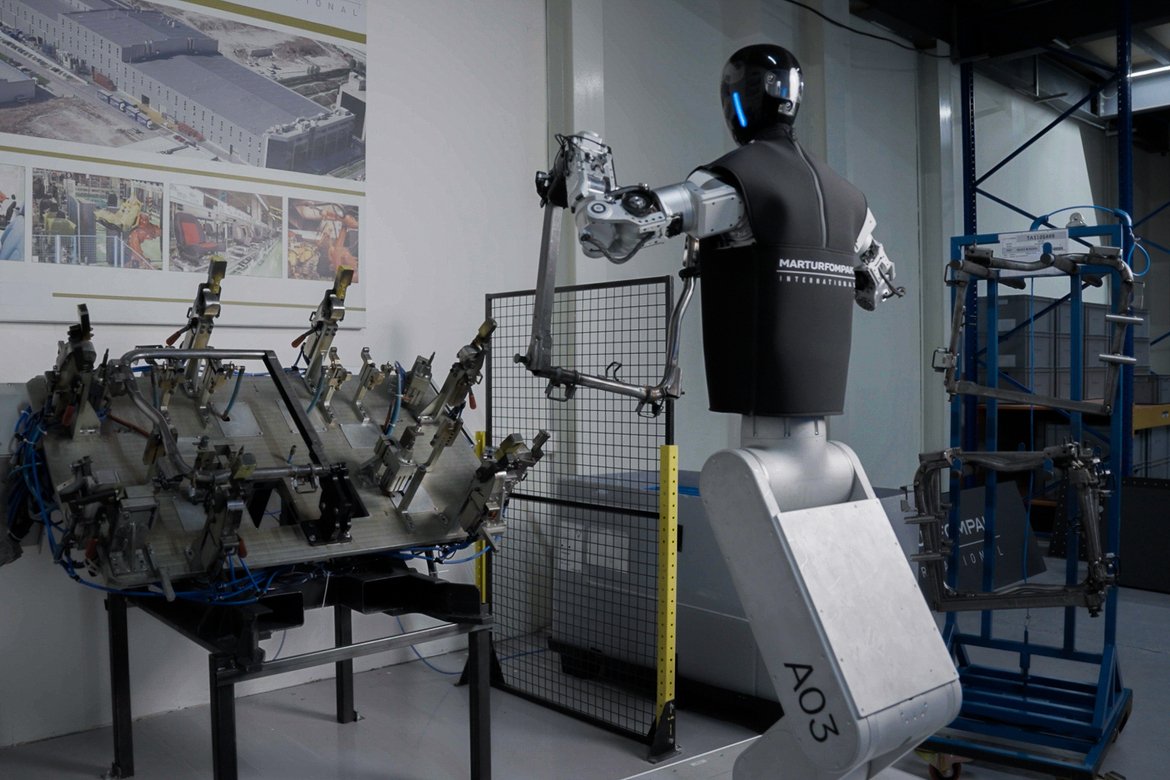
The HMND 01 Alpha Wheeled robot then executed a logistics workflow inside a warehouse environment. It autonomously navigated to a designated pallet, retrieved a standardized container, and delivered it to a trolley as part of an order fulfillment cycle. The robot repeated the process across multiple iterations, handling different container types and operating within existing facility constraints.
This model differs from traditional automation, where tasks are predefined and robots follow rigid sequences. Instead, the system treats the robot as an endpoint of enterprise decision-making, allowing workflows to adapt dynamically based on business inputs.
SAP described the approach as embedding business context into robotic behavior, enabling machines to respond to operational priorities in real time rather than executing isolated tasks.
Embodied AI Moves into Enterprise Infrastructure
The trial reflects a broader convergence between two previously separate domains: enterprise AI and embodied AI. Software agents have long been capable of making decisions across functions such as procurement, scheduling, and inventory management. What has been missing is a direct link between those decisions and physical execution.
By connecting an enterprise agent to a humanoid system, the project demonstrates how digital instructions can translate into real-world actions without human mediation. In this case, warehouse picking becomes an extension of enterprise planning systems rather than a standalone robotic function.
The robot operated with a dual-arm payload capacity of 8 kilograms and was tested under real operational conditions over a multi-week deployment. The structured rollout included simulation and physical twin development, followed by on-site setup, training, and optimization, reflecting a methodology closer to enterprise software deployment than traditional robotics testing.
Executives involved in the project framed the outcome as a transition point. The ability to integrate robots into enterprise systems, measure them against operational metrics, and deploy them within existing workflows suggests that humanoid platforms are moving beyond experimental pilots.
A Bridge Between Pilots and Scaled Deployment
Despite the progress, the trial remains a proof of concept. The next phase will focus on extended validation in live production environments, where reliability, uptime, and integration complexity become more visible.
Still, the implications are notable. If enterprise systems can reliably orchestrate fleets of robots as extensions of digital processes, automation could shift from task-specific deployments to system-wide coordination. In such a model, robots are not programmed individually but managed as part of a broader computational infrastructure.
For Humanoid, the project provides evidence that its platform can operate within industrial constraints. For SAP, it demonstrates a pathway to extend enterprise AI beyond software into physical operations.
More broadly, the trial highlights an emerging pattern in robotics: the value of a robot is increasingly tied not just to its hardware capabilities, but to how seamlessly it integrates into existing digital systems. As that integration improves, the boundary between decision-making and execution may continue to narrow.