Autonomous underwater vehicles are built to withstand unpredictable ocean conditions, but their rigid fins often require significant energy to counteract sudden currents and turbulence. Researchers at the University of Southampton are proposing a different approach: fins that sense water flow and adjust their shape in real time.
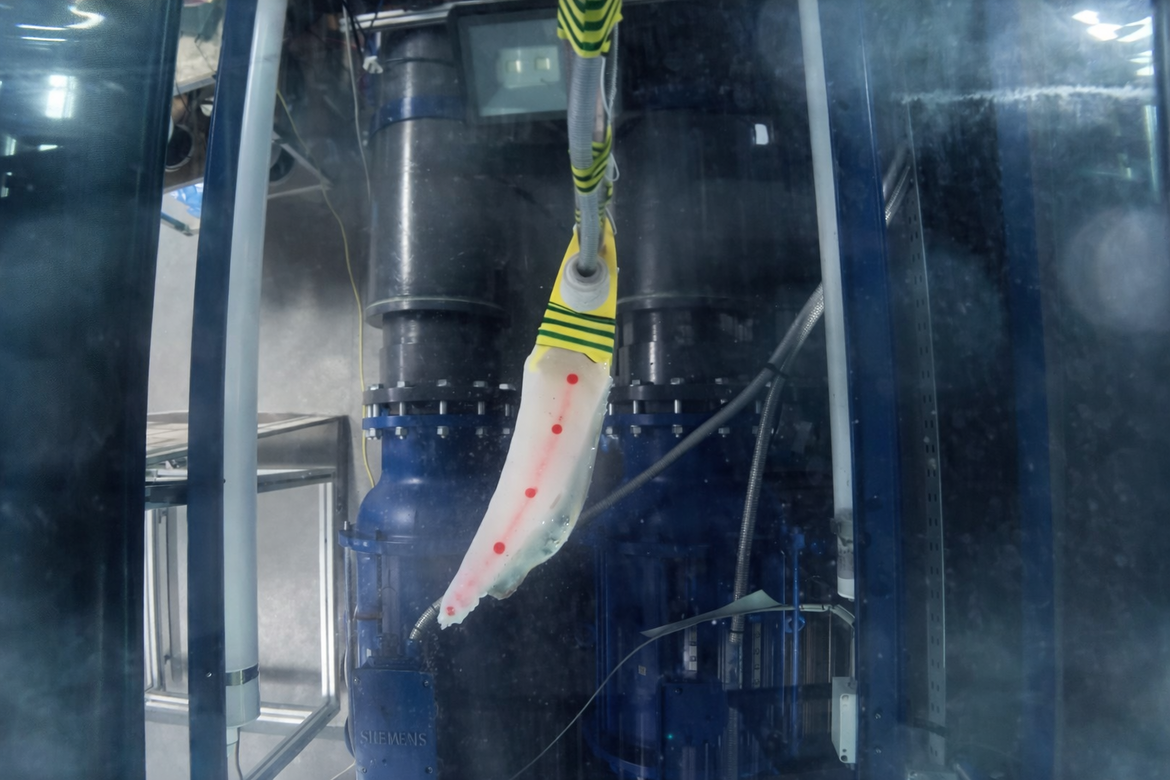
The team has developed a flexible robotic fin embedded with electronic skin capable of detecting subtle changes in water movement. The system automatically modifies the fin’s stiffness and curvature to stabilize underwater robots while reducing energy consumption.
The research, published in npj under the title “Harnessing proprioception in aquatic soft wings enables hybrid passive-active disturbance rejection,” reflects a broader push toward soft robotics and adaptive control in marine environments.
Inspired by Biological Sensing
The design draws from biological proprioception mechanisms observed in birds and fish. Birds detect airflow changes through sensory feedback in their feathers, while fish rely on lateral line systems and fin rays to perceive water disturbances.
To replicate similar sensing capabilities, the Southampton engineers embedded flexible liquid metal wiring inside a silicone fin. When water flow deforms the fin, the integrated electronic skin registers changes in electrical resistance. These signals are transmitted to a hydraulic system inside the robot’s body, which adjusts internal pressure through connected hoses to alter the fin’s shape.
Rather than relying solely on active propulsion corrections, the system combines passive flexibility with active hydraulic adjustment.
Reducing Energy Use in Turbulent Waters
Rigid AUVs typically expend substantial energy to maintain orientation when struck by waves or shifting currents. According to the researchers, the adaptive fin significantly improves disturbance rejection.
In controlled tests, the fin reduced unwanted buoyancy effects caused by sudden water flow by 87 percent compared with a similar vehicle using rigid fins. The robot demonstrated improved self-stabilization and maneuverability while consuming less energy to maintain position.
The findings suggest potential advantages for underwater inspection, environmental monitoring, and defense applications where energy efficiency and stability are critical.
Technical Constraints Remain
Despite promising results, integration challenges remain. Scaling the flexible system to larger vehicles and embedding it into rigid hull designs could complicate deployment. Long-term durability of the electronic skin and hydraulic components in harsh marine environments also requires further validation.
The researchers note that more robust actuators and structural refinements may help address these constraints.
The project illustrates how bio-inspired sensing and soft robotics are reshaping underwater vehicle design. As offshore energy, marine research, and subsea infrastructure monitoring expand, adaptive control systems such as this may become increasingly relevant to improving endurance and operational stability in dynamic ocean conditions.