Industrial robotics has long relied on simulation to design production lines and program machines, but translating those virtual models into reliable real-world performance has remained a persistent challenge.
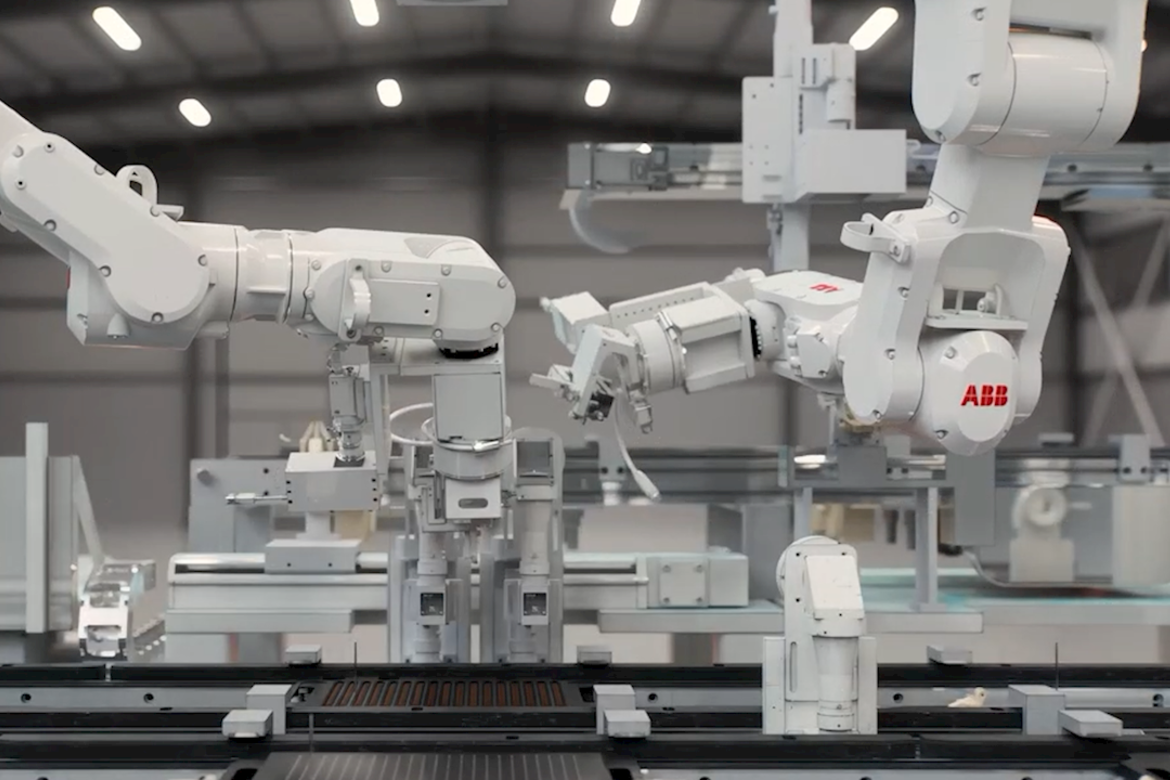
ABB Robotics and NVIDIA say they are taking a significant step toward closing that gap. The companies announced a collaboration that integrates NVIDIA’s Omniverse simulation libraries into ABB’s RobotStudio platform, enabling manufacturers to train AI-driven robots in physically accurate digital environments before deploying them on factory floors.
The partnership reflects a growing push across the robotics industry to apply artificial intelligence not only to perception and decision-making but also to the way robots are designed, trained, and validated before they enter production.
Closing the Simulation to Reality Gap
Simulation has been a standard tool in manufacturing for decades, allowing engineers to model production lines and test automation systems without disrupting real operations. But even sophisticated digital twins have struggled to reproduce the complexities of real-world factory environments.
Differences in lighting, materials, object behavior, and mechanical tolerances often produce what engineers call the “sim-to-real gap”, where robots trained in simulation behave differently once deployed.
ABB and NVIDIA say combining RobotStudio’s robot programming environment with NVIDIA’s physically accurate Omniverse simulation tools could significantly reduce that gap. Developers will be able to generate synthetic training data and train AI models in detailed digital twins of factories, then transfer those models directly to physical robots.
ABB said the combined system could achieve simulation accuracy of up to 99 percent when transitioning from virtual training to real-world operation.
A key element is ABB’s virtual controller technology, which runs the same firmware used in physical robots. That allows developers to test programs in simulation under conditions that closely mirror real machines. When paired with the company’s Absolute Accuracy calibration technology, which reduces positioning errors to roughly half a millimeter, the platform is intended to support high-precision industrial tasks.
Digital Training for Complex Manufacturing
The companies say improved simulation accuracy could significantly accelerate the way factories deploy new automation systems.
Using digital twins and synthetic data, engineers can design and test production lines virtually before installing physical equipment. ABB estimates this approach could cut commissioning time by up to 80 percent while reducing development costs by as much as 40 percent by eliminating physical prototypes.
For industries with fast product cycles, such as consumer electronics, the ability to simulate entire production processes before deployment could also shorten time to market.
Foxconn, the world’s largest contract electronics manufacturer, is already piloting the technology for assembly processes that require extremely precise manipulation of small components. The company is using virtual training environments to simulate multiple product variants and production scenarios before robots are deployed on real assembly lines.
Dr. Zhe Shi, chief digital officer at Foxconn, said the approach allows manufacturers to run engineering and production planning in parallel rather than sequentially, accelerating factory ramp-up for new devices.
A New Layer of Physical AI for Industry
The collaboration also highlights how large robotics vendors are beginning to integrate AI infrastructure directly into industrial automation platforms.
ABB is exploring the use of NVIDIA’s Jetson edge computing modules within its Omnicore robot controller, enabling real-time AI inference directly on industrial robots. That could allow robots to adapt to changing environments, interpret visual data, and modify tasks dynamically without relying on centralized computing.
The companies say the integrated platform will be released to ABB’s roughly 60,000 RobotStudio users in the second half of 2026 under a new system called RobotStudio HyperReality.
Beyond large manufacturers, the technology is also being positioned for smaller factories. WORKR, a U.S.-based robotics workforce company, plans to demonstrate how robots trained using synthetic data and Omniverse simulation can be deployed without traditional programming, allowing operators to teach new tasks quickly.
The demonstration, scheduled at NVIDIA’s GTC conference, reflects a broader trend in robotics toward simplifying deployment for manufacturers that lack specialized automation engineers.
What This Signals for the Robotics Industry
The collaboration underscores a growing convergence between industrial robotics and the AI infrastructure ecosystem.
Historically, factory automation focused primarily on mechanical precision and deterministic programming. But as robots take on more flexible tasks, manufacturers increasingly need systems capable of learning from data and adapting to complex environments.
Physically accurate simulation environments may become a critical step in that process. Training robots in large-scale digital environments allows developers to generate enormous datasets and refine AI models before robots interact with real machinery or workers.
For companies like ABB, the approach could reshape how industrial automation systems are designed, shifting much of the engineering process into virtual environments.
If widely adopted, the combination of AI training, digital twins, and robotics simulation could make factory automation faster to deploy and easier to scale, potentially accelerating the spread of intelligent robotics across global manufacturing.