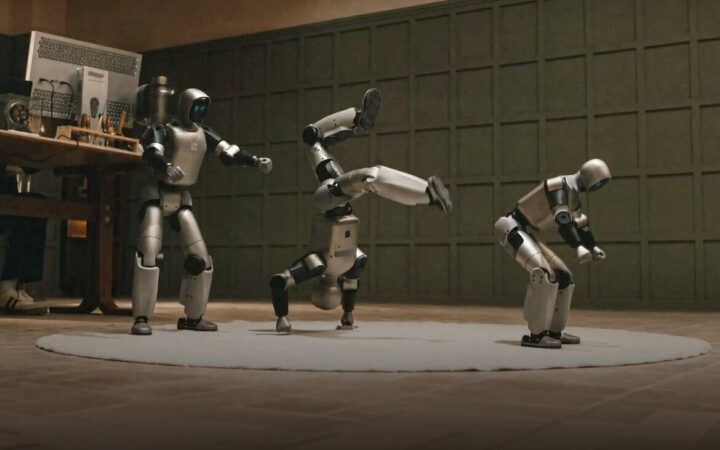



Chinese robotics company AGIBOT presented its latest full-size humanoid robot, the A3, on Friday in Shanghai, marking one of the company’s most visible demonstrations of dynamic embodied intelligence to date. The event positions AGIBOT more directly in the race to build agile, general-purpose humanoids capable of operating beyond controlled lab environments.
The unveiling comes amid intensified competition in China’s humanoid robotics sector, where companies are moving rapidly from static walking demos toward machines capable of athletic, high-load maneuvers.
From Stable Walking to Dynamic Motion
In public demonstrations, the A3 executed mid-air kicks, rapid spinning strikes, and complex coordinated sequences reminiscent of martial arts training. While such movements may appear theatrical, they serve a technical purpose: stress-testing whole-body control systems under extreme dynamic conditions.
Humanoid robots historically struggled with balance recovery and high-speed motion due to limitations in actuator torque, joint responsiveness, and latency in perception-to-action loops. Movements such as jumping kicks require synchronized control of hips, knees, ankles, and upper-body counterbalances, all coordinated in milliseconds.
The A3’s performance suggests improvements in three critical areas:
- High power-density actuators capable of explosive bursts without destabilizing the platform
- Advanced balance algorithms for real-time center-of-mass adjustment
- Low-latency motion planning systems that integrate perception and control
Unlike choreographed walking sequences, airborne maneuvers introduce transient instability. A robot must predict landing forces and pre-adjust joint stiffness before ground contact. This type of anticipatory control is a stepping stone toward real-world tasks such as climbing debris, navigating uneven terrain, or handling dynamic industrial environments.
Athleticism as a Benchmark for Physical Intelligence
The demonstration reflects a broader shift in how robotics companies measure progress. Early humanoid milestones focused on bipedal locomotion. The next phase emphasizes agility, resilience, and coordinated whole-body action.
Dynamic martial arts-style routines push hardware and software simultaneously. They test actuator durability, thermal management, sensor fusion, and high-frequency control loops under stress. More importantly, they showcase integrated embodied intelligence, where perception, prediction, and actuation operate as a unified system.
This shift mirrors trends across the sector. Chinese competitor Unitree Robotics has also accelerated development of high-mobility humanoids, emphasizing speed and balance recovery. The competitive landscape increasingly rewards systems that can combine strength, flexibility, and computational adaptability.
While spectacle draws attention, the underlying technical implications are practical. Robots capable of maintaining stability during aggressive maneuvers are more likely to withstand unpredictable conditions in logistics, manufacturing, and public service roles.
China’s Accelerating Humanoid Push
The A3 unveiling in Shanghai highlights how Chinese robotics firms are compressing development cycles. Public demonstrations are no longer limited to cautious lab experiments but are becoming stress tests in front of live audiences.
This reflects a maturing ecosystem where hardware supply chains, actuator innovation, AI model training, and simulation platforms are advancing in parallel. Companies are increasingly treating humanoids not as research novelties but as future infrastructure systems.
The key question now is not whether humanoids can walk reliably, but whether they can operate dynamically, safely, and economically at scale. AGIBOT’s A3 suggests that the benchmark for physical intelligence is rising, and that athletic capability may become a proxy for broader real-world robustness.
As embodied AI moves from static balance toward high-energy coordination, demonstrations like this serve as early signals of where the industry is heading: toward machines that are not just stable, but physically expressive and adaptable under pressure.
Disclaimer: RobotsBeat is an independent media brand owned and operated by NuvexMedia LLC, publishing news, research, and insights on artificial intelligence, emerging technologies, automation, and related industries. NuvexMedia LLC invests in and collaborates with companies across the AI, Robotics, technology, software, and digital innovation sectors. These relationships do not influence RobotsBeat's editorial coverage, and the publication maintains full editorial independence to provide accurate, timely, and objective information. © 2026 NuvexMedia LLC. All rights reserved. This content is for informational purposes only and should not be considered legal, tax, investment, financial, or other professional advice.