Australia could unlock up to AUD $201 billion in additional economic output by 2040 through greater adoption of robotics, according to new modeling – but realizing that potential will depend less on technology breakthroughs than on closing persistent gaps in deployment.
The analysis, commissioned by Amazon Australia and conducted by consulting firm ACIL Allen, suggests that relatively modest increases in robot usage across industry and services could generate economy-wide productivity gains, higher wages and new employment opportunities.
The findings add to a growing global narrative: robotics is no longer just a tool for individual firms, but a macroeconomic lever shaping national competitiveness.
Productivity Gains Beyond Manufacturing
The report outlines a scenario in which Australia doubles its industrial robot density while increasing service robot adoption by around 15% in non-manufacturing sectors.
Under those conditions, average incomes could rise by roughly AUD $6,500 per person annually, while the economy could support nearly 129,000 additional jobs each year.
The benefits are not limited to traditional automation sectors.
While industries such as mining and agriculture already make significant use of robotics, the report highlights untapped potential in areas like logistics, retail and services – sectors where automation has historically been slower to scale.
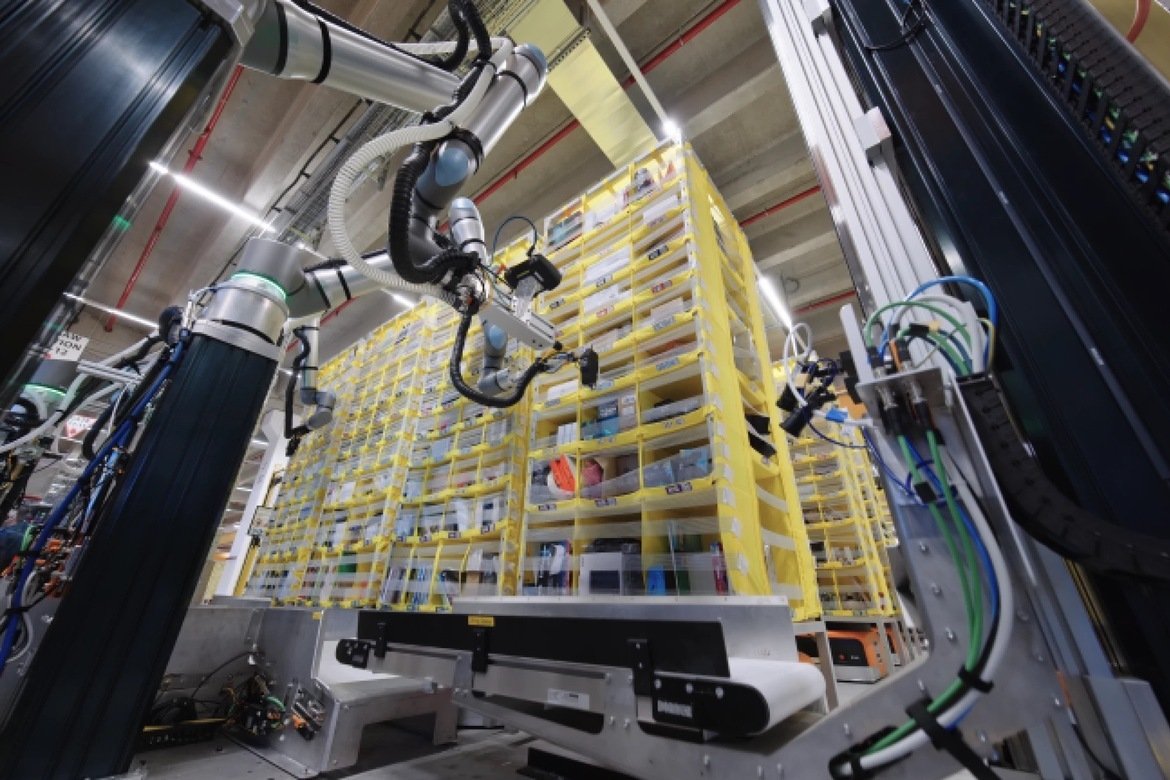
Amazon’s own operations illustrate the shift. In its fulfillment centers, mobile robots are used to transport heavy inventory, reducing physical strain on workers and allowing employees to transition toward oversight, maintenance and system management roles.
At the same time, software systems are becoming increasingly important. The company points to AI-driven fleet management tools that optimize robot movement, improving efficiency across large-scale operations.
The Commercialization Bottleneck
Despite strong research capabilities, particularly in field robotics, Australia continues to lag behind other markets in adoption, production and robotics-related employment.
The report identifies a familiar challenge: translating academic innovation into commercial deployment.
Bridging that gap requires more than investment in research. It depends on building connections between universities, industry and end users, along with creating environments where technologies can be tested, refined and scaled.
Robotics adoption also involves a complex ecosystem. Businesses must invest not only in hardware but also in software integration, workforce training and ongoing maintenance – factors that can slow uptake even when the underlying technology is mature.
The result is uneven adoption, with robotics concentrated in sectors where the return on investment is clear, while other industries remain cautious.
A National Competitiveness Question
The modeling suggests that even incremental progress could have broad economic effects, amplifying productivity across sectors rather than delivering isolated gains.
This scaling effect is central to the argument for robotics investment: improvements in automation can ripple through supply chains, labor markets and service industries.
At the same time, the findings highlight a strategic question for policymakers.
Countries that successfully integrate robotics into their economies may gain advantages in productivity, wages and industrial competitiveness. Those that lag risk falling behind as automation becomes a standard component of global business operations.
Australia’s position reflects both opportunity and constraint.
The country has strong research foundations and sector-specific expertise, particularly in challenging environments such as mining. But without stronger pathways to commercialization and wider adoption, those advantages may not translate into economic impact.
The report’s conclusion is cautious but clear: the potential gains from robotics are substantial, but they will depend on execution – not just innovation.