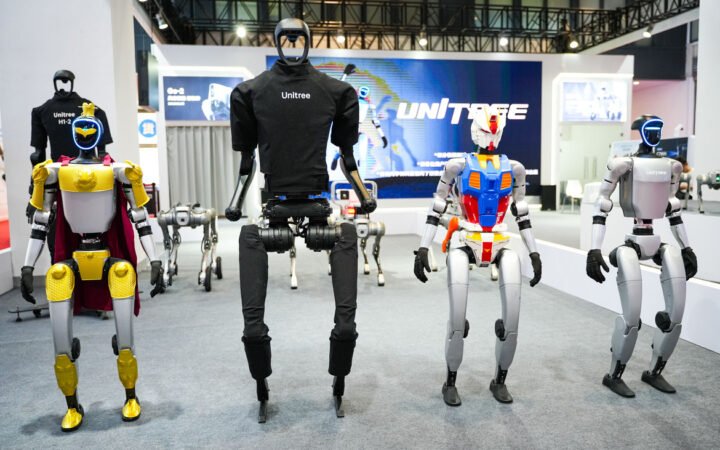
U.S.-based robotics company GoLabs has launched a custom robotic security service built around Unitree quadruped platforms. The company is positioning itself as a domestic vendor and integrator of Unitree hardware, allowing customers in the United States to procure and deploy the robots without the cost and lead times associated with international shipping. GoLabs handles setup, calibration, programming, and ongoing system integration within existing security infrastructure, alongside troubleshooting support.
The quadrupeds are configured for autonomous patrol applications and are equipped with wide-angle HD cameras for 24/7 live monitoring, alongside thermal and night vision sensors that allow operation in complete darkness. The platforms support autonomous elevator navigation and anomaly detection, and can be deployed in environments that pose health risks to human personnel, including high-altitude sites, oxygen-deficient zones, and nuclear industrial areas. Mapping and navigation rely on an integrated 4D LiDAR system combined with SLAM, enabling the robots to generate 3D maps of facilities and follow assigned patrol paths and checkpoints.
The launch reflects the growing role of system integrators and value-added resellers in scaling robotics deployments, particularly for hardware platforms developed by overseas manufacturers. Unitree, based in China, has become one of the most widely deployed quadruped suppliers globally, but commercial customers in the United States typically require localized support, integration services, and procurement structures that direct import does not easily provide. GoLabs is targeting that gap.
Robotic security patrols remain a relatively early-stage application area, with most deployments concentrated in logistics warehouses, data centers, large event venues, and critical infrastructure sites. Whether quadruped platforms can displace meaningful share from incumbent fixed-camera systems and human guard services will depend on operational reliability over extended deployments, integration with existing security operations centers, and total cost of ownership compared to traditional alternatives.
Disclaimer: RobotsBeat is an independent media brand owned and operated by NuvexMedia LLC, publishing news, research, and insights on artificial intelligence, emerging technologies, automation, and related industries. NuvexMedia LLC invests in and collaborates with companies across the AI, Robotics, technology, software, and digital innovation sectors. These relationships do not influence RobotsBeat's editorial coverage, and the publication maintains full editorial independence to provide accurate, timely, and objective information. © 2026 NuvexMedia LLC. All rights reserved. This content is for informational purposes only and should not be considered legal, tax, investment, financial, or other professional advice.