CES 2026: Kodiak and Bosch Partner to Scale Autonomous Trucking Hardware

Kodiak has entered a strategic agreement with Bosch to scale production-grade autonomous trucking hardware, aiming to accelerate commercial deployment of driverless trucks.

By Daniel Krauss Published: Updated:

Kodiak AI has announced a strategic agreement with Bosch to scale the manufacturing of production-grade autonomous trucking hardware, marking a significant step toward large-scale deployment of driverless trucks. The collaboration was revealed ahead of CES 2026, where a Kodiak Driver-powered autonomous truck will be displayed at Bosch’s booth in Las Vegas.

The partnership focuses on building a redundant, automotive-grade platform that integrates hardware, firmware, and software interfaces required to deploy Kodiak’s AI-powered virtual driver at scale. By combining Kodiak’s autonomy software with Bosch’s manufacturing expertise and supply chain capabilities, the companies aim to move autonomous trucking beyond pilots and into sustained commercial operations.

Scaling Physical AI for Heavy-Duty Trucks

Kodiak’s autonomous system, known as the Kodiak Driver, is designed as a unified platform that blends AI-driven perception and planning software with modular, vehicle-agnostic hardware. The system can be integrated either directly on a truck production line or through aftermarket upfitters, giving fleet operators flexibility in how autonomous capability is deployed.

Under the agreement, Bosch will support the development of a redundant autonomous hardware platform, supplying key components such as sensors, steering systems, and other vehicle actuation technologies. These components are designed to meet automotive-grade reliability standards, a critical requirement for long-haul trucking applications where uptime and safety are paramount.

“Advancing the deployment of driverless trucks and physical AI requires not only robust autonomy software, but also manufacturing experience and a resilient supply chain,” said Don Burnette, founder and chief executive of Kodiak. He emphasized that Bosch’s industrial scale and system-level integration expertise are essential for commercial success.

From Commercial Pilots to Industrial Scale

Kodiak has already deployed trucks operating without human drivers in commercial service, positioning the company as one of the few autonomous trucking developers with real-world revenue-generating operations. The new agreement is intended to build on that foundation by enabling higher-volume production and standardized hardware configurations.

Bosch’s role extends beyond component supply. As the world’s largest automotive supplier, the company brings decades of experience in industrialization, quality assurance, and global manufacturing. This expertise is expected to help Kodiak transition from limited deployments to repeatable, scalable production suitable for fleet-wide adoption.

Paul Thomas, president of Bosch in North America and president of Bosch Mobility Americas, said the collaboration allows Bosch to deepen its understanding of real-world autonomous vehicle requirements while contributing production-grade systems to the broader autonomous mobility ecosystem.

CES 2026 and the Push Toward Autonomous Freight

Autonomous trucking emerged as a key theme at CES 2026, with increasing emphasis on commercialization rather than experimental prototypes. Kodiak and Bosch used the event to highlight how Physical AI systems are moving into operational environments where reliability, redundancy, and cost efficiency matter as much as technical performance.

The Kodiak Driver-powered truck on display demonstrates how the integrated platform brings together sensors, compute, and vehicle control into a single autonomous system. Unlike many earlier demonstrations, the focus is on readiness for deployment rather than future concepts.

Industry analysts view the partnership as a sign that autonomous trucking is entering a more mature phase, where partnerships with established automotive suppliers are essential to overcoming manufacturing and regulatory hurdles.

Broader Implications for Autonomous Logistics

For Kodiak, the deal supports its long-term vision of becoming a trusted provider of autonomous ground transportation across commercial and public-sector applications. The company has also positioned its technology for use in government and national security contexts, where reliability and safety standards are especially stringent.

The collaboration underscores a broader trend in robotics and automation, where autonomy developers increasingly rely on established industrial partners to bridge the gap between software innovation and large-scale deployment. As Physical AI systems move from test routes to highways and supply chains, the ability to manufacture and support hardware at scale becomes a decisive competitive advantage.

With CES 2026 as the backdrop, the Kodiak-Bosch agreement signals growing confidence that autonomous trucking is transitioning from experimentation to infrastructure, setting the stage for wider adoption in the years ahead.

Automation, Business & Markets, News, Robots & Robotics

Faraday Future Expands Robotics Push with Dealership Deployments and School Programs

Faraday Future has delivered new humanoid robots for dealership use while testing education-focused deployments, signaling a broader strategy to integrate embodied AI across services and learning.

By Daniel Krauss | Edited by Kseniia Klichova Published:
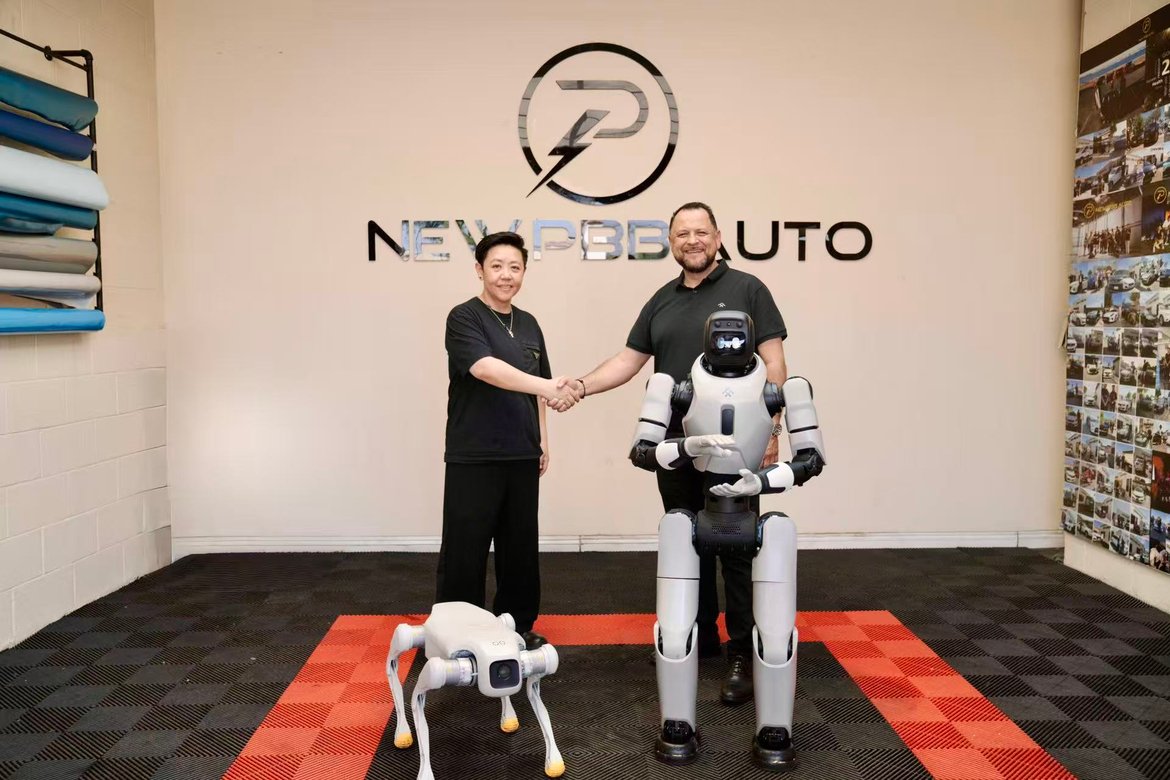
Faraday Future’s humanoid robots are being deployed in dealership environments and educational programs as part of the company’s broader embodied AI strategy. Photo: Faraday Future

Faraday Future is expanding its presence in robotics with new deployments of humanoid systems in both commercial and educational settings, as the electric vehicle maker pushes deeper into what it calls an “embodied AI” ecosystem.

The California-based company said it recently delivered two of its robots – the Master and Aegis models – to Los Angeles-based New PBB Auto, where they will be used for reception and customer-facing duties in dealership and showroom environments.

The move reflects an emerging strategy among robotics companies to introduce humanoid systems into service roles where interaction with customers is as important as physical capability.

At the same time, Faraday Future is testing how its robots can be used in education, pointing to a broader effort to position embodied AI as both a commercial tool and a learning platform.

From Showroom Assistants to Service Platforms

The initial deployment focuses on dealership operations, where the robots are expected to greet visitors, provide information and assist with basic customer service tasks.

Such roles are increasingly seen as an early entry point for humanoid robots. Unlike industrial environments, where precision and speed dominate, service settings require machines to interact naturally with people – an area where embodied AI systems are still evolving.

Faraday Future’s approach suggests that automakers may view robotics as an extension of their existing ecosystems, connecting vehicles, retail environments and digital services.

The delivery is tied to a broader business relationship with New PBB Auto, which has previously committed to future vehicle orders from the company.

Testing Robots as Educational Tools

Alongside commercial deployments, Faraday Future has begun experimenting with robotics in education.

In Los Angeles, the company hosted an interactive demonstration involving more than 300 students, where participants engaged directly with humanoid robots, a robotic dog and one of the company’s vehicles.

The event, held in collaboration with a local school district, emphasized hands-on interaction rather than passive demonstrations. Company representatives said the experience highlighted how direct engagement with robots can increase student interest in artificial intelligence and STEM fields.

Faraday Future is now exploring whether such programs could be scaled into structured educational offerings, potentially combining robotics demonstrations with curriculum development.

The company describes this approach as a “Robot & Vehicle + Education” model, in which embodied AI systems are used not only as tools but also as teaching platforms.

Automakers Enter the Robotics Race

Faraday Future’s expansion into robotics underscores a broader trend in the automotive industry.

As vehicles become increasingly software-driven, automakers are exploring adjacent markets where artificial intelligence and hardware integration intersect. Robotics – particularly humanoid systems – represents one such opportunity.

Companies including Tesla have already signaled ambitions to develop humanoid robots alongside their automotive businesses. Faraday Future’s approach suggests a different entry point, focusing initially on service and education rather than large-scale industrial deployment.

The strategy also reflects a key challenge facing the robotics industry: identifying practical, near-term use cases.

While humanoid robots are often associated with future household or industrial roles, many companies are beginning with smaller, controlled deployments in environments such as retail, hospitality and education.

For Faraday Future, the combination of dealership deployments and school programs provides an early test of how embodied AI systems can function in real-world settings.

Whether these applications scale into a broader business remains uncertain. But the company’s efforts highlight how robotics is increasingly being treated not as a standalone industry, but as part of a wider ecosystem connecting mobility, services and digital intelligence.


Business & Markets, News, Robots & Robotics

New System Lets Robots Outpace Human Teachers in Learning Tasks

Researchers have developed a system that allows robots to perform learned tasks faster than human demonstrations, addressing a key limitation in imitation learning.

By Laura Bennett | Edited by Kseniia Klichova Published:
Robots trained with imitation learning perform tasks such as food handling and object manipulation, with new systems enabling faster execution than human demonstrations. Photo: Georgia Tech

A new robotics system developed by researchers aims to solve one of imitation learning’s most persistent limitations: speed.

The approach allows robots to perform tasks significantly faster than the humans who trained them, while maintaining precision and control. The advance could accelerate the adoption of robots in industries where efficiency and throughput are critical, from manufacturing to food preparation.

Imitation learning – where robots learn by observing human actions – has become a central method in modern robotics. But until now, robots have largely been constrained by the pace of human demonstrations, limiting their usefulness in real-world applications.

The new system, called SAIL (Speed Adaptation for Imitation Learning), is designed to break that constraint.

Breaking the Human-Speed Barrier

Imitation learning has gained traction because it allows robots to acquire complex, humanlike behaviors without requiring engineers to manually program every movement.

Tasks such as folding laundry, arranging objects or handling food are difficult to encode explicitly but relatively easy for humans to demonstrate. By observing these demonstrations, robots can learn to replicate them.

The challenge has been that robots typically execute these learned behaviors at roughly the same speed as the original demonstrations. Attempting to move faster can introduce instability, reduce accuracy or cause failures when environmental conditions change.

SAIL addresses this by introducing a system that adapts motion speed dynamically while preserving stability.

The approach combines multiple components that manage motion smoothness, track positioning, adjust execution speed based on task complexity and account for hardware limitations. Together, these elements allow robots to accelerate beyond their training data without losing control.

Toward Practical, General-Purpose Robots

In testing, robots using SAIL completed a range of tasks – including stacking objects, folding cloth and preparing food – up to three to four times faster than conventional imitation-learning systems.

The results suggest that robots can exceed human speed while maintaining the level of precision required for real-world work.

At the same time, the system is designed to recognize when slowing down is necessary. Tasks that require sustained contact or delicate handling may still benefit from reduced speed to avoid errors.

This balance between speed and control reflects a broader challenge in robotics: building systems that are not only capable but also reliable under varying conditions.

Researchers say the goal is not simply faster robots, but systems that can intelligently adapt their behavior depending on the task.

Closing the Gap Between Research and Deployment

The development highlights a key transition underway in robotics.

While imitation learning has enabled impressive demonstrations in laboratory settings, deploying such systems in real-world environments requires meeting stricter demands for speed, consistency and robustness.

Industrial applications, in particular, require robots to operate at a pace that justifies their cost while maintaining high levels of accuracy.

By allowing robots to learn from human demonstrations but operate beyond human speed, SAIL could help bridge the gap between research prototypes and commercial systems.

The work also points toward a broader ambition in robotics: creating general-purpose machines capable of performing a wide range of tasks that human hands can do.

Achieving that goal will require not only learning from humans, but also surpassing human limitations where efficiency demands it.

News, Robots & Robotics, Science & Tech

U.S. Lawmakers Move to Ban Chinese Humanoid Robots over Security Concerns

U.S. lawmakers are introducing legislation to block government use of Chinese-made humanoid robots, reflecting growing concerns over data security and technological competition.

By Rachel Whitman | Edited by Kseniia Klichova Published: Updated:
A U.S. senator speaks at a podium during a public address in Washington, D.C., as lawmakers introduce legislation targeting foreign-made robotics systems. Photo: Senator Tom Cotton / Facebook

U.S. lawmakers are preparing to introduce legislation that would prohibit federal agencies from purchasing or operating humanoid robots made by Chinese companies, marking a new phase in the geopolitical competition over robotics and artificial intelligence.

The proposed American Security Robotics Act, backed by bipartisan leadership in the Senate, would bar the use of government funds to acquire or deploy unmanned ground systems from adversarial nations, including China. A companion bill is expected in the House of Representatives.

The measure reflects growing concern in Washington that advanced robotics systems could pose security risks as they become more capable, connected and embedded in critical operations.

Robotics Becomes a Security Issue

The legislation is framed around the idea that humanoid robots and other autonomous systems could collect sensitive data or be remotely influenced by foreign actors.

Lawmakers argue that as robots gain more sensors, connectivity and autonomy, they may introduce vulnerabilities not present in traditional hardware. Concerns include the potential for data transmission back to foreign entities or remote control capabilities embedded in the systems.

The bill would include limited exemptions for military and law enforcement research, provided that such systems are isolated from external communication channels.

The proposal follows earlier scrutiny of Chinese robotics firms, some of which have drawn attention from U.S. officials over potential links to state-backed initiatives.

A Growing Global Robotics Rivalry

The timing of the bill highlights intensifying competition between the United States and China in the development of humanoid robots and embodied AI systems.

Chinese companies have rapidly advanced in the sector, with firms such as Unitree and Agibot gaining visibility through new product launches and planned public listings. At the same time, U.S. companies including Tesla and a new wave of startups are investing heavily in humanoid robotics.

The competition is not only technological but also industrial. Humanoid robots are increasingly viewed as a potential platform for automating labor across manufacturing, logistics and service industries.

As a result, governments are beginning to treat robotics as a strategic technology with implications for economic competitiveness and national security.

Policy Meets Physical AI

The proposed legislation underscores a broader shift in how policymakers are approaching artificial intelligence.

While earlier debates focused largely on software – including data privacy, algorithmic bias and generative AI – the emergence of embodied AI is introducing new considerations tied to physical systems.

Robots operate in real-world environments, interact with infrastructure and may handle sensitive materials or data. These characteristics raise questions about supply chains, system integrity and operational control.

At the same time, policymakers are seeking to support domestic robotics development. Proponents of the bill argue that restricting foreign systems could help strengthen U.S. industry while reducing potential risks.

Whether the legislation passes in its current form remains uncertain. But its introduction signals that humanoid robotics is no longer just a technological race – it is increasingly a matter of national policy.

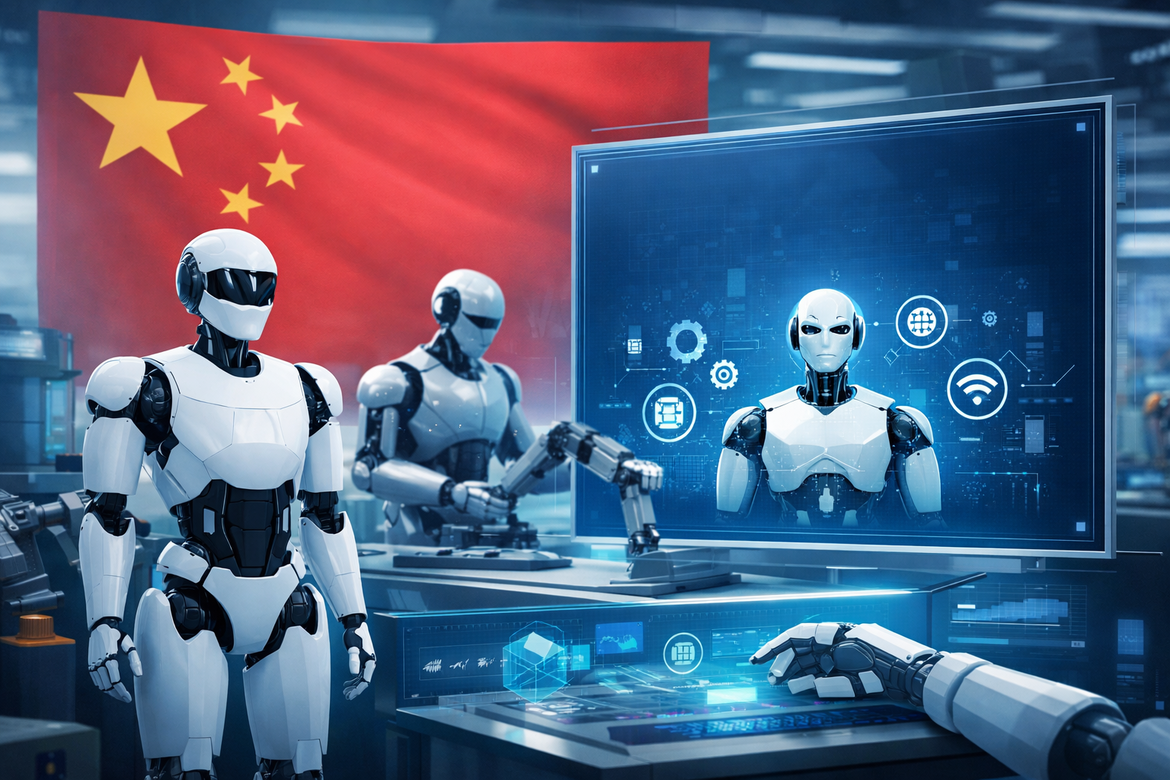
China Introduces First Industry Standard for Embodied AI Systems

China has released its first industry standard for embodied artificial intelligence, establishing a unified framework to evaluate and deploy next-generation robotic systems.

By Daniel Krauss | Edited by Kseniia Klichova Published: Updated:
China has introduced a national industry standard for embodied AI systems, aiming to unify evaluation methods and accelerate deployment of humanoid robots and physical AI technologies. Photo: Kseniia Klichova / RobotsBeat

China has released its first industry standard for embodied artificial intelligence, signaling a shift from experimental development toward formalized evaluation and deployment of physical AI systems.

The standard, developed by the China Academy of Information and Communications Technology in collaboration with more than 40 institutions, introduces a unified framework for benchmarking and testing embodied AI technologies. It is scheduled to take effect on June 1, 2026.

The move reflects growing efforts to define how robots and AI systems operating in the physical world should be measured, compared and validated as the sector expands rapidly.

Establishing Benchmarks for Physical AI

Unlike traditional software-based AI, embodied intelligence involves systems that must perceive, decide and act within real-world environments. Measuring performance in such systems has historically been difficult, with companies relying on proprietary metrics or isolated testing scenarios.

The new standard aims to address that gap by defining consistent evaluation methodologies and capability requirements across the industry.

It outlines how embodied AI systems should be assessed in areas such as perception, motion control and interaction with environments. It also introduces guidance on system architecture, helping standardize how hardware and software components are integrated.

By creating a shared set of benchmarks, the framework is expected to make it easier to compare different technologies and accelerate adoption in industrial and commercial settings.

From Research to Industrialization

The release of the standard builds on earlier efforts by China’s Ministry of Industry and Information Technology, which published a broader framework for humanoid robots and embodied intelligence earlier this year.

Together, these initiatives suggest that China is moving to formalize the technical foundations of the sector as it transitions from research to large-scale deployment.

Standardization has historically played a critical role in scaling emerging technologies. In industries such as telecommunications and manufacturing, common standards have enabled interoperability, reduced uncertainty and encouraged investment.

For embodied AI, the introduction of shared evaluation criteria could help companies move beyond isolated pilot projects and toward more widely deployable systems.

A Strategic Push in the Global Robotics Race

China’s move comes amid intensifying global competition in robotics and artificial intelligence.

Governments and companies are increasingly viewing embodied AI as a strategic technology with implications for manufacturing, logistics, healthcare and national security.

By establishing early standards, China may be positioning itself to influence how the global industry defines performance and safety benchmarks for humanoid robots and other physical AI systems.

The challenge for the industry will be ensuring that such standards remain flexible enough to accommodate rapid technological advances while providing meaningful guidance for deployment.

As embodied AI systems move closer to real-world adoption, the question is no longer only how to build capable robots, but also how to measure their performance in consistent and reliable ways.

News, Policy & Regulation, Robots & Robotics

SAIC GM Deploys Humanoid Robots on Buick Battery Production Line

SAIC-GM has introduced humanoid robots into a Buick battery assembly line, marking an early step toward integrating embodied AI into automotive manufacturing.

By Laura Bennett | Edited by Kseniia Klichova Published:
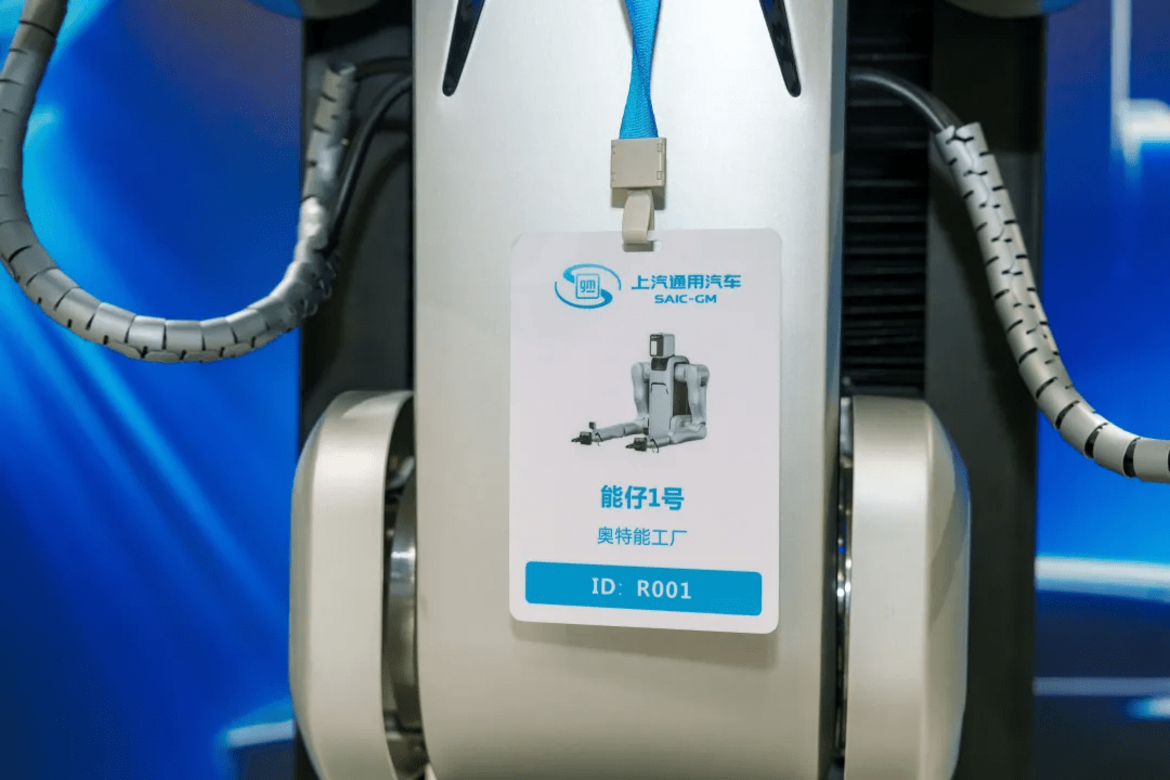
A wheeled humanoid robot operates on SAIC-GM’s battery assembly line, handling cell loading tasks as part of early embodied AI deployment in automotive manufacturing. Photo: SAIC-GM

SAIC-GM has deployed humanoid robots on a battery assembly line for Buick vehicles, marking one of the first known integrations of embodied intelligent machines into automotive production in China.

The robots, developed jointly with Shanghai-based startup Agibot, are currently operating on the production line for the Buick Electra E7, a plug-in hybrid SUV scheduled for release this year. The deployment represents a pilot phase as the automaker evaluates how humanoid systems can function within existing manufacturing workflows.

Unlike traditional industrial robots, which are typically fixed in place and designed for repetitive tasks, the new system introduces a more flexible, mobile form of automation.

A Different Approach to Factory Robotics

The robot, named Nengzai No. 1, uses a wheeled base rather than legs, allowing it to move efficiently across the factory floor while maintaining stability for precision tasks.

Equipped with dual robotic arms and a visual perception system, it can identify battery components, plan grasping paths and execute loading operations without relying entirely on pre-programmed sequences.

SAIC-GM says the robot achieves positioning accuracy within 0.1 millimeters, while operating at a pace of roughly two seconds per task, aligning with the speed requirements of a mass-production environment.

The system also occupies significantly less space than conventional automated workstations, using less than 15 percent of the typical footprint. This compact design allows manufacturers to increase production density without expanding factory floor space.

The decision to deploy the robots on battery assembly lines reflects the complexity and precision required in handling battery cells, where both accuracy and consistency are critical.

From Fixed Automation to Embodied Systems

The pilot signals a broader shift in manufacturing automation.

Traditional automotive factories rely heavily on fixed robotic arms programmed for specific tasks. While efficient, these systems lack flexibility and require reconfiguration when production lines change.

Humanoid and mobile robots, by contrast, are designed to adapt to different tasks and environments. Their ability to navigate spaces and manipulate objects more dynamically could make them suitable for a wider range of applications within factories.

SAIC-GM’s approach combines mobility with humanoid-style manipulation, suggesting a hybrid path toward more flexible automation.

The company says it has tested the robots across more than 100 potential workstations before selecting battery assembly as the first deployment scenario.

Expanding the Role of Humanoid Robots

The current deployment is limited in scope, but SAIC-GM plans to expand the use of embodied robots across additional areas of production and logistics.

The company is also exploring bipedal humanoid robots alongside wheeled systems, indicating that different robot forms may coexist depending on the requirements of specific tasks.

The move comes as automakers globally are experimenting with humanoid robotics. Companies including Tesla and BMW have begun testing similar systems for manufacturing tasks, while Chinese manufacturers are accelerating development of embodied AI platforms.

For SAIC-GM, the integration of humanoid robots into a live production line suggests that the technology is beginning to move beyond demonstration and into early industrial application.

If the pilot proves successful, it could signal a gradual transition toward more adaptive, AI-driven automation in automotive manufacturing, where robots are no longer confined to fixed positions but operate as flexible workers within the production environment.

Automation, News, Robots & Robotics, Science & Tech
Exit mobile version