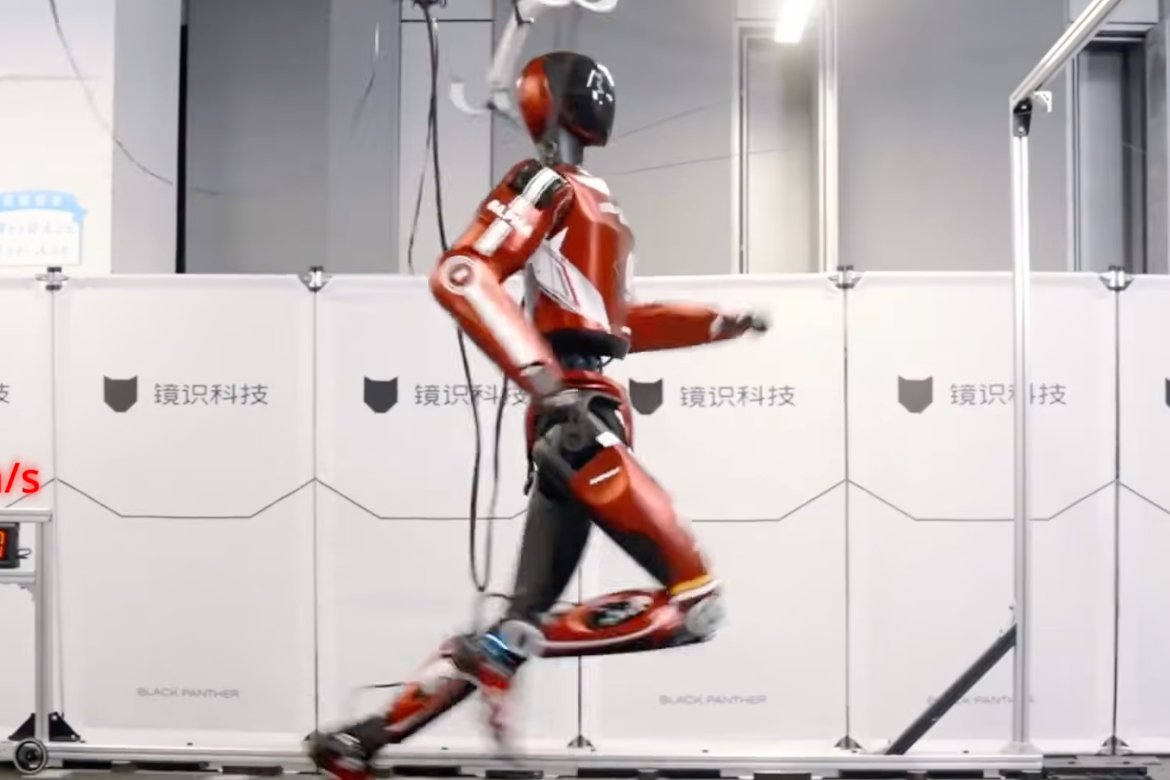


A team of engineers from Zhejiang University, working in partnership with Chinese technology startups, has unveiled a humanoid robot designed for one purpose few machines have mastered – speed. Named Bolt after sprinting legend Usain Bolt, the robot can reportedly run at up to 10 meters per second, placing it within striking distance of elite human athletic performance.
The achievement marks a significant milestone for humanoid robotics, a field that has long struggled to balance speed, stability, and energy efficiency. While many humanoid robots can walk, climb stairs, or carry objects, sustained high-speed running has remained an elusive goal.
Designed to Move Like a Human
Bolt stands approximately 1.75 meters tall and weighs around 75 kilograms. Engineers deliberately chose human-like proportions rather than optimizing purely for mechanical efficiency. The goal was to study how closely a robot built at human scale could replicate natural running dynamics without relying on oversized feet, extended limbs, or non-anthropomorphic designs.
During a public demonstration, Bolt raced against a human competitor – the head of startup Mirror Me, one of the project’s collaborators – as well as alongside Wang Hongtao, president of Zhejiang University. The comparison highlighted how closely the robot’s stride length, cadence, and posture now resemble those of a trained runner.
Official Launch | Mirror Me Technology Humanoid Robot Bolt
Founder Enters the Race in Person
No CGI Fully Real Footage
10 m/s — The World’s Fastest Humanoid Robot pic.twitter.com/yurRxXI9Fb— MirrorMe tech (@MirrorMeteni7w) February 2, 2026
At its top speed, Bolt approaches the pace of Usain Bolt, who famously completed the 100 meters in a world-record 9.58 seconds. While the robot does not yet match that burst performance or endurance, researchers say the gap is narrowing faster than many expected.
Advances in Control and Balance
Behind Bolt’s performance lies a combination of lightweight structural materials, high-torque actuators, and advanced control algorithms. High-speed bipedal running requires precise coordination between balance, force distribution, and real-time adjustment to ground contact – problems that become exponentially harder as speed increases.
According to researchers involved in the project, Bolt relies on predictive motion planning and rapid sensor feedback to maintain stability at high velocity. Rather than reacting after imbalance occurs, the robot anticipates changes in momentum and adjusts its gait accordingly.
This approach mirrors broader trends in robotics research, where machine learning and model-based control are increasingly combined to handle dynamic, unpredictable motion. Similar techniques are being explored in legged robots developed in the United States and Europe, though few humanoids have demonstrated comparable sprinting capability.
Why Speed Matters in Humanoid Robotics
High-speed locomotion is not just a spectacle. Researchers argue that speed is a proxy for overall system performance, touching everything from actuator power density and thermal management to control robustness and mechanical durability.
A humanoid that can run reliably is also likely capable of navigating uneven terrain, recovering from slips, and operating in time-sensitive environments. Potential applications include disaster response, industrial inspection, and security scenarios where rapid movement is critical.
At the same time, the Bolt project reflects China’s growing investment in humanoid robotics as a strategic technology area. Universities, startups, and government-backed research programs are increasingly aligned around building full-stack robotic systems that combine hardware, AI, and large-scale manufacturing.
A Signal of What Comes Next
The developers caution that Bolt remains a research platform rather than a commercial product. Sustaining top speed over long distances, improving energy efficiency, and ensuring safe operation around humans remain open challenges.
Still, the demonstration suggests that humanoid robots are entering a new phase – one where athletic capabilities once thought exclusive to biology are becoming engineering problems rather than physical impossibilities.
As global competition in humanoid robotics accelerates, Bolt’s sprint may be remembered less for how fast it ran and more for what it signaled: that the limits of human-like robotic motion are being rewritten.
Disclaimer: RobotsBeat is an independent media brand owned and operated by NuvexMedia LLC, publishing news, research, and insights on artificial intelligence, emerging technologies, automation, and related industries. NuvexMedia LLC invests in and collaborates with companies across the AI, Robotics, technology, software, and digital innovation sectors. These relationships do not influence RobotsBeat's editorial coverage, and the publication maintains full editorial independence to provide accurate, timely, and objective information. © 2026 NuvexMedia LLC. All rights reserved. This content is for informational purposes only and should not be considered legal, tax, investment, financial, or other professional advice.