Faraday Future is expanding its presence in robotics with new deployments of humanoid systems in both commercial and educational settings, as the electric vehicle maker pushes deeper into what it calls an “embodied AI” ecosystem.
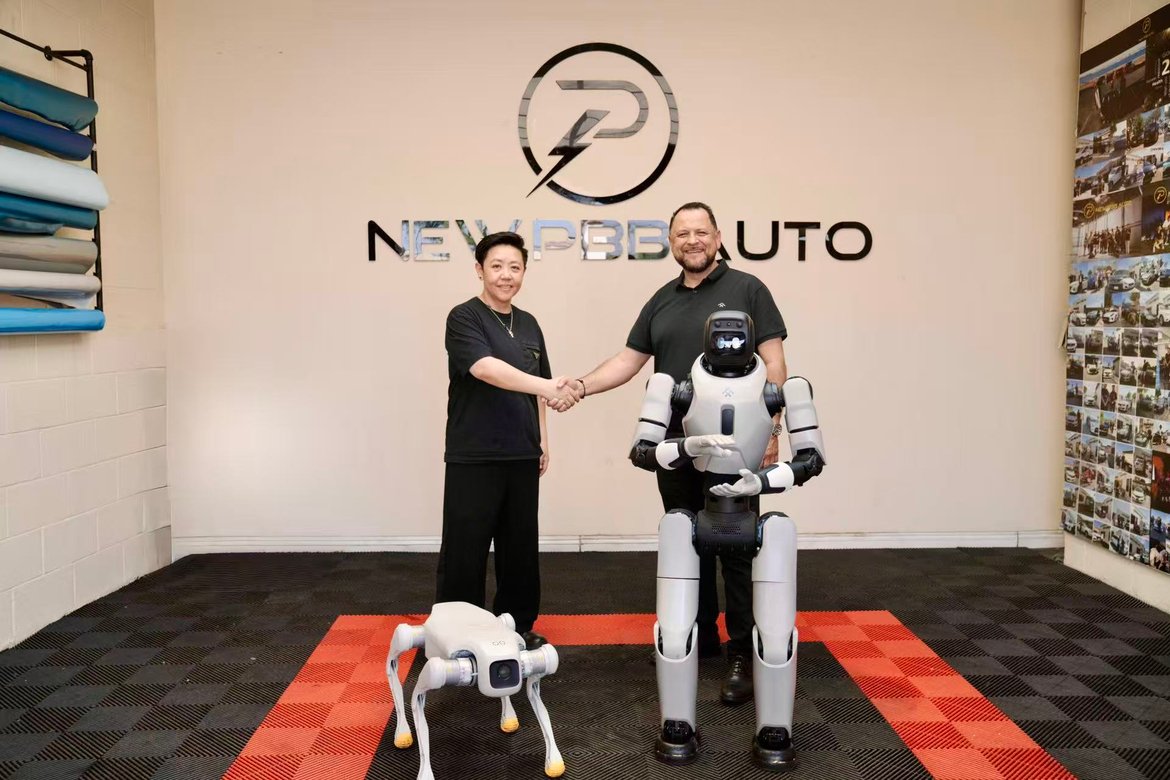
The California-based company said it recently delivered two of its robots – the Master and Aegis models – to Los Angeles-based New PBB Auto, where they will be used for reception and customer-facing duties in dealership and showroom environments.
The move reflects an emerging strategy among robotics companies to introduce humanoid systems into service roles where interaction with customers is as important as physical capability.
At the same time, Faraday Future is testing how its robots can be used in education, pointing to a broader effort to position embodied AI as both a commercial tool and a learning platform.
From Showroom Assistants to Service Platforms
The initial deployment focuses on dealership operations, where the robots are expected to greet visitors, provide information and assist with basic customer service tasks.
Such roles are increasingly seen as an early entry point for humanoid robots. Unlike industrial environments, where precision and speed dominate, service settings require machines to interact naturally with people – an area where embodied AI systems are still evolving.
Faraday Future’s approach suggests that automakers may view robotics as an extension of their existing ecosystems, connecting vehicles, retail environments and digital services.
The delivery is tied to a broader business relationship with New PBB Auto, which has previously committed to future vehicle orders from the company.
Testing Robots as Educational Tools
Alongside commercial deployments, Faraday Future has begun experimenting with robotics in education.
In Los Angeles, the company hosted an interactive demonstration involving more than 300 students, where participants engaged directly with humanoid robots, a robotic dog and one of the company’s vehicles.
The event, held in collaboration with a local school district, emphasized hands-on interaction rather than passive demonstrations. Company representatives said the experience highlighted how direct engagement with robots can increase student interest in artificial intelligence and STEM fields.
Faraday Future is now exploring whether such programs could be scaled into structured educational offerings, potentially combining robotics demonstrations with curriculum development.
The company describes this approach as a “Robot & Vehicle + Education” model, in which embodied AI systems are used not only as tools but also as teaching platforms.
Automakers Enter the Robotics Race
Faraday Future’s expansion into robotics underscores a broader trend in the automotive industry.
As vehicles become increasingly software-driven, automakers are exploring adjacent markets where artificial intelligence and hardware integration intersect. Robotics – particularly humanoid systems – represents one such opportunity.
Companies including Tesla have already signaled ambitions to develop humanoid robots alongside their automotive businesses. Faraday Future’s approach suggests a different entry point, focusing initially on service and education rather than large-scale industrial deployment.
The strategy also reflects a key challenge facing the robotics industry: identifying practical, near-term use cases.
While humanoid robots are often associated with future household or industrial roles, many companies are beginning with smaller, controlled deployments in environments such as retail, hospitality and education.
For Faraday Future, the combination of dealership deployments and school programs provides an early test of how embodied AI systems can function in real-world settings.
Whether these applications scale into a broader business remains uncertain. But the company’s efforts highlight how robotics is increasingly being treated not as a standalone industry, but as part of a wider ecosystem connecting mobility, services and digital intelligence.