
Decathlon, the world’s largest sporting goods retailer, says automation is transforming the performance of its European distribution network as fleets of warehouse robots dramatically increase productivity.
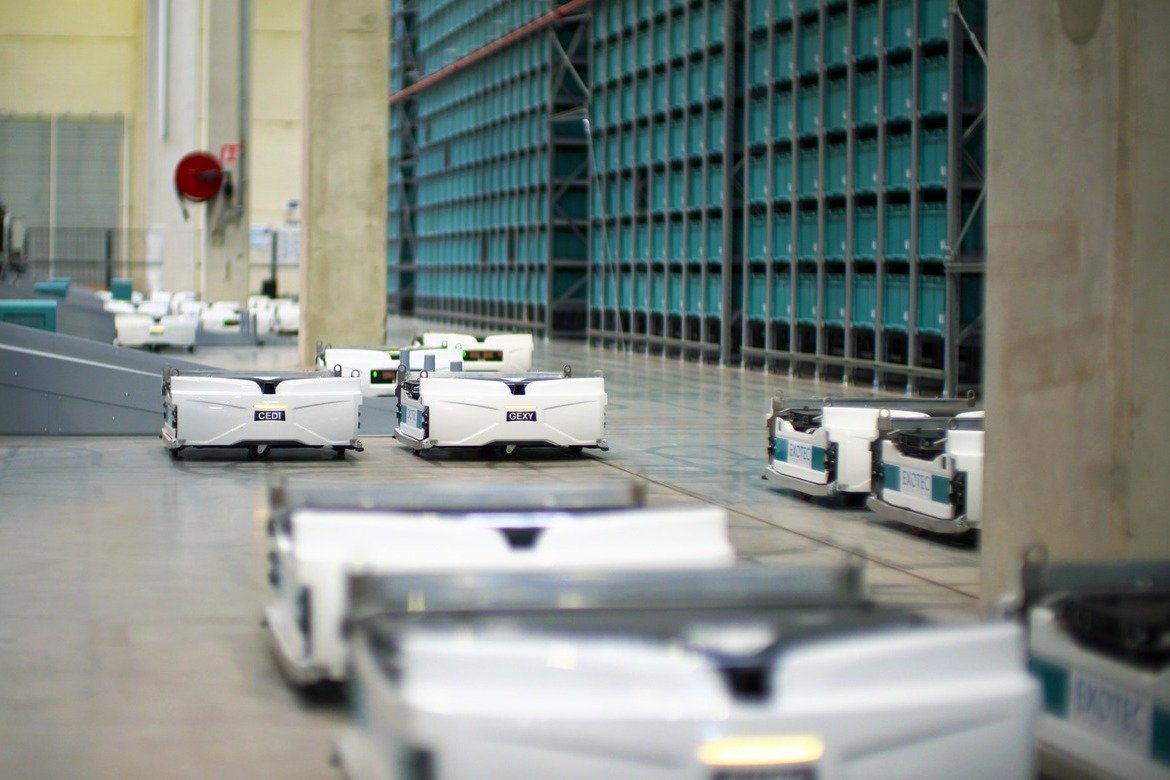
The company reported significant operational gains across seven automated facilities where robots developed by French robotics company Exotec now handle a large share of sorting and picking tasks. At one warehouse in Portugal, the system doubled order preparation capacity from 57,000 to 114,000 shipments.
The deployment illustrates how robotics is rapidly reshaping retail logistics, a sector already under pressure to deliver faster fulfillment while controlling costs.
Robots Replace Miles of Walking
At Decathlon’s distribution center in Northampton, England, warehouse employees once walked more than six miles per shift while manually collecting products from shelves.
Today a fleet of roughly 100 robots performs much of that work.
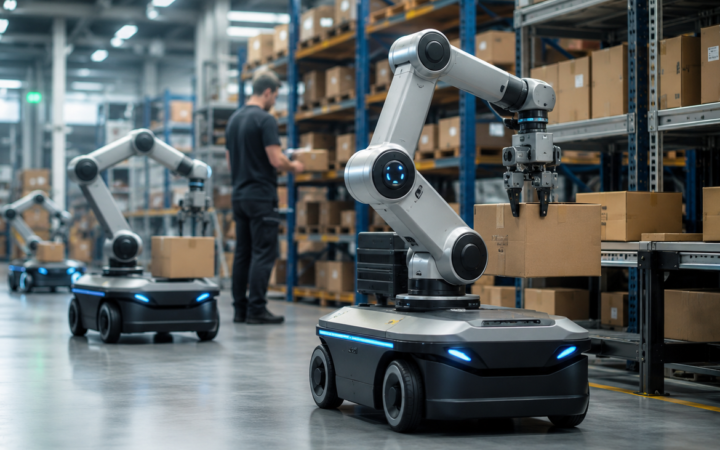
The machines move autonomously through a three-dimensional storage grid, climbing shelves more than 12 meters high to retrieve inventory. They transport boxes directly to human workers stationed at packing stations, where items are sorted into shipments destined for stores.
The result, according to Decathlon’s logistics leadership, is a system that operates more than three times as efficiently as the previous manual process.
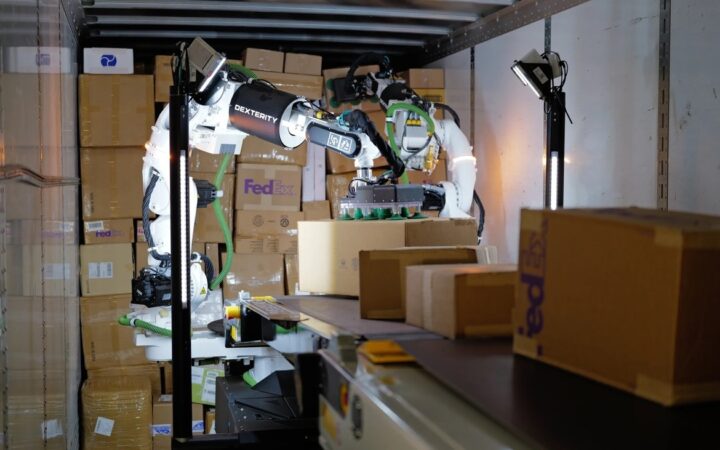
Robotic arms have also taken over physically demanding tasks such as unloading pallets and placing stock into the warehouse system. Boxes weighing up to 25 kilograms are lifted using suction mechanisms and routed into the storage grid.
The warehouse software maintains a detailed map of tens of thousands of storage locations, allowing robots to locate products and deliver them to workers with minimal delay.
Productivity Gains and Workforce Debate
While the automation has improved efficiency, it has also altered the nature of warehouse work.
Tasks that once required dozens of workers now need far fewer people. Decathlon says picking operations that previously required 50 to 60 employees can now be performed by about a dozen staff members supported by robotic systems.
Company executives argue that the technology is not primarily about reducing headcount but about shifting workers into different roles.
Employees who previously handled manual picking tasks are increasingly being trained for other positions such as equipment maintenance, customer service or repair services in the company’s growing circular economy operations.
Warehouse staff also report improvements in working conditions. Robots have eliminated tasks that required constant walking, climbing ladders or lifting heavy boxes from high shelves.
Still, labor groups remain skeptical. Union representatives say large-scale warehouse automation inevitably reduces the number of frontline logistics jobs, even if companies redeploy some workers elsewhere.
Automation’s Expanding Role in Logistics
The changes at Decathlon reflect a broader transformation underway across the logistics sector.
Warehouses are rapidly adopting robotic systems capable of navigating storage grids, retrieving inventory and preparing shipments with minimal human intervention. The shift is being driven by rising e-commerce demand, labor shortages and pressure to accelerate delivery times.
In the United Kingdom alone, logistics accounts for about eight percent of national employment and contributes roughly £170 billion to the economy. Many of these jobs are concentrated in distribution hubs such as the so-called logistics “golden triangle” in central England.
Automation is already reshaping the skill profile required for these roles. Employers increasingly seek workers with technical and analytical capabilities to operate, monitor and maintain automated systems.
Yet robotics has limits. Decathlon executives note that automated systems operate within fixed capacity constraints. Unlike human teams, robots cannot simply work overtime during sudden spikes in demand.
Even so, the company views robotics as essential for scaling its supply chain.
As retailers compete to move goods faster and more efficiently, automated warehouses like Decathlon’s are becoming a preview of how logistics networks may operate in the coming decade.
Disclaimer: RobotsBeat is an independent media brand owned and operated by NuvexMedia LLC, publishing news, research, and insights on artificial intelligence, emerging technologies, automation, and related industries. NuvexMedia LLC invests in and collaborates with companies across the AI, Robotics, technology, software, and digital innovation sectors. These relationships do not influence RobotsBeat's editorial coverage, and the publication maintains full editorial independence to provide accurate, timely, and objective information. © 2026 NuvexMedia LLC. All rights reserved. This content is for informational purposes only and should not be considered legal, tax, investment, financial, or other professional advice.