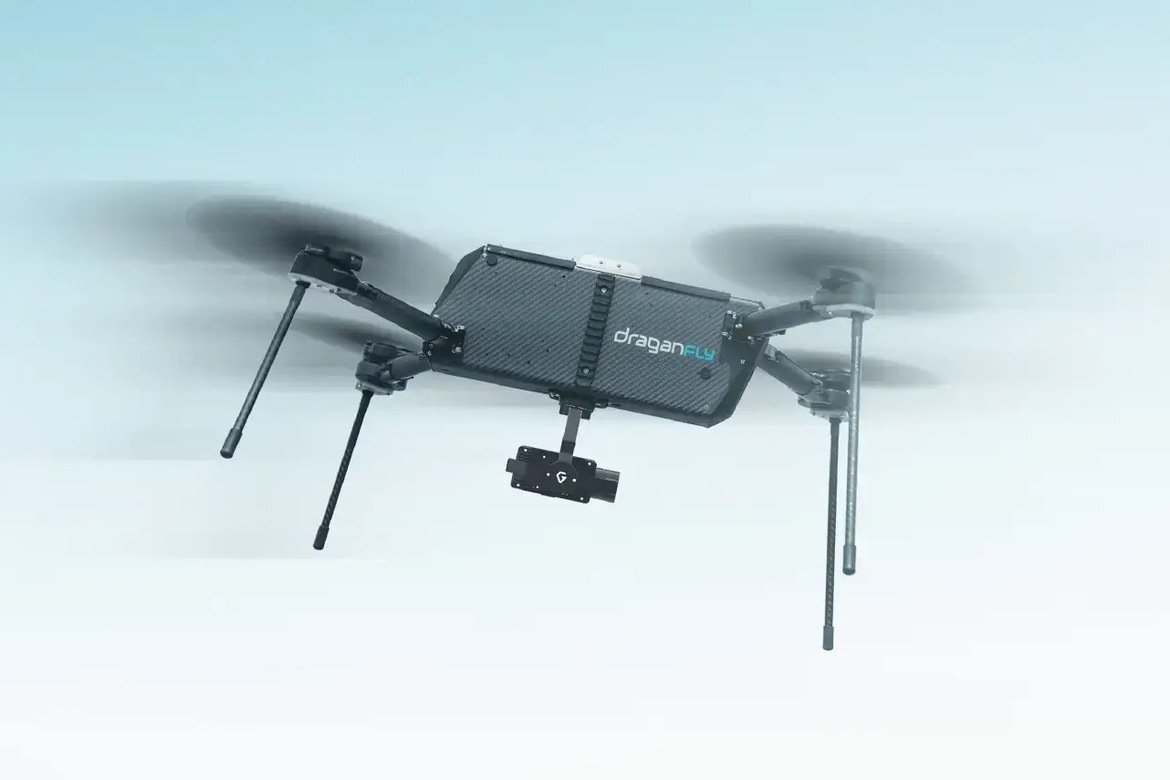
Draganfly and Palladyne AI have reached a technical integration milestone that could accelerate the development of autonomous drone swarms for defense operations. The companies confirmed that Palladyne’s SwarmOS autonomy platform has been successfully integrated with Draganfly’s drone systems and validated through flight simulation testing.
The milestone represents an early step toward deploying distributed drone swarms capable of operating with limited communications and minimal centralized control – a capability that military planners increasingly view as critical for modern battlefield environments.
Unlike traditional drone systems that rely on pre-programmed flight paths or centralized command, the integrated platform is designed to allow drones to coordinate autonomously using onboard intelligence and real-time collaboration.
Decentralized Autonomy at the Edge
At the core of the joint system is Palladyne AI’s Decentralized Edge Collaborative Autonomy architecture, known as DECA, implemented through the SwarmOS platform.
The system is designed to give each drone in a swarm the ability to interpret its environment, make tactical decisions, and coordinate with other units in real time. Rather than relying on a constant connection to a command center, the drones exchange information locally and adapt collectively as mission conditions change.
This architecture is intended to address one of the central challenges in deploying drone swarms in contested environments: communications degradation. In scenarios where GPS signals are jammed or command links are disrupted, decentralized autonomy allows the swarm to continue operating.
The system is also designed to dynamically reconfigure itself if individual drones fail or are lost during a mission, allowing the remaining units to continue executing tasks without direct human control.
Cameron Chell, chief executive of Draganfly, described the integration milestone as a proof point that collaborative autonomy between drones is moving from concept toward operational capability.
Ben Wolff, president and CEO of Palladyne AI, emphasized that the goal of the system is not simply synchronized flight formations but distributed decision-making within the swarm.
Military Interest in Scalable Autonomous Systems
The collaboration comes as defense agencies are increasing investment in autonomous systems capable of operating in complex environments where communications may be unreliable or adversaries actively disrupt networks.
Drone swarms are increasingly viewed as a potential force multiplier for intelligence, surveillance and reconnaissance missions, logistics operations and tactical support roles.
The ability to deploy dozens or potentially hundreds of autonomous drones that can coordinate without continuous command links could significantly expand operational flexibility while reducing risk to human operators.
Draganfly has already been involved in defense-related deployments, including work supporting U.S. Air Force Special Operations Command as well as projects in surveillance, mapping and tactical drone operations.
The integration of Palladyne’s autonomy software with Draganfly’s hardware platforms reflects a broader shift in the drone industry toward combining advanced AI decision systems with mature aerial robotics hardware.
A Growing Market for Autonomous Swarms
While autonomous drone swarms have long been explored in research programs, operational deployment has been limited by technical challenges in coordination, reliability and communication resilience.
Advances in edge computing, sensor fusion and distributed artificial intelligence are beginning to address those limitations. The result is growing interest from defense agencies seeking systems that can operate across air, ground and maritime domains with minimal human intervention.
For companies like Draganfly and Palladyne AI, the integration milestone is less about a single product than about validating the architecture required for scalable autonomous systems.
If the approach proves reliable in real-world environments, it could help shift drone operations from remotely piloted platforms toward collaborative autonomous fleets capable of executing complex missions with limited oversight.