Faraday Future is no longer framing intelligence as something confined to cars. The company has officially launched its embodied AI robotics division and introduced three commercial robotic products, marking a decisive expansion beyond electric vehicles and into physical artificial intelligence.
The move positions Faraday Future alongside a growing list of automakers and tech firms redefining mobility as an intelligent, autonomous system rather than a traditional product category. Company executives argue that embodied AI represents a natural evolution of the vehicle-as-robot concept Faraday Future has promoted for nearly a decade.
The company has launched a new internal initiative centered on embodied artificial intelligence and revealed plans to develop a lineup of humanoid robots designed for real-world interaction. Executives described the effort as an expansion of the company’s mission rather than a departure from mobility, arguing that modern vehicles are increasingly becoming intelligent robotic systems.
The announcement arrives amid a broader industry shift. Just days earlier, Tesla announced it would wind down production of its flagship Model S and Model X vehicles to redirect resources toward Optimus, its humanoid robot platform. Together, the moves highlight how legacy automotive players increasingly see physical AI – not just transportation – as the next frontier.
Three Robots, One Ecosystem Strategy
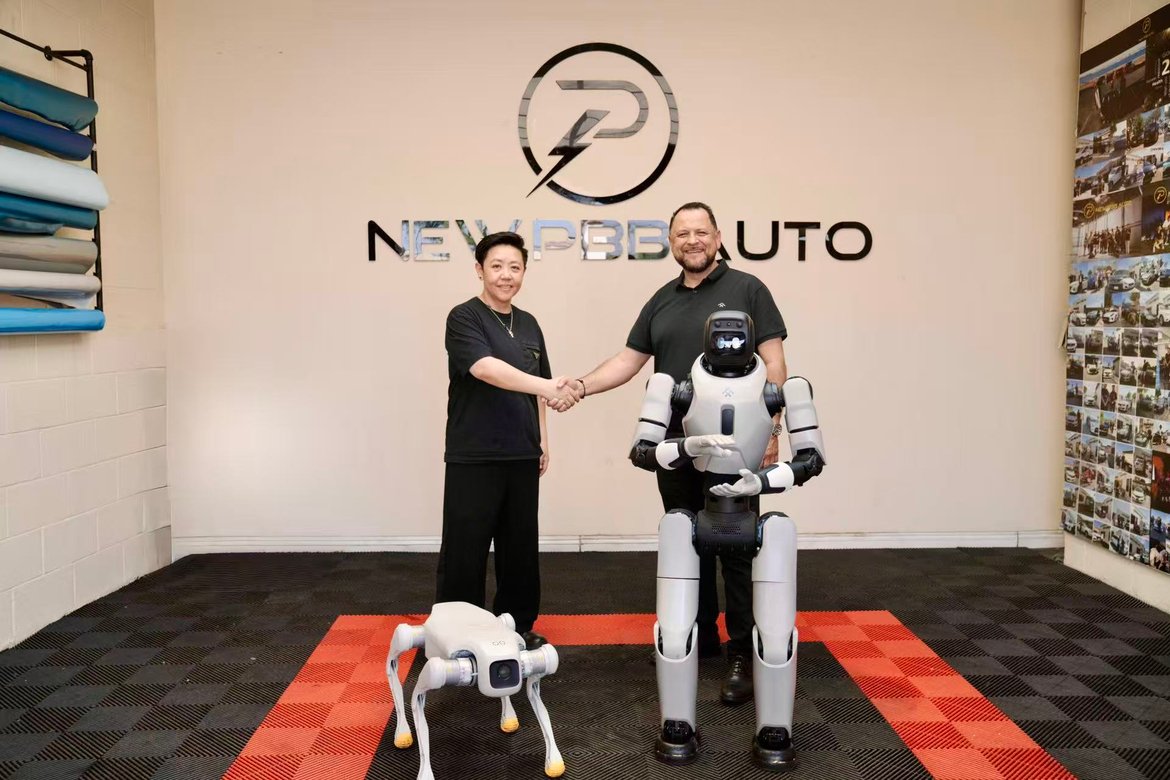
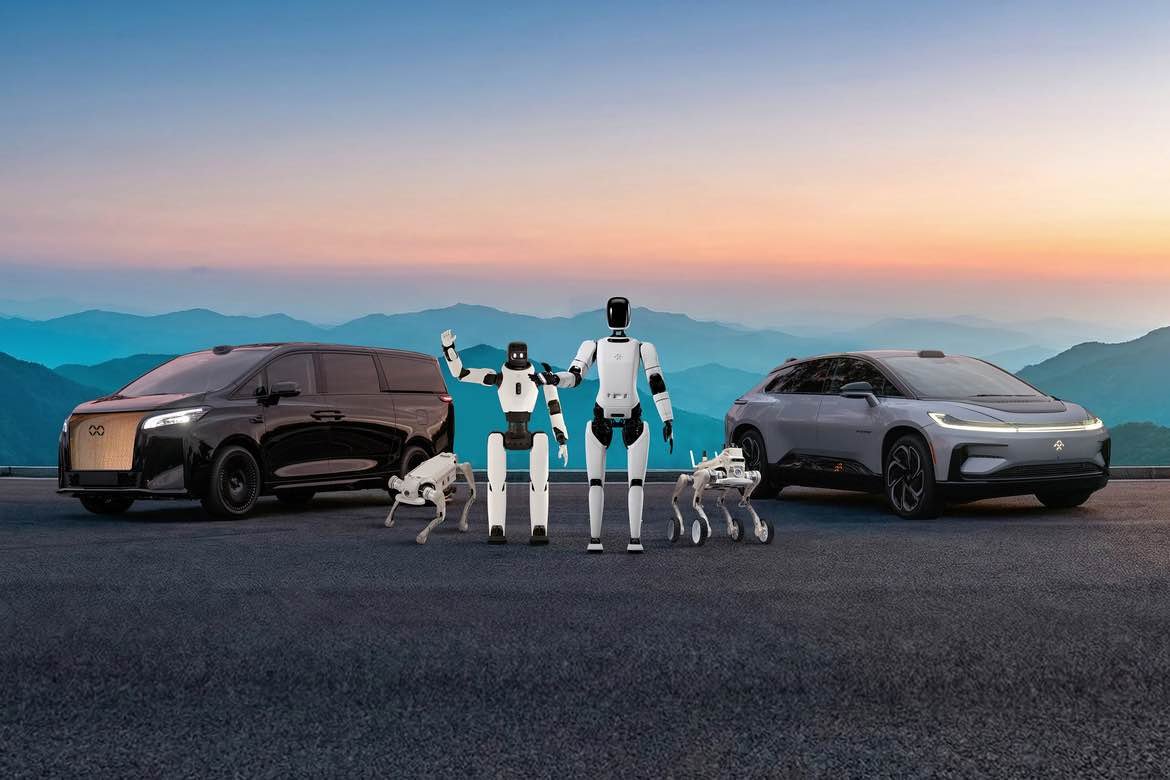
Faraday Future’s first robotics lineup includes three distinct platforms. FF Futurist is positioned as a full-size professional humanoid robot designed for public-facing and enterprise roles, from hospitality and retail to education and exhibitions. FF Master targets consumer and institutional environments as a more athletic, interaction-focused humanoid companion. FX Aegis rounds out the lineup as a quadruped robot aimed at security, patrol, and outdoor assistance tasks.
All three products are being offered with a new ecosystem-based pricing model that separates hardware from software capabilities. Base prices range from $2,499 for FX Aegis to $34,990 for FF Futurist, with optional ecosystem skill packages enabling advanced AI functions, customization, and continuous upgrades. The company describes the model as demand-driven, designed to mirror how software platforms evolve over time rather than traditional one-time hardware sales.
Faraday Future said more than 1,200 units are already covered by paid B2B deposits, signaling early commercial interest ahead of first deliveries expected by the end of February. Production preparation is underway, while customization, testing, and data training continue in parallel to accelerate deployment.
Why Faraday Future Believes Robotics Can Scale Faster Than Cars
Company leadership argues that embodied AI robotics offer structural advantages over vehicles: lighter capital requirements, faster iteration cycles, and earlier paths to positive cash flow. Robotics and vehicles are positioned as dual engines, sharing AI models, manufacturing expertise, and distribution channels.
At the technical level, Faraday Future is betting on a modular AI architecture built around what it calls a three-part system: physical devices, an open AI brain platform, and a decentralized data factory designed to continuously improve robot performance through real-world usage. The company believes this approach allows robots to adapt across industries without being locked into single-purpose designs.
The company also sees automotive dealerships as a natural sales and service channel for robotics. Executives argue that future dealers will evolve into intelligent terminal operators, offering vehicles and robots through shared infrastructure, financing models, and service networks.
Faraday Future’s leadership frames the launch not as a speculative experiment, but as the opening move in a long-term transition. As embodied AI advances and robots move from labs into everyday environments, the company believes ownership could eventually surpass today’s global vehicle fleet.
For Faraday Future, the future of mobility is no longer defined by wheels alone – but by intelligent machines capable of working, learning, and interacting alongside humans.