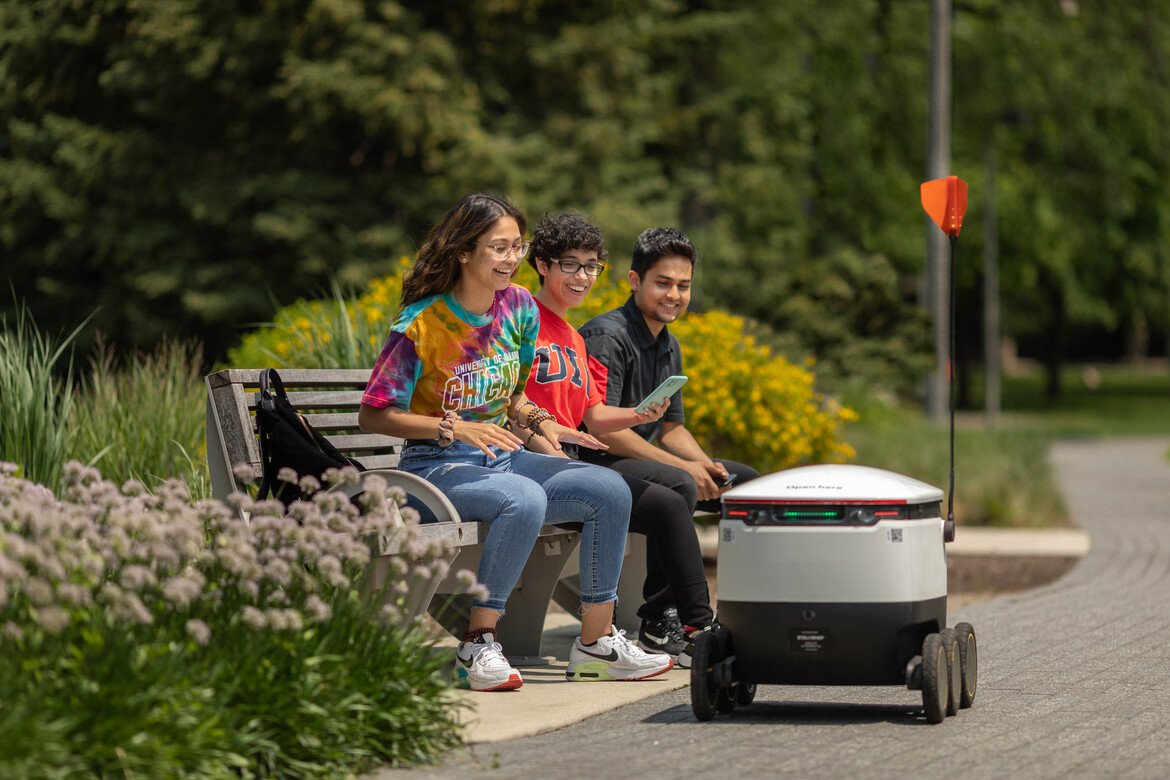
Florida Polytechnic University has deployed a fleet of autonomous delivery robots integrated directly with its campus dining payment system, marking what partners describe as the first point-of-sale integration of its kind in a university setting. The rollout connects ordering, payment processing, and physical delivery into a single workflow, offering a glimpse into how service robotics is evolving beyond standalone applications.
The initiative, launched in partnership with Starship Technologies and campus dining operator Chartwells Higher Education Dining Services, enables students and staff to order food through a mobile app and receive it via autonomous robots navigating campus sidewalks. The system is tied into existing meal plans and digital payment tools, allowing transactions and fulfillment to occur within the same infrastructure.
While robot delivery on campuses is no longer new, the integration of payment systems represents a deeper level of operational alignment between software platforms and physical automation.
From Delivery Feature to Integrated Service System
The deployment is built around Starship’s broader “360” platform, which combines autonomous delivery with point-of-sale infrastructure, mobile ordering, and self-service kiosks. Instead of treating delivery robots as an add-on, the system positions them as one component within a unified service architecture.
In practice, this means orders placed through campus dining channels are automatically routed through a centralized system that manages preparation, payment, and dispatch. Once ready, robots navigate to pick-up locations, travel across campus using a combination of sensors and computer vision, and deliver meals directly to users, who unlock the compartments via a mobile app.
The robots are designed to operate in typical campus conditions, including crossing streets, climbing curbs, and functioning in variable weather. Their navigation systems rely on real-time mapping and obstacle avoidance, allowing them to move within pedestrian environments without dedicated infrastructure.
This level of integration reduces friction across the service chain. Menu customization, payment authorization, and delivery tracking are handled within a single interface, aligning digital transactions with physical fulfillment.
Campuses as Early Platforms for Embodied AI
University campuses have increasingly become testing grounds for service robotics, offering controlled environments with high demand density and predictable logistics patterns. The Florida Polytechnic deployment extends that role by incorporating deeper enterprise-style integration.
Rather than focusing solely on mobility or delivery performance, the project emphasizes system-level coordination. The robots operate as endpoints within a broader software ecosystem, similar to how warehouse robots are integrated into logistics platforms.
This reflects a wider shift in robotics adoption. Value is increasingly derived from how well robots connect to existing systems, rather than from standalone capabilities. In this case, linking autonomous delivery to point-of-sale infrastructure enables a continuous workflow from order placement to fulfillment.
The approach also mirrors trends in enterprise automation, where digital platforms orchestrate multiple layers of operation. By embedding robots into those platforms, organizations can extend automation into physical services without redesigning the entire environment.
The Florida Polytechnic rollout remains a campus-scale deployment, but its implications extend beyond food delivery. As point-of-sale systems, mobile applications, and autonomous machines converge, service robotics may become less visible as a separate technology and more embedded within everyday infrastructure.
For Starship Technologies, the integration signals a move toward platform-based offerings rather than individual robotic services. For institutions like Florida Polytechnic, it demonstrates how automation can be introduced not as a standalone feature, but as part of a coordinated digital and physical system.