

HD Hyundai is moving forward with tests of humanoid robots designed specifically for shipyard welding, marking one of the most ambitious attempts yet to introduce humanoid machines into heavy industrial production.
The South Korean industrial group announced that several of its affiliates have partnered with U.S.-based robotics firm Persona AI to develop and test AI-powered humanoid robots capable of performing welding operations during ship construction.
The project brings together HD Korea Shipbuilding & Offshore Engineering, HD Hyundai Robotics, and Persona AI under a joint development agreement focused on creating robots capable of operating in demanding shipyard environments.
The effort reflects a broader push across heavy industry to apply artificial intelligence and robotics to tasks traditionally performed by highly skilled human workers.
Training Robots on Skilled Welder Expertise
At the center of the project is the challenge of translating human welding expertise into robotic systems.
HD Korea Shipbuilding & Offshore Engineering plans to train AI models using data gathered from experienced welders working in its shipyards. These datasets capture the techniques, motion patterns, and process conditions required for high-quality welding in ship construction.
The goal is to create a robotic system capable of replicating the precision and adaptability of human welders while operating continuously in industrial conditions.
HD Hyundai Robotics will be responsible for integrating the robotic systems and developing technology for monitoring welding quality and controlling the process during operation.
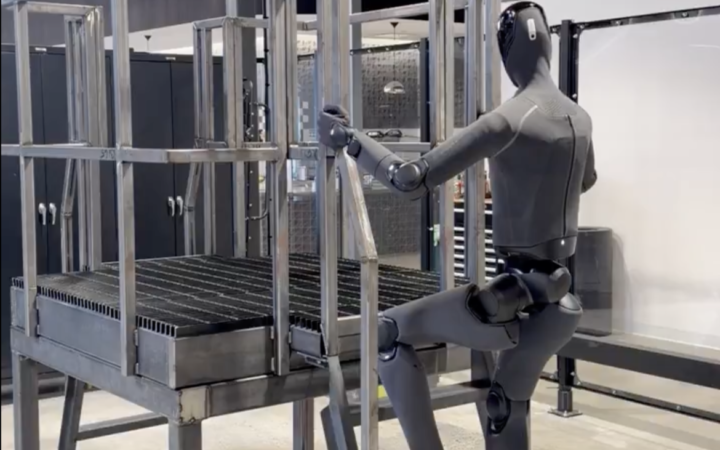
The humanoid platform itself is being developed by Persona AI, whose role includes designing a bipedal robot capable of navigating shipyard environments where narrow walkways, scaffolding, and uneven surfaces can complicate mobility.
Building Robots for Shipyard Conditions
Shipbuilding presents a particularly difficult environment for automation.
Unlike factory assembly lines with predictable layouts, shipyards involve large structures, confined spaces, and constantly changing work environments as vessels move through different construction stages.
Robots designed for these environments must combine multiple capabilities: stable locomotion, environmental perception, precise manipulation, and the ability to operate safely alongside human workers.
The welding robots being developed by HD Hyundai are expected to integrate these functions, allowing them to move between work areas and perform complex welding tasks without requiring fixed automation setups.
Initial prototypes have already undergone early technical evaluations and were judged capable enough to move into expanded testing.
Toward the Smart Shipyard
For HD Hyundai, the project is part of a broader strategy to modernize shipbuilding operations.
Shipyards face growing pressure to improve productivity while addressing worker safety concerns and labor shortages in skilled trades. Welding, in particular, involves physically demanding work often performed in hazardous environments.
Humanoid robots could potentially take on the most dangerous or repetitive tasks while human workers focus on supervision, planning, and specialized operations.
The company describes the welding humanoid as a foundation for future “smart shipyards”, where robotics and AI systems support complex construction processes.
Although the robots remain in the development stage, their eventual deployment could signal a shift in how large-scale industrial infrastructure is built.
As robotics systems become more capable of navigating complex environments and performing skilled manual work, industries such as shipbuilding may increasingly adopt humanoid machines to augment human labor on some of their most demanding tasks.
Disclaimer: RobotsBeat is an independent media brand owned and operated by NuvexMedia LLC, publishing news, research, and insights on artificial intelligence, emerging technologies, automation, and related industries. NuvexMedia LLC invests in and collaborates with companies across the AI, Robotics, technology, software, and digital innovation sectors. These relationships do not influence RobotsBeat's editorial coverage, and the publication maintains full editorial independence to provide accurate, timely, and objective information. © 2026 NuvexMedia LLC. All rights reserved. This content is for informational purposes only and should not be considered legal, tax, investment, financial, or other professional advice.