NVIDIA is expanding its robotics software ecosystem with new AI models, simulation frameworks, and development tools aimed at accelerating the creation of general-purpose robots capable of operating in real-world environments.
The updates, announced around NVIDIA’s GTC developer conference, reflect a broader shift in robotics toward systems that can combine general intelligence with specialized task skills. Rather than building machines designed for a single function, developers are increasingly working toward what NVIDIA describes as “generalist-specialist” robots – machines that can understand instructions, learn new behaviors, and adapt those skills to specific jobs.
At the center of this effort is the NVIDIA Isaac platform, a robotics development stack that integrates simulation, data generation, AI model training, and deployment tools into a unified workflow designed to move robots from experimentation to production more quickly.
From Data Bottlenecks to Synthetic Training
One of the biggest challenges in robotics development has traditionally been data.
Unlike large language models, which can train on vast amounts of text from the internet, robots require detailed examples of physical interactions – how to grasp objects, move through environments, or respond to unexpected conditions. Collecting that data in the real world is slow, expensive, and often dangerous.
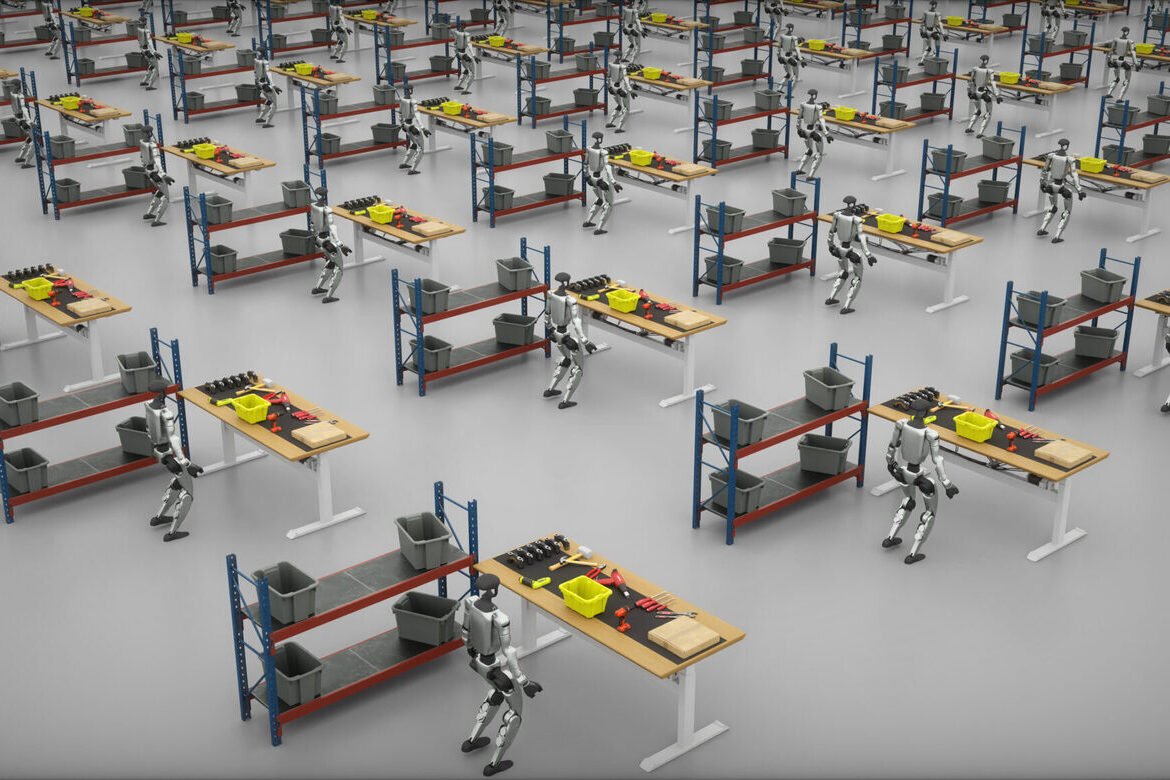
NVIDIA’s strategy relies heavily on simulation to address this bottleneck. Its Isaac Sim platform allows developers to recreate physical environments digitally, combining real sensor data with simulated scenarios to generate massive training datasets.
These synthetic environments can reproduce edge cases that would be difficult or risky to capture in the real world, such as rare accidents, unusual object configurations, or extreme environmental conditions.
According to industry estimates cited by NVIDIA, synthetic data currently accounts for roughly one-fifth of training data used in edge AI systems. By the end of the decade, that share could exceed 90 percent as simulation-based training becomes the dominant approach.
Training Robot Brains in Virtual Worlds
Once data is generated, robots must learn how to act on it.
NVIDIA’s Isaac platform includes robot “brain” models known as vision-language-action systems, which combine perception, reasoning, and control. One example is the company’s GR00T family of models, which developers can adapt and train for specific robotic tasks.
These systems allow robots to interpret visual input, understand natural language instructions, and translate them into physical actions. A robot trained with such models could theoretically learn tasks ranging from folding laundry to navigating hospital corridors or assembling industrial components.
Training these skills directly on physical robots would be prohibitively slow. Instead, developers use Isaac Lab, a large-scale simulation training environment that allows robots to practice thousands of scenarios simultaneously.
In these virtual worlds, robots can run millions of experiments – learning from successes and failures in parallel – compressing what would normally take years of physical testing into days or weeks of simulation.
Bridging the Gap Between Simulation and Reality
While simulation has become a central tool in robotics development, transferring those skills into the real world remains a critical hurdle.
To address this, NVIDIA integrates multiple physics engines within its simulation environment to ensure that virtual environments behave realistically. These engines simulate gravity, collisions, and object dynamics, enabling robots to learn behaviors that translate more reliably when deployed on physical machines.
The company also supports both software-in-the-loop and hardware-in-the-loop testing, allowing developers to evaluate robot policies both in simulated environments and on real computing hardware before deployment.
Once trained, robots can run their models on NVIDIA’s Jetson edge computing platforms, which provide the processing power required for real-time perception, mapping, and decision-making.
This edge computing layer enables robots to process sensor data locally while maintaining the ability to update or retrain models in the cloud.
Toward the Generalist Robot Era
The long-term goal of these systems is to enable robots that can learn continuously rather than relying on fixed task programming.
NVIDIA’s emerging research frameworks aim to standardize how robots represent body structure, motion, and behavior, allowing developers to transfer skills between different machines without rebuilding software from scratch.
This approach could make it easier to train robots that can operate across different environments and industries, from warehouses and factories to hospitals and homes.
The shift reflects a broader trend across robotics: as AI models grow more capable, the challenge is no longer just building better machines, but creating development pipelines that allow robots to learn faster, adapt more easily, and operate safely outside controlled laboratory settings.
If those pipelines succeed, the result could be a new generation of robots that are not only specialized tools but adaptable physical AI systems capable of working across a wide range of real-world tasks.