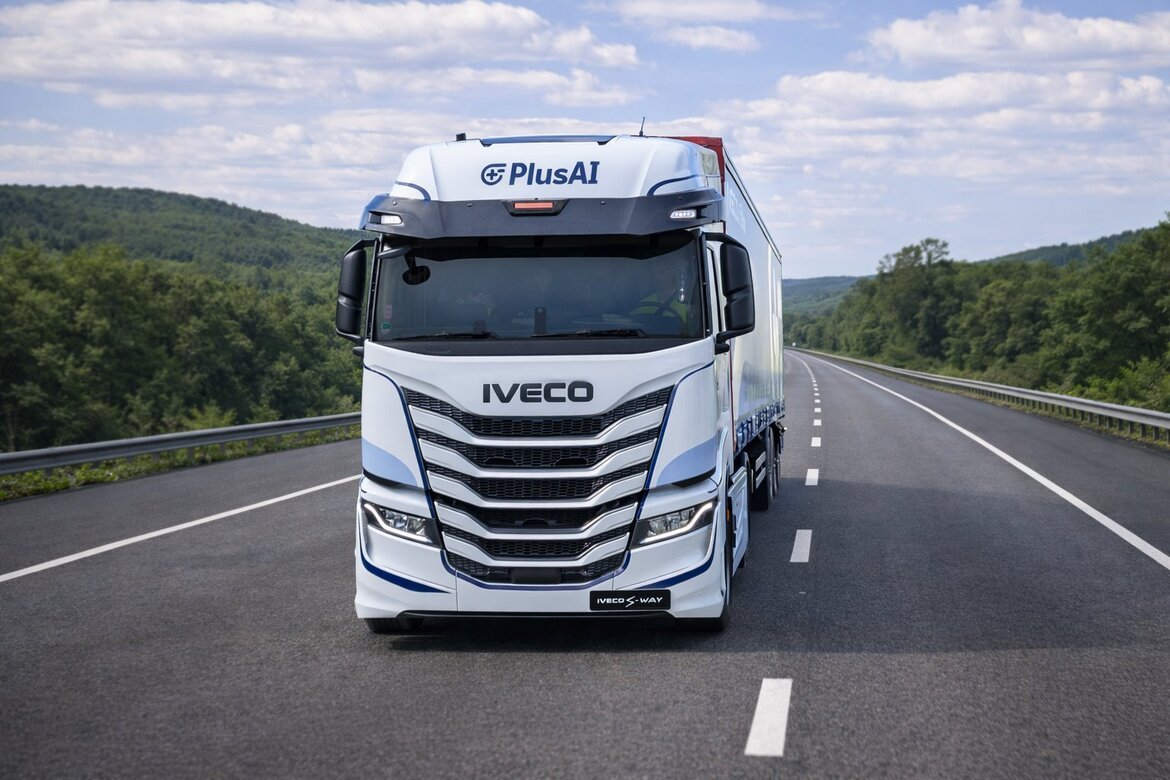
Autonomous trucking developer PlusAI has introduced a new version of its self-driving system designed to support continuous freight operations, marking a step toward large-scale deployment of autonomous trucks in commercial logistics networks.
The company’s upgraded platform, called SuperDrive 6.0, adds capabilities for night driving and construction zone navigation – two conditions that have historically limited the operational range of autonomous freight vehicles.
PlusAI says the system is engineered for commercial-scale deployment rather than limited pilot testing, as the company moves closer to launching factory-built driverless trucks later this decade.
Expanding the Operational Envelope for Autonomous Trucks
Long-haul trucking has been viewed as one of the most promising applications for autonomous driving, largely because highway environments are more structured and predictable than dense urban traffic.
However, achieving reliable operations across a full 24-hour logistics cycle has required solving a range of technical challenges, including low-light perception, unpredictable road construction layouts, and complex interactions with other vehicles.
SuperDrive 6.0 introduces new capabilities designed to address those constraints. According to PlusAI, the system can now operate in construction zones and is expected to support night driving in upcoming releases.
These additions could allow autonomous trucks equipped with the system to run continuously on commercial freight routes.
“SuperDrive 6.0 isn’t an incremental update; it’s a major advancement of what an autonomous ‘brain’ can do,” said David Liu, PlusAI’s chief executive and co-founder. He said the expanded operating capabilities could enable autonomous trucks to run around the clock on logistics routes.
The software has been trained using more than seven million miles of real-world driving data collected across the United States, Europe, and Asia.
Improving the Economics of Autonomous Driving
Beyond new driving capabilities, the company says SuperDrive 6.0 introduces changes aimed at improving the economics of autonomous trucking.
Developing autonomous vehicle software typically requires large volumes of labeled data and extensive testing cycles, both of which contribute significantly to development costs.
PlusAI said the latest version of its system uses a combination of autolabeling, imitation learning, and reinforcement learning to accelerate AI training. According to the company, the approach has increased training speed tenfold while reducing data labeling costs by roughly three times.
Those improvements allow new features to move from internal validation to real-world deployment more quickly, compressing development timelines and reducing the cost of expanding into new operating environments.
A New Architecture for Commercial Deployment
At the hardware level, SuperDrive 6.0 uses a distributed computing architecture built around multiple high-performance system-on-chip processors, including NVIDIA’s DRIVE Orin and Thor platforms.
The system is designed to maintain performance under conditions that can disrupt autonomous driving hardware, such as partial sensor failures, calibration drift, or degraded environmental perception.
PlusAI says resilience under these conditions is essential for commercial freight operations, where vehicles must operate for long periods without interruption.
A key component of the software stack is a transformer-based layer called Reflex, part of the company’s AV 2.0 architecture. This system integrates perception and motion forecasting, allowing the vehicle to predict the behavior of nearby traffic participants.
According to the company, the motion forecasting model doubles prediction accuracy for dynamic actors such as merging vehicles, pedestrians, and lane-changing traffic.
Toward Driverless Freight Networks
Autonomous trucks equipped with earlier versions of SuperDrive are already transporting commercial freight on routes in Texas, though they still operate within supervised environments.
PlusAI says its long-term goal is to deploy factory-built autonomous trucks capable of operating without human drivers by 2027.
The company is also preparing to go public through a merger with the special purpose acquisition company Churchill Capital Corp IX, a move that could provide additional capital for scaling its technology and expanding commercial partnerships.
The combination of improved AI systems and growing industry investment suggests that autonomous trucking is moving from experimental pilots toward operational logistics networks.
Whether those systems can operate reliably across the full complexity of real-world highways remains one of the central questions facing the autonomous vehicle industry.