
Researchers at the Italian Institute of Technology in Genoa have developed a soft robotic arm that moves like an elephant’s trunk, capable of elongating, compressing, bending, pinching, scooping, and reaching – all using a single continuous structure with no hard joints or separate gripper. The prototype emerges from PROBOSCIS, a five-year EU-funded research initiative bringing together biologists, engineers, and materials scientists to decode the mechanics of elephant trunk movement and translate them into robotic hardware.
The project was initiated by Lucia Beccai, a soft robotics researcher at IIT, who identified the elephant trunk as the closest natural analog to what robotics has been missing: a single structure that can handle a grape and lift a heavy load with the same physical system.
Why the Trunk Is Difficult to Replicate
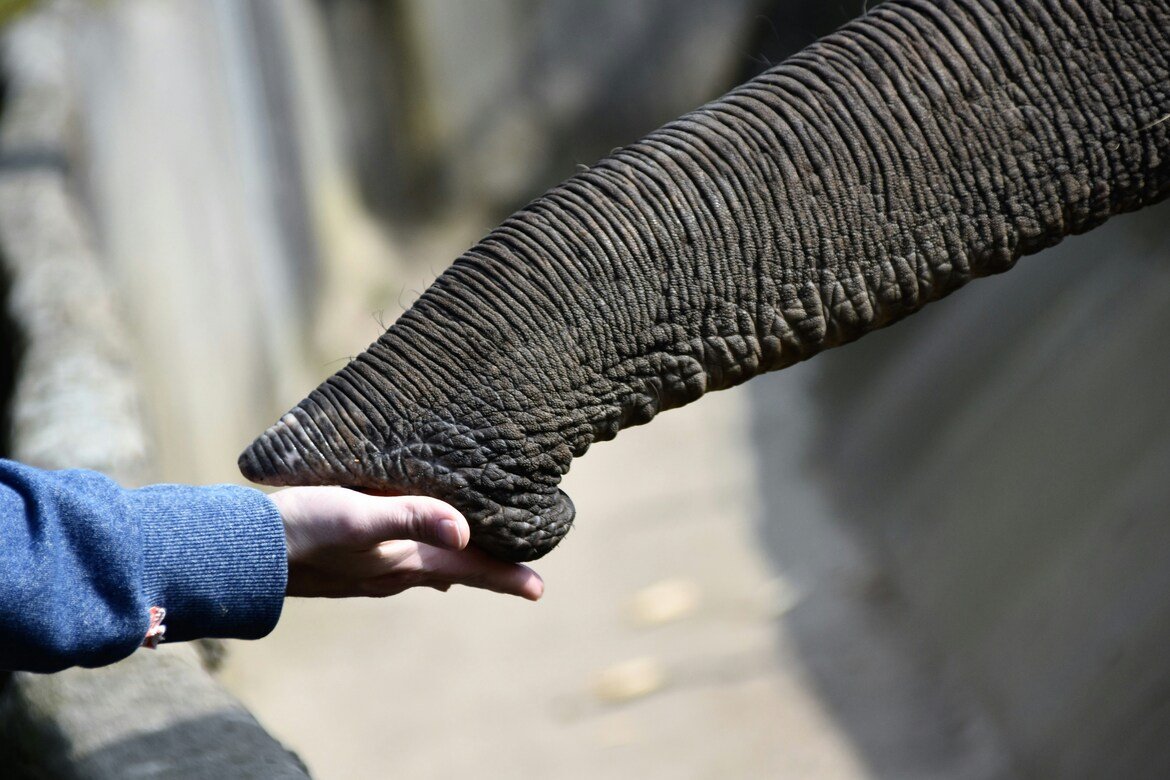
The elephant trunk is a muscular hydrostat – the same structural category as an octopus tentacle or a human tongue. It contains more than 100,000 individual muscles and no skeleton, allowing it to extend, contract, bend, and twist in any direction simultaneously. Critically, there is no distinction between arm and gripper: the entire trunk is one continuous structure capable of whole-body manipulation.
To study trunk mechanics, Professor Michel Milinkovitch at the University of Geneva led a team using motion-capture techniques borrowed from film production – placing reflective marker spots on elephant trunks and recording movement with high-speed cameras. The analysis revealed that elephants combine a small set of fundamental behaviors – shortening, elongating, and bending different sections – to achieve complex manipulation tasks. One particularly unexpected finding was that when reaching behind their heads, elephants create temporary pseudo-joints by stiffening sections of the trunk, effectively generating a shoulder and elbow structure on demand.
The Engineering Solution
Beccai’s team translated these biological findings into a 3D-printed soft robotic system. The prototype uses pneumatic actuators – balloon-like structures that extend and contract as they are inflated and deflated with air – combined with a mesh-like lattice structure that can deform in multiple directions. The entire device, including optical sensors that provide real-time feedback on touch and bending, is printed in a single continuous process from the same soft resin.
The single-material approach is central to the design’s performance. By eliminating the material and mechanical interfaces between components, the system achieves continuity of motion combined with integrated sensory feedback – a combination that conventional rigid-arm robotics with separate sensing systems cannot replicate.
The control architecture draws on Milinkovitch’s biological finding about muscle synergies. Rather than controlling each actuator individually, the system manages a small number of coordinated muscle group patterns, with the physical structure handling the mechanical complexity. This approach reduces computational demand and energy consumption, making battery-powered deployment outside laboratory conditions more viable.
Applications and Limitations
The research project wrapped up in April 2025, and the prototype remains a laboratory demonstrator. The team says it already addresses most of the design constraints limiting today’s robotic arms in unstructured environments. Potential applications identified by the researchers include soft fruit harvesting, domestic tasks such as sorting laundry and handling fragile dishes, environmental operations in fragile ecosystems, and search and rescue in rubble environments where a soft arm can navigate gaps and use touch sensing to locate people.
Beccai’s primary target is assistive robotics. “My dream is to build a system in healthcare that can help a disabled or elderly person by lifting them, but at the same time hand over a fork or a fresh piece of fruit,” she said. A robot strong enough for patient transfers yet gentle enough for daily object handling could meaningfully extend independent living for people with mobility limitations – and its softness, she argues, means it need not feel intimidating to be around.
Disclaimer: RobotsBeat is an independent media brand owned and operated by NuvexMedia LLC, publishing news, research, and insights on artificial intelligence, emerging technologies, automation, and related industries. NuvexMedia LLC invests in and collaborates with companies across the AI, Robotics, technology, software, and digital innovation sectors. These relationships do not influence RobotsBeat's editorial coverage, and the publication maintains full editorial independence to provide accurate, timely, and objective information. © 2026 NuvexMedia LLC. All rights reserved. This content is for informational purposes only and should not be considered legal, tax, investment, financial, or other professional advice.