A new radiation-resistant wireless chip developed by researchers in Japan could enable a new generation of untethered robots designed for nuclear cleanup operations.
Engineers at the Institute of Science Tokyo have created a 2.4 GHz Wi-Fi receiver capable of operating under radiation levels that would normally disable conventional electronics. The development addresses one of the persistent challenges facing robotics inside nuclear facilities: reliable communication in extreme radiation environments.
Robots have already become a critical tool in nuclear disaster response and decommissioning, particularly at Japan’s Fukushima Daiichi nuclear power plant following the 2011 earthquake and tsunami. Most of those machines, however, rely on wired connections to maintain control and communications with operators outside hazardous areas.
That reliance on cables restricts movement, complicates navigation through damaged structures, and limits how many robots can operate simultaneously.
Why Radiation Breaks Wireless Systems
High levels of gamma radiation create severe reliability problems for semiconductor electronics. Radiation can trap electrical charges inside insulating layers within transistors, leading to signal degradation, increased noise and eventual failure of communication circuits.
Wireless systems are especially vulnerable because they must detect weak signals and maintain stable amplification across sensitive radio-frequency components.
To address the issue, the research team redesigned the Wi-Fi receiver architecture to reduce the number of vulnerable components. Fewer transistors mean fewer sites where radiation-induced charge buildup can occur.
In one key modification, the engineers replaced a transistor traditionally used in the variable gain amplifier with an inductor. Because inductors are passive components rather than active semiconductor devices, they are far less sensitive to radiation exposure.
The chip also integrates a low-noise amplifier designed to strengthen weak incoming signals and maintain stable wireless communication even as radiation gradually affects the circuit.
Toward Untethered Robots in Nuclear Facilities
Testing showed that the chip could tolerate cumulative radiation exposure of up to 500 kilograys, levels associated with the intense gamma radiation emitted by fuel debris during nuclear decommissioning.
Even at those doses, the receiver’s signal gain declined only slightly while noise levels increased marginally, leaving overall performance comparable to standard commercial Wi-Fi receivers operating in normal environments.
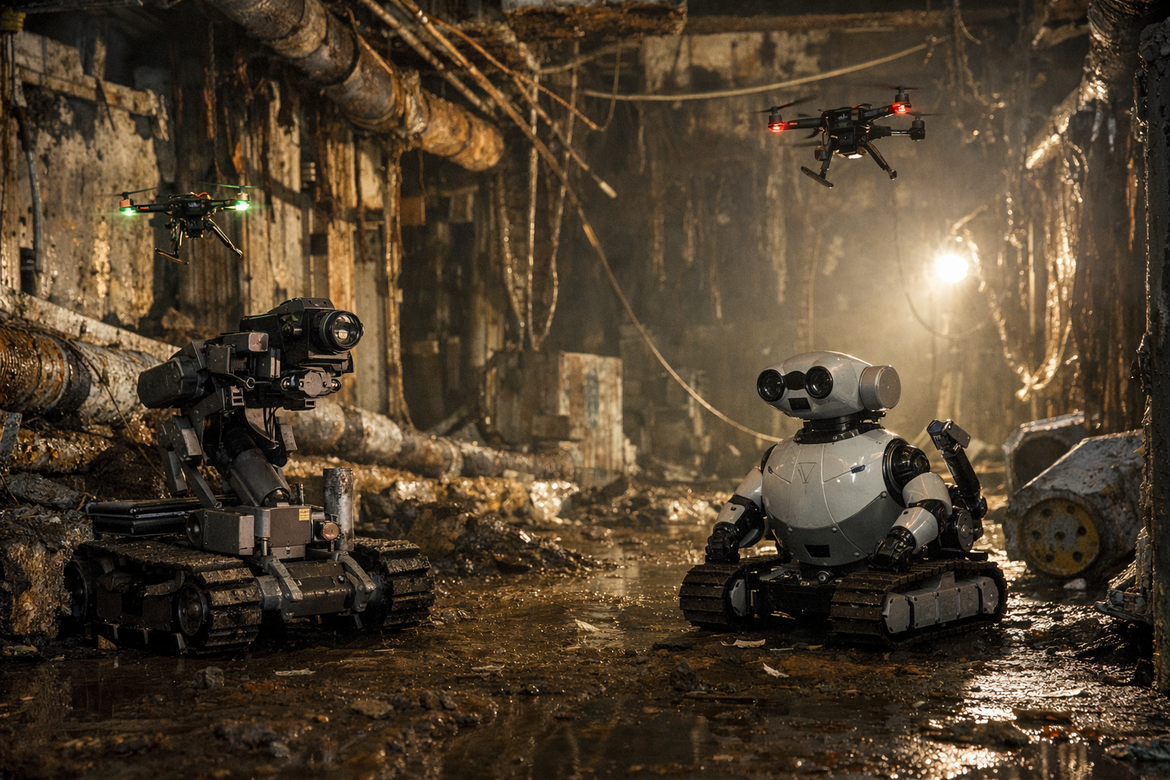
According to the researchers, this level of resilience could make it possible to deploy wireless robots and drones inside heavily contaminated facilities without relying on physical communication cables.
Removing cables could dramatically expand how robots are used during nuclear cleanup operations. Autonomous or remotely operated machines could move through complex structures more freely, coordinate with multiple units simultaneously, and conduct inspections or debris removal in areas too dangerous for human workers.
The potential impact extends beyond Fukushima. Many aging nuclear facilities around the world face decades-long decommissioning projects where radiation exposure remains a constant hazard.
Radiation-tolerant wireless systems could enable fleets of robots to perform inspection, mapping and dismantling tasks while reducing the exposure risk for human operators.
The research also reflects a broader trend in robotics toward designing electronics specifically for extreme environments, from nuclear reactors and deep oceans to space exploration.
For nuclear cleanup efforts in particular, reliable wireless communication may become a key enabling technology for scaling robotic operations inside some of the most hostile environments on Earth.