A surgeon in London has successfully removed a patient’s prostate using a robotic system located roughly 1,500 miles away in Gibraltar, highlighting the growing potential of long-distance robotic surgery, reports The Guardian.
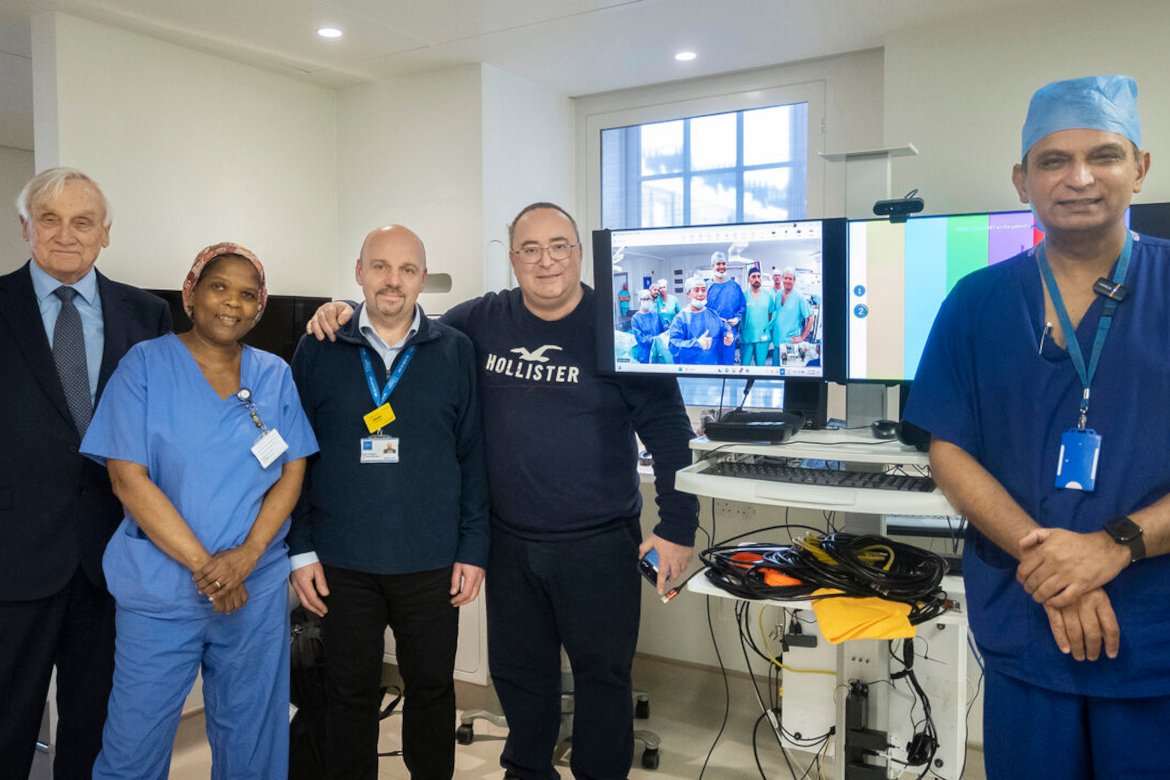
The procedure involved a 62-year-old patient, Paul Buxton, who underwent a robotic prostatectomy at St Bernard’s Hospital in Gibraltar while the operation was conducted remotely from London’s Harley Street district. The surgery was performed by Prof. Prokar Dasgupta, a leading urologist and head of the robotic centre of excellence at The London Clinic.
Using a specialized surgical console, Dasgupta controlled the Toumai Robotic System developed by Shanghai-based MicroPort’s MedBot. The robot, equipped with four articulated arms and a high-definition 3D camera, executed the delicate procedure inside the operating theatre while transmitting real-time visual feedback to the surgeon.
A Milestone in Remote Robotic Surgery
The operation relied on a high-speed fibre optic connection linking London and Gibraltar, supported by a backup 5G network to ensure continuity in case of connectivity issues. According to the medical team, the system maintained a delay of only 60 milliseconds between the surgeon’s commands and the robot’s movements.
“We operated on an NHS patient in Gibraltar from the London Clinic 2,400km away using a robot with a 3D HD camera with four arms,” Dasgupta said. “The robot is completely controlled from a console using high-speed lines with a time delay of only 0.06 seconds.”
Medical staff were present in the operating room in Gibraltar throughout the procedure, prepared to intervene if the connection failed or complications arose. The surgery was completed successfully, and Buxton reported feeling “fantastic” within days of the operation.
For the patient, who has lived in Gibraltar for four decades, the alternative would likely have involved travelling to the United Kingdom for treatment and spending weeks waiting for surgery.
“If I hadn’t gone for the telesurgery in Gibraltar, I would have had to fly to London and go on the NHS waiting list,” Buxton said, adding that taking part in the procedure felt like being involved in “medical history.”
Rapid Growth of the Toumai Surgical Robot
The Toumai system used in the operation is part of a rapidly expanding global surgical robotics platform. According to its developer, Toumai has surpassed 200 commercial orders worldwide across nearly 50 countries and regions, with close to 130 systems already installed in hospitals.
Adoption has accelerated quickly, doubling from just over 100 orders in late 2025 to more than 200 within a few months. Growth has been particularly strong in emerging healthcare markets such as India and Brazil, while hospitals in developed markets including Spain and Australia are also expanding deployments.
The platform has supported thousands of procedures across urology, thoracic surgery, general surgery, gynecology, and head and neck operations. Nearly 800 remote robotic surgeries have already been performed in more than 20 countries, all reportedly completed successfully.
Expanding Access to Specialist Care
Remote robotic surgery has long been viewed as a way to connect expert surgeons with patients in regions where specialized care is difficult to access. Instead of transporting patients long distances, the technology allows experienced doctors to perform procedures remotely while local medical teams provide on-site support.
Dasgupta said the potential humanitarian impact could be significant, particularly for patients in remote locations or smaller healthcare systems that lack highly specialized surgeons. “I think it is very, very exciting,” he said. “The humanitarian benefit is going to be significant.”
The success of the Gibraltar procedure comes as hospitals and technology providers worldwide continue experimenting with telesurgery, aided by improvements in robotics, fiber-optic networks, and low-latency communication systems. Dasgupta is expected to repeat the remote procedure soon while broadcasting it to thousands of surgeons attending a major European urology conference.
While remote surgery still requires rigorous safeguards and reliable connectivity, the milestone operation suggests that robotics may increasingly enable expert medical care to reach patients regardless of distance.