Samsung Electronics is placing a major strategic bet on one of the most difficult problems in robotics: building robot hands capable of manipulating objects with human-like precision.
The company recently established a new research group called Hand Lab within its Future Robotics Task Force. The initiative focuses on developing advanced robotic hands that could eventually enable humanoid robots and automated manufacturing systems to handle delicate tasks currently performed by humans.
Industry analysts view the move as a signal that Samsung intends to compete more aggressively in the emerging humanoid robotics market.
While robots have become increasingly capable of walking, navigating environments, and maintaining balance, engineers say the real challenge lies elsewhere – dexterous manipulation.
Why Robotic Hands Matter
In robotics research, the ability to move like a human is no longer the primary obstacle.
Modern robots can climb stairs, recover from falls, and navigate complex environments with increasing reliability. But performing tasks that humans consider simple – tightening a screw, picking up a fragile object, or assembling small components – remains extremely difficult.
These tasks require a combination of force control, tactile feedback, and coordinated finger motion that traditional industrial robots struggle to achieve.
Most factory robots rely on simple grippers designed for highly structured environments. Humanoid robots, however, must interact with tools, components, and devices originally designed for human hands.
The result is a growing consensus within robotics research that the future of humanoid robots depends heavily on hand design.
Samsung’s decision to create a specialized research group dedicated to robotic hands reflects this shift in priorities.
A Tendon-Driven Approach to Dexterity
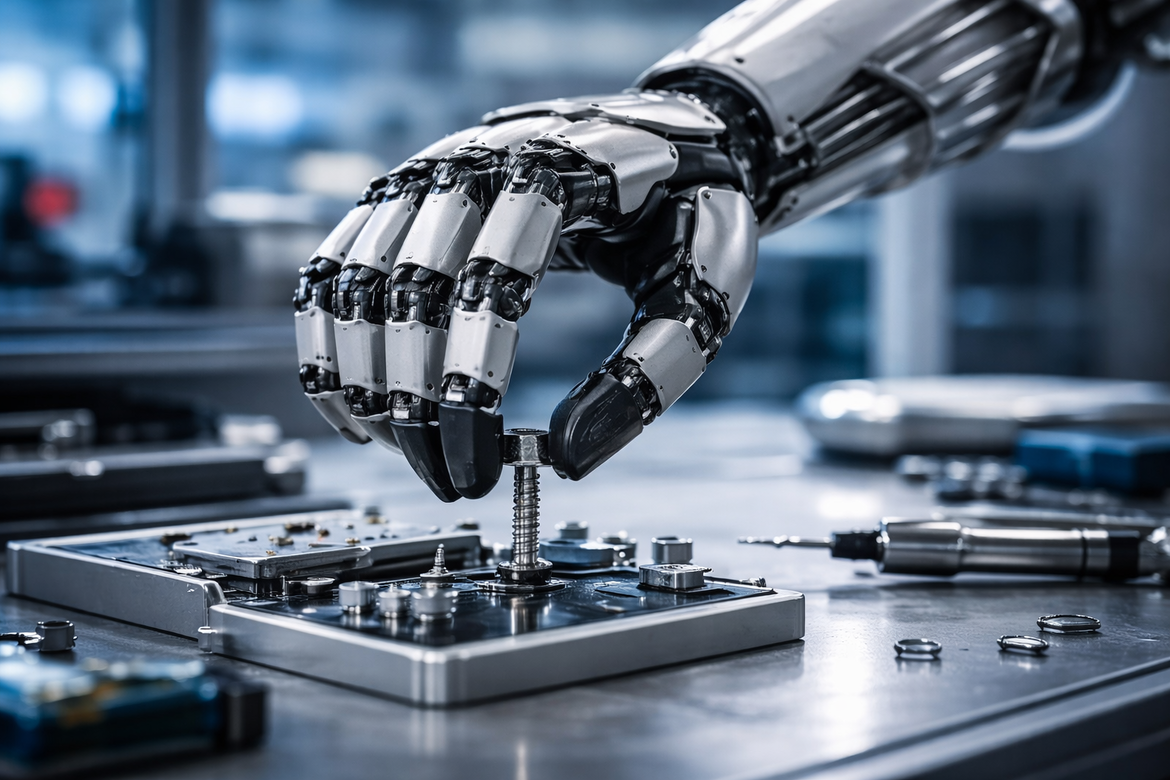
According to industry reports, Samsung’s robotic hand project is exploring a tendon-driven design, a system inspired by the anatomy of the human hand.
Instead of placing motors directly inside each finger, artificial tendons – cables running through the arm – pull and control finger movements. This architecture allows for smoother motion, finer force control, and potentially greater energy efficiency.
The approach is significantly more complex to engineer and manufacture than conventional robotic grippers, which is why most industrial robots avoid it.
However, tendon-driven systems can produce more natural and adaptable movements, making them well suited for humanoid robotics.
Samsung also plans to incorporate tactile sensors that allow robotic fingers to detect pressure, texture, and contact forces. These signals could feed into machine-learning systems that help robots adjust their grip in real time.
Such capabilities are considered essential for what researchers increasingly call physical AI – systems that combine artificial intelligence with real-world robotic interaction.
Building a Robotics Ecosystem
Samsung’s focus on robotic manipulation is part of a broader strategy to build a vertically integrated robotics ecosystem.
Over the past several years, the company has expanded its investments in robotics technology across multiple business units.
Samsung SDI is developing batteries tailored for robotics systems, while Samsung Electro-Mechanics is working on actuators and components for robotic motion.
The company also acquired a controlling stake in Korean robotics developer Rainbow Robotics, known for its humanoid and dual-arm robotic platforms.
Together, these initiatives could allow Samsung to integrate hardware, sensors, computing, and AI into a unified robotics platform.
The company has also outlined a longer-term plan to create AI-powered autonomous factories by 2030, where intelligent robots perform tasks ranging from logistics and inspection to complex assembly.
In such environments, robotic hands capable of delicate manipulation could become the key enabling technology.
Global Competition Intensifies
Samsung’s push into robotic manipulation also reflects rising global competition in humanoid robotics.
China’s robotics sector is expanding rapidly, with analysts projecting tens of thousands of humanoid robots could be produced annually within the next few years.
Chinese manufacturers have already achieved scale in service robots such as delivery and cleaning machines, often competing on cost.
Samsung appears to be taking a different approach – focusing on technological differentiation rather than mass production.
If the company succeeds in developing robotic hands capable of human-level dexterity, it could unlock new applications not only in electronics manufacturing but also across logistics, construction, and industrial automation.
Within robotics circles, engineers often summarize the challenge with a simple observation:
Many robots can walk.
Very few can truly use their hands.
Samsung’s new Hand Lab is designed to change that.