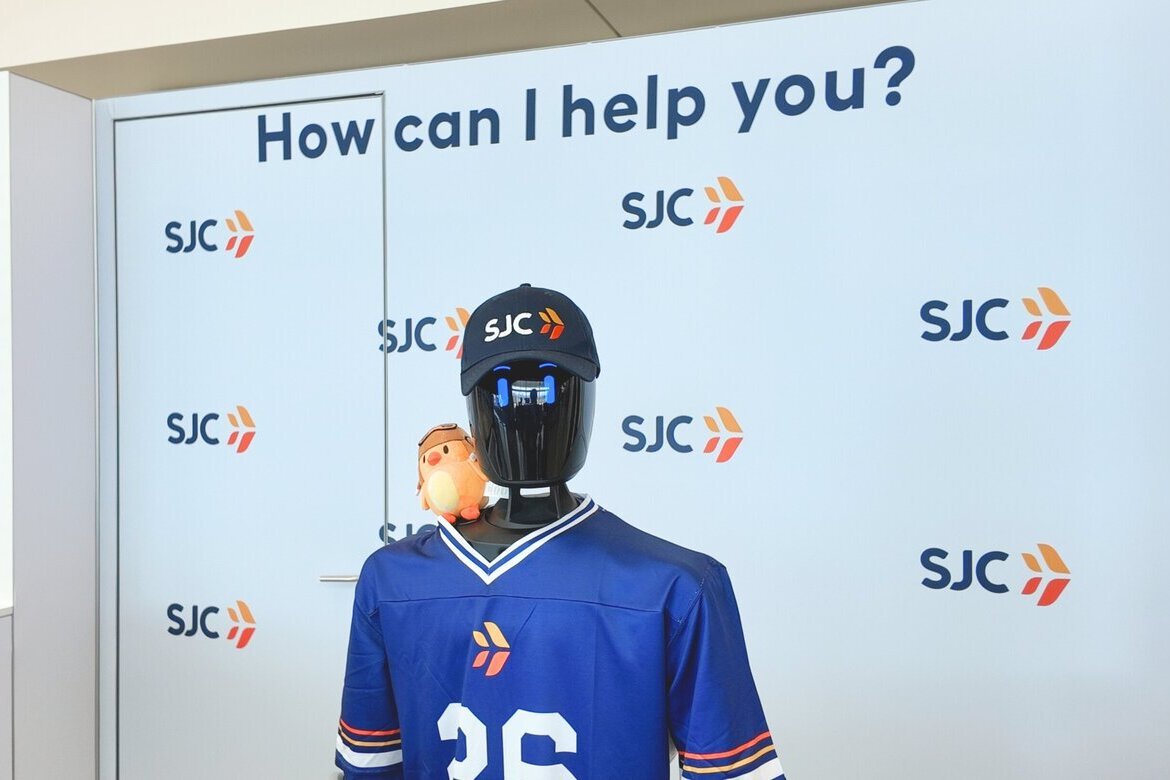

San José Mineta International Airport has begun testing an AI-powered humanoid robot designed to help travelers navigate the terminal, marking another example of robotics moving into public-facing service roles.
The robot, named José, is stationed in Terminal B near Gate 24 and serves as a digital concierge for passengers. Developed by Silicon Valley startup IntBot, the system can greet travelers, answer questions and provide real-time information about flights and airport services.
The deployment is part of a four-month pilot program aimed at evaluating whether humanoid robots can meaningfully improve passenger experience and operational efficiency in a busy transportation hub.
Airports have long experimented with automation, but the arrival of physically embodied AI assistants signals a new phase in the adoption of robotics for customer-facing roles.
A Multilingual Digital Concierge
José is designed to interact naturally with passengers using conversational AI and contextual reasoning. The robot can communicate in more than 50 languages, allowing it to assist international travelers who may struggle to navigate airport signage or find staff who speak their language.
The system combines speech recognition, natural language processing and physical presence to operate in crowded environments where traditional kiosks or mobile apps may be less effective.
Passengers can ask questions about directions, boarding gates, airport services or local transportation. The robot responds verbally while using its screen and gestures to provide additional guidance.
Airport officials say the goal is not to replace human staff but to provide an additional layer of assistance during busy travel periods.
Airports as Testing Grounds for Robotics
San José’s decision to test a humanoid robot reflects a broader trend in which airports are becoming experimental spaces for robotics and artificial intelligence.
Airports present a challenging environment for automation: they are crowded, multilingual and constantly changing. Successfully operating in such conditions requires machines that can navigate complex social and logistical situations.
For technology companies, these environments provide valuable real-world data about how robots interact with people.
The pilot also reflects San José’s role as a gateway to Silicon Valley, where many robotics and AI companies are developing new applications for embodied intelligence.
City officials say the program aligns with the region’s focus on practical technology deployment rather than purely experimental demonstrations.
Measuring the Impact of Service Robots
Over the next four months, airport officials and IntBot engineers will evaluate how travelers respond to the robot and whether it improves customer service outcomes.
Metrics will likely include passenger engagement, accessibility improvements and the system’s ability to handle large volumes of questions during peak travel periods.
For IntBot, the deployment represents an opportunity to demonstrate that socially intelligent robots can function reliably in complex public environments.
If the pilot proves successful, similar systems could appear in other transportation hubs, shopping centers or public facilities where multilingual assistance is valuable.
More broadly, the experiment highlights how robotics developers are shifting their focus from controlled industrial settings to everyday environments where machines must interact directly with people.
Airports, with their mix of logistical complexity and constant passenger flow, may offer an early glimpse of how humanoid service robots will eventually integrate into public infrastructure.
Disclaimer: RobotsBeat is an independent media brand owned and operated by NuvexMedia LLC, publishing news, research, and insights on artificial intelligence, emerging technologies, automation, and related industries. NuvexMedia LLC invests in and collaborates with companies across the AI, Robotics, technology, software, and digital innovation sectors. These relationships do not influence RobotsBeat's editorial coverage, and the publication maintains full editorial independence to provide accurate, timely, and objective information. © 2026 NuvexMedia LLC. All rights reserved. This content is for informational purposes only and should not be considered legal, tax, investment, financial, or other professional advice.