Saronic has raised $1.75 billion in a Series D round, pushing its valuation to $9.25 billion and positioning the company among the most heavily funded players in autonomous maritime systems. The investment underscores growing demand for AI-driven vessels, but more importantly, highlights a broader shift toward rebuilding industrial capacity around software-defined platforms.
Unlike many robotics startups focused primarily on autonomy software, Saronic is pursuing a vertically integrated model that combines vessel design, manufacturing, and deployment. The approach reflects increasing recognition that scaling physical AI systems requires not just intelligence, but production infrastructure.
Rebuilding Shipbuilding Around Autonomy
Saronic’s strategy centers on what it describes as an autonomy-first design philosophy. Rather than retrofitting existing vessels with autonomous capabilities, the company is developing ships from the ground up to operate without crews, integrating AI systems into core architecture.
This design approach is paired with investment in manufacturing. A key component is the development of “Port Alpha”, a next-generation shipyard intended to support high-throughput production of autonomous vessels. The company is also expanding existing facilities in Louisiana and Texas, signaling an effort to establish new shipbuilding capacity rather than rely on legacy infrastructure.
The emphasis on production reflects a structural challenge in the maritime sector. Shipbuilding capacity in the United States has declined over decades, limiting the ability to scale new platforms. By combining software-defined systems with modern manufacturing, Saronic is attempting to address both technological and industrial constraints simultaneously.
From Prototype Systems to Fleet-Scale Deployment
The funding will also support expansion of Saronic’s portfolio of autonomous surface vessels, ranging from smaller platforms such as the 24-foot Corsair to larger systems like the 180-foot Marauder. These vessels are designed for missions requiring extended range, endurance, and payload capacity, particularly in defense and maritime security contexts.
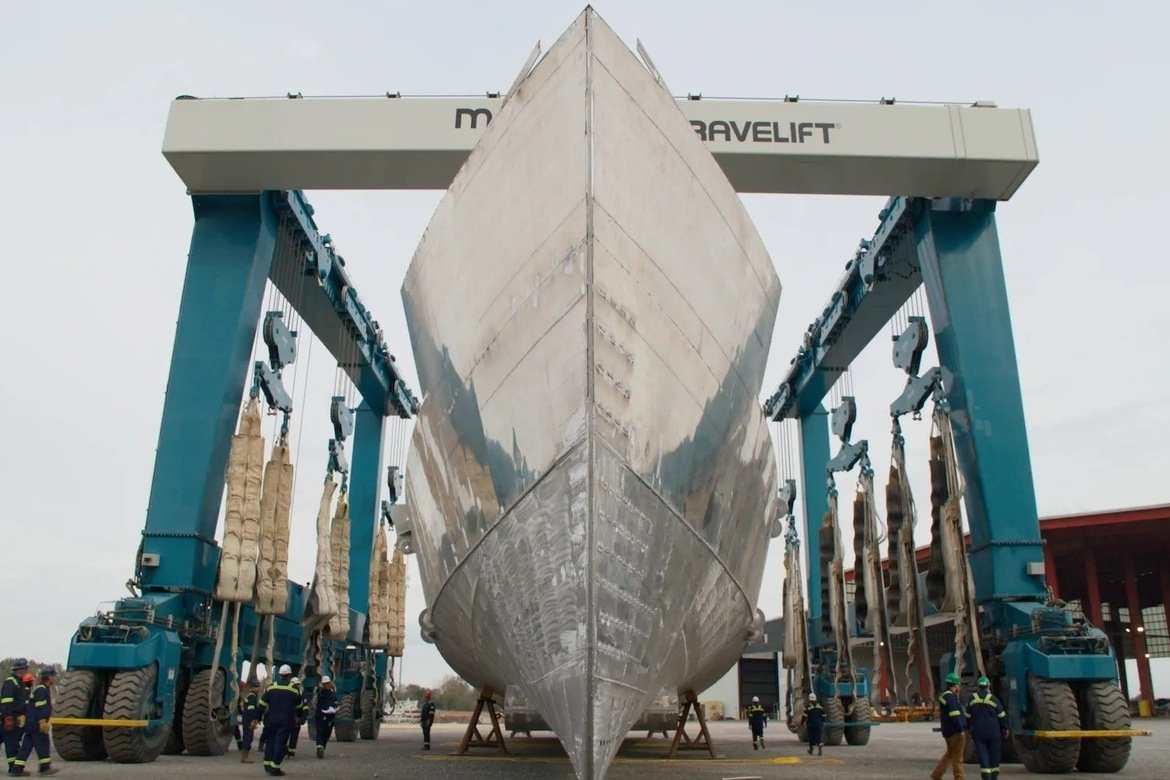
The company’s recent trajectory suggests a transition from prototype development to production. It reported completing the first hull of its Marauder platform within months of acquiring a shipyard, indicating an accelerated manufacturing timeline compared with traditional shipbuilding cycles.
This shift is reinforced by growing engagement with government customers, including a production contract with the U.S. Navy. Such partnerships provide both validation and demand signals, particularly as defense organizations explore autonomous systems to extend operational reach without increasing personnel requirements.
Investors in the round, led by Kleiner Perkins, emphasized that the combination of autonomy and manufacturing scale is relatively rare. The ability to produce systems consistently, rather than demonstrate isolated technical capability, is increasingly seen as a defining advantage in physical AI sectors.
Scaling Production as the New Competitive Edge
Saronic’s funding round reflects a broader trend in robotics and autonomous systems: the convergence of software innovation with industrial-scale production. As autonomy matures, the bottleneck is shifting from algorithmic capability to the ability to manufacture, deploy, and sustain systems in large numbers.
In the maritime domain, where platforms are capital-intensive and operational timelines span decades, this shift is particularly pronounced. Companies that can integrate AI with production infrastructure may be better positioned to define the next generation of naval and commercial fleets.
For Saronic, the challenge now lies in translating capital and ambition into sustained output. If successful, the company’s model could reshape not only how ships operate, but how they are built in the first place.