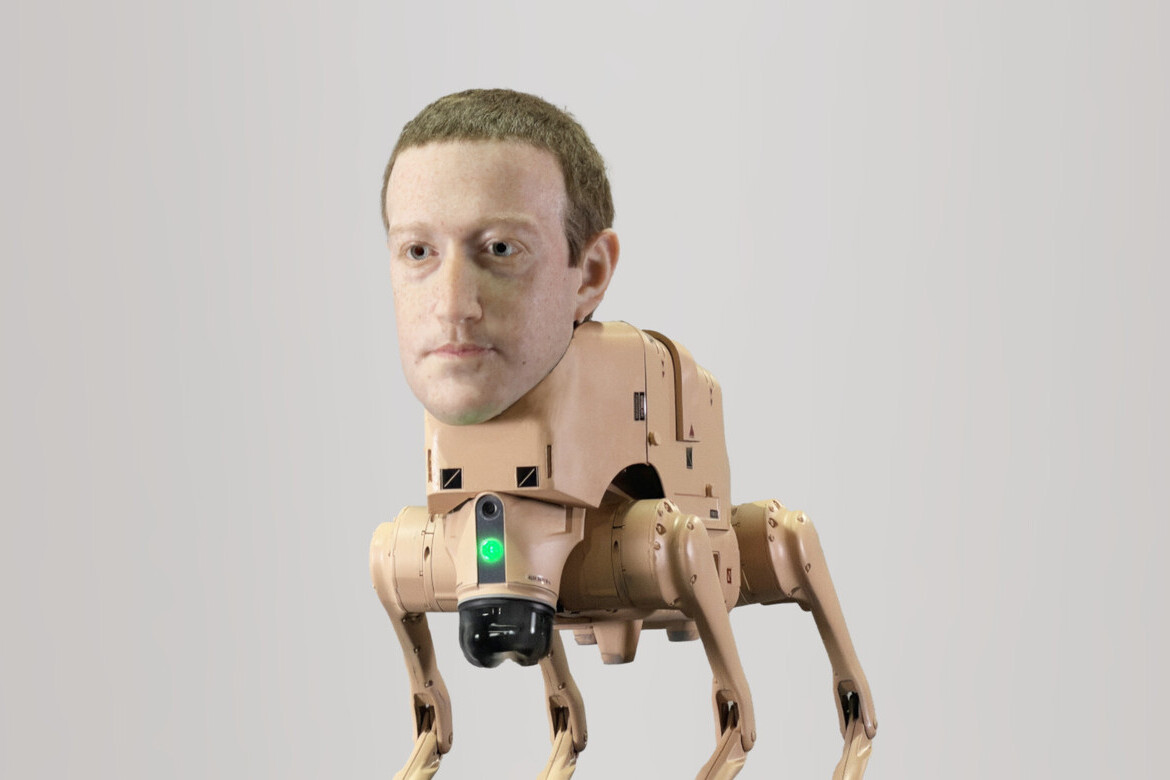


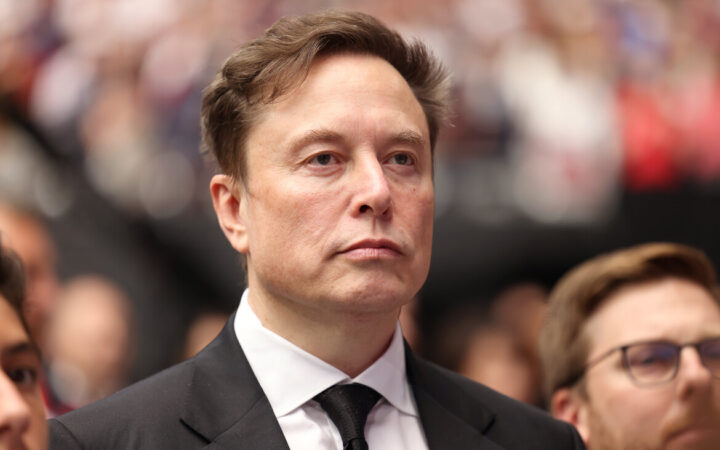
American digital artist Beeple, whose legal name is Mike Winkelmann, has opened an interactive installation at Berlin’s Neue Nationalgalerie featuring robot dogs fitted with hyper-realistic silicone heads modeled after some of the most recognizable figures in technology and cultural history. The dogs roam freely through the museum, carrying the likenesses of Elon Musk, Mark Zuckerberg, Jeff Bezos, Andy Warhol, and Pablo Picasso – as well as a head modeled after Beeple himself.
The work, entitled “Regular Animals”, was first shown at Art Basel Miami Beach in 2025 and is now on extended display in Berlin.
How the Installation Works
Each robot dog is equipped with integrated cameras that continuously capture images of its surroundings as it moves through the gallery. Those images are processed by AI and periodically printed – with the output filtered through the personality or aesthetic worldview of the figure each dog represents. The Picasso dog produces images in Cubist style. The Warhol dog outputs in pop art. The technology billionaire dogs reinterpret their surroundings through AI models conditioned on each figure’s public identity and worldview.
The printing mechanism is deliberately unglamorous: the dogs occasionally stop and produce the images in a manner the artist and press have described as defecating. The choice of delivery method is part of the work’s visual language.
The Commentary Behind the Hardware
Beeple has been direct about the installation’s intent. “In the past, our view of the world was shaped in part by how artists saw the world,” he told the Associated Press. “How Picasso painted changed how we saw the world, how Warhol talked about consumerism, pop culture, that changed how he saw those things.”
The figures who shape perception now, he argues, are not artists but technology executives controlling algorithmic platforms that determine what billions of people see and do not see. “That’s an immense amount of power that I don’t think we’ve fully understood, especially because when they want to make a change, they don’t need to lobby the U.N. They don’t need to get something through Congress or the EU – they just wake up and change these algorithms.”
By placing those figures’ faces on quadruped robots – hardware associated with surveillance, industrial automation, and military research – the installation draws a connection between algorithmic power and physical AI systems that is rarely made this explicitly in a public cultural setting.
Lisa Botti, the exhibition’s curator, said artificial intelligence is among the phenomena most significantly affecting daily life and that museums are the appropriate spaces for society to examine such shifts. Beeple, according to Christie’s, is the third most expensive living artist to sell at auction, after David Hockney and Jeff Koons.
Disclaimer: RobotsBeat is an independent media brand owned and operated by NuvexMedia LLC, publishing news, research, and insights on artificial intelligence, emerging technologies, automation, and related industries. NuvexMedia LLC invests in and collaborates with companies across the AI, Robotics, technology, software, and digital innovation sectors. These relationships do not influence RobotsBeat's editorial coverage, and the publication maintains full editorial independence to provide accurate, timely, and objective information. © 2026 NuvexMedia LLC. All rights reserved. This content is for informational purposes only and should not be considered legal, tax, investment, financial, or other professional advice.