Canadian Robotics Council Forms Capital Committee to Boost Domestic Robotics Investment

The Canadian Robotics Council has created a Capital Committee to connect robotics startups with banks, venture firms, and specialized financing. The initiative aims to increase domestic investment in Canadian robotics and physical AI companies.

By Daniel Krauss Published: Updated:

The Canadian Robotics Council has established a Capital Committee designed to increase investment in Canada’s robotics sector. The group brings together representatives from major financial and venture organizations, including BDC Capital, Garage Capital, Inovia Capital, RBC Dominion Securities, Two Small Fish Ventures, and Version One Ventures. According to BetaKit, the committee was created to strengthen links between capital providers and robotics companies that often need significant funding to scale hardware, manufacturing, and deployment operations.

The committee will focus on three areas: expanding funding for robot makers and automation adopters, giving investors better technical frameworks for evaluating robotics startups, and connecting entrepreneurs with supply chains, early customers, and specialized financing. The Canadian Robotics Council argues that Canada has strong robotics research and early-stage innovation, but scaling companies requires deeper investor understanding of hardware risk, deployment timelines, and technical due diligence. Its founding members have already backed Canadian robotics companies including Avidbots, Clearpath Robotics, Haply Robotics, Kindred Systems, and Waabi.

The move reflects a broader concern that Canada could underinvest in physical AI while focusing more heavily on software-based artificial intelligence. Robotics companies typically require more capital than pure software startups, but they can also create stronger industrial spillovers through manufacturing, automation adoption, and domestic supply chains. By formalizing investor engagement, the council is positioning robotics as a strategic infrastructure sector rather than a narrow hardware category.

News, Policy & Regulation, Robots & Robotics

AI, Quantum Tech, and Humanoid Robots Headline 28th Beijing International High-Tech Expo

The 28th China Beijing International High-tech Expo opened with embodied intelligence, quantum computing, and commercial aerospace as central themes. Humanoid robots from Beijing E-Town and a next-generation quantum computer featured among the headline exhibits.

By Laura Bennett | Edited by Kseniia Klichova Published:

The 28th China Beijing International High-tech Expo opened on Friday at the China National Convention Center, with artificial intelligence, quantum technology, and robotics positioned as the event’s central themes. The expo, which runs through May 10, is showcasing technologies aimed at filling domestic gaps across sectors including embodied intelligence, commercial aerospace, advanced medical equipment, and semiconductors. The lineup reflects China’s continued effort to consolidate strategic technology development under high-visibility national platforms.

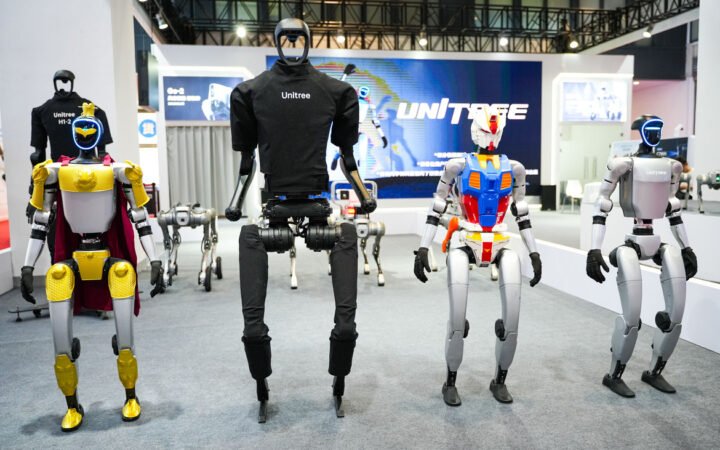
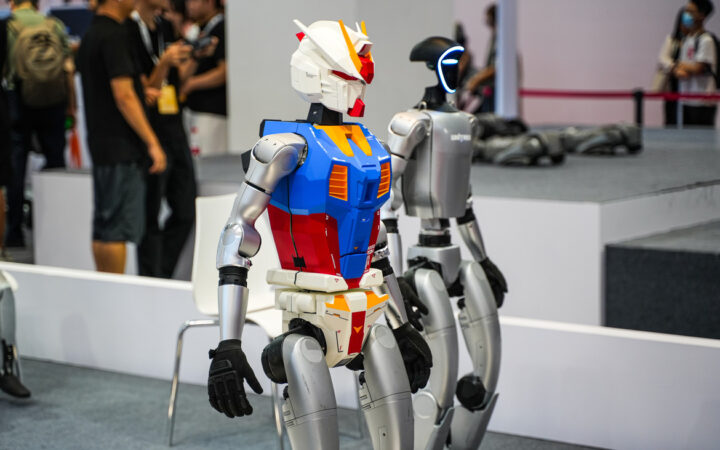
Robotics exhibits included a group of humanoid platforms from Beijing E-Town, a technology hub that has become a focal point for the city’s embodied intelligence ecosystem. Additional showcases featured industrial intelligent robots, autonomous following robots, and AI-powered cultural heritage demonstration robots. At the Chaoyang district exhibition area, 18 newly developed technologies and products made their debut, including a next-generation quantum computer, general-purpose photonic quantum chips, and the country’s first satellite-based Internet of Things payload.

Commercial aerospace was another headline category, with rocket models including LandSpace’s Zhuque-2 and Zhuque-3 and Galactic Energy’s Ceres-1 drawing visitor attention. Organizers framed these exhibits as evidence of China’s progress in reusable launch technology and orbital capabilities. The pairing of robotics, quantum systems, and launch hardware in a single venue reflects how Beijing is bundling its frontier technology programs into integrated industrial narratives rather than treating them as isolated sectors.

For the broader robotics industry, the expo serves as a barometer of how Chinese embodied intelligence platforms are being positioned domestically, particularly in the run-up to anticipated mass production milestones from major Chinese humanoid developers in late 2026. Beijing E-Town, in particular, has been a recurring presence in coverage of the country’s humanoid ecosystem, and continued visibility at national-level exhibitions reinforces its role as a coordinated cluster for hardware, software, and deployment partners.

Artificial Intelligence (AI), News, Robots & Robotics, Science & Tech

GoLabs Launches U.S. Robotic Security Service Built on Unitree Quadrupeds

U.S.-based robotics company GoLabs has launched a custom robotic security service built on Unitree quadruped platforms. The offering includes deployment, calibration, and integration support for autonomous patrol applications across industrial and commercial sites.

By Daniel Krauss Published:

U.S.-based robotics company GoLabs has launched a custom robotic security service built around Unitree quadruped platforms. The company is positioning itself as a domestic vendor and integrator of Unitree hardware, allowing customers in the United States to procure and deploy the robots without the cost and lead times associated with international shipping. GoLabs handles setup, calibration, programming, and ongoing system integration within existing security infrastructure, alongside troubleshooting support.

The quadrupeds are configured for autonomous patrol applications and are equipped with wide-angle HD cameras for 24/7 live monitoring, alongside thermal and night vision sensors that allow operation in complete darkness. The platforms support autonomous elevator navigation and anomaly detection, and can be deployed in environments that pose health risks to human personnel, including high-altitude sites, oxygen-deficient zones, and nuclear industrial areas. Mapping and navigation rely on an integrated 4D LiDAR system combined with SLAM, enabling the robots to generate 3D maps of facilities and follow assigned patrol paths and checkpoints.

The launch reflects the growing role of system integrators and value-added resellers in scaling robotics deployments, particularly for hardware platforms developed by overseas manufacturers. Unitree, based in China, has become one of the most widely deployed quadruped suppliers globally, but commercial customers in the United States typically require localized support, integration services, and procurement structures that direct import does not easily provide. GoLabs is targeting that gap.

Robotic security patrols remain a relatively early-stage application area, with most deployments concentrated in logistics warehouses, data centers, large event venues, and critical infrastructure sites. Whether quadruped platforms can displace meaningful share from incumbent fixed-camera systems and human guard services will depend on operational reliability over extended deployments, integration with existing security operations centers, and total cost of ownership compared to traditional alternatives.

News, Robots & Robotics

Faraday Future Reports 68 Cumulative Embodied AI Robot Shipments Toward 200-Unit June Target

Faraday Future has reported 46 new robot sales and shipments in April, bringing cumulative deliveries to 68 units against a target of 200 by the end of June. The company is also expanding its embodied AI robotics business through U.S. university partnerships and K-12 education programs.

By Daniel Krauss Published:

Faraday Future Intelligent Electric has reported 46 new robotics sales and shipments in April through its embodied AI business unit, bringing cumulative deliveries to 68 units. The figures were disclosed in a weekly investor update from founder and global co-CEO YT Jia. The company is targeting 200 cumulative shipments by the end of June and says each delivered model is producing positive gross margin. Faraday Future positions itself as the first U.S. company to deliver both humanoid and bionic robots, with the rollout structured around what it calls a “Device-Data-Brain” flywheel.

April deliveries were directed to a mix of B2C buyers and B2B education customers, including Boston International Business School and Triple I. On the platform side, the company has launched a developer incentive program and what it describes as the first youth developer program for AI-native users. It is also building out an EAI Data Factory framework intended to support model training using operational data collected from deployed units. Detailed technical specifications for the robots, including form factor breakdown between humanoid and bionic models, were not disclosed in the update.

The education channel is emerging as a primary near-term distribution route. Faraday Future and Boston International Business School officially launched the BIBS–FF AI and Robotics Institute in Omaha, timed to coincide with the Berkshire Hathaway annual shareholders meeting. The company says it is in discussions with UCLA on potential collaboration and recently ran a K–12 immersive robotics class with BrainBuilders STEM Education that drew more than 30 students and parents. Next steps include strategic partnerships with K–12 schools and universities, robot procurement programs, and an EAI education summer camp.

The shipment numbers remain modest by the standards of established robotics manufacturers, and Faraday Future’s broader financial position has historically been a source of investor scrutiny. However, the disclosed figures are notable as concrete deployment data from a publicly listed U.S. company attempting to bridge electric vehicles and humanoid robotics under a single platform strategy. Whether the 200-unit June target is reached and whether the education-led distribution model produces durable demand will be the key indicators of execution in the coming quarter.

Business & Markets, News, Robots & Robotics

Schaeffler and VinDynamics Sign Partnership to Develop Humanoid Robot Actuator Systems

German motion technology company Schaeffler and Vingroup-backed VinDynamics have signed a memorandum of understanding to jointly develop actuator systems for humanoid robots. The deal marks Schaeffler’s first humanoid robotics partnership in Southeast Asia.

By Rachel Whitman Published:

Schaeffler and VinDynamics have signed a memorandum of understanding to establish a strategic partnership focused on joint research and technology development for humanoid robots. Under the agreement, signed in Hanoi, Schaeffler will supply high-precision actuator systems and related motion technology components to VinDynamics, a humanoid robotics company backed by Vingroup. The deal marks Schaeffler’s first cooperation with a humanoid robotics company in Southeast Asia, expanding its existing portfolio of partnerships with humanoid developers globally.

The collaboration covers research, development, and optimization of actuator systems and related motion technology components, which provide the precise and reliable movement that humanoid platforms require. VinDynamics will conduct technical assessments and optimize its control software for compatibility with Schaeffler’s hardware. The partnership also extends to product simulation and validation, with VinDynamics sharing operational data from deployed actuators back to Schaeffler. That data feedback loop is intended to support iterative design improvements and to enable services such as condition monitoring and predictive maintenance.

The deal reflects the growing structural importance of component suppliers in the humanoid robotics value chain. Actuators are among the most cost-sensitive and reliability-critical parts of humanoid platforms, and major industrial component manufacturers including Schaeffler, Bosch, and Harmonic Drive have been positioning themselves to supply emerging humanoid programs. By embedding directly with a developer at an early stage, Schaeffler can shape actuator specifications around real deployment data rather than relying on generic industrial benchmarks.

For Vietnam, the partnership signals an effort to establish a domestic humanoid robotics capability through Vingroup’s broader industrial portfolio, which already includes electric vehicles and consumer electronics. While most humanoid development today is concentrated in China, the United States, and parts of Europe, the VinDynamics-Schaeffler agreement extends the geographic spread of the sector and indicates that Southeast Asia is beginning to attract serious component-level engagement from established global suppliers.

Business & Markets, News, Robots & Robotics

GS25 Becomes First Convenience Store Chain to Sell Humanoid Robots in South Korea

South Korean convenience store chain GS25 has begun selling humanoid robots, quadrupeds, and AI social robots as part of its Family Month curated lineup. The retailer is offering 11 robot products, marking the first time humanoid robots are being sold through the convenience store channel.

By Rachel Whitman Published:

South Korean convenience store chain GS25, operated by GS Retail, has begun selling humanoid robots through its retail channel as part of a curated lineup of more than 130 Family Month items. The retailer is offering 11 robot products, including the AI social robot Liku, a G1 humanoid robot, an Air quadruped walking robot, and Ailico robot keyrings. According to GS Retail, this marks the first time humanoid robots are being sold through the convenience store format in the country.

Liku, positioned as the flagship product, is a Korean-developed AI social robot equipped with conversation and emotion-expression capabilities, with target use cases in children’s education and elderly care. The broader robot lineup ranges from full-sized humanoid and quadruped platforms to smaller form factors such as keyring devices designed for portable, low-stakes interaction. The robots are being offered alongside non-technology items including pure gold and silver bars, Korean beef, seafood, and fruits as part of the chain’s Family Month promotion.

The move signals a shift in how consumer-facing robotics products are reaching the mass market in South Korea. Rather than being confined to specialty retailers, electronics chains, or direct-from-manufacturer sales, robots are now being positioned alongside everyday consumer goods. This approach treats robots as gift or lifestyle items, lowering the perceived barrier for first-time buyers and broadening the distribution surface for early-stage humanoid and social robot products.

Whether the convenience store channel becomes a meaningful sales pathway for humanoid robots will depend on price points, after-sales support, and consumer interest beyond the initial promotional window. Still, the listing reflects the maturation of South Korea’s domestic robotics ecosystem and the willingness of major retailers to test embodied AI products in formats traditionally reserved for fast-moving consumer goods.

News, Robots & Robotics
Exit mobile version