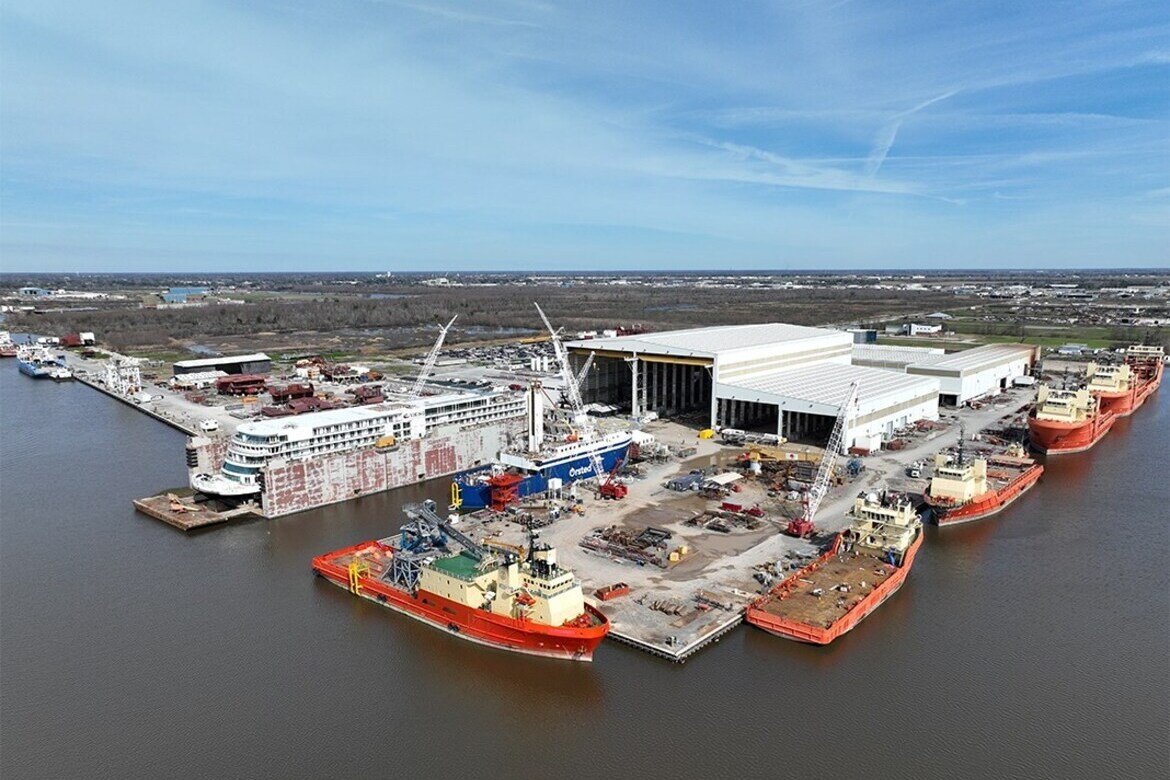

HD Hyundai Robotics has secured its first robotic welding order from the U.S. shipbuilding industry, supplying its ArcLift GO system to Chouest Group Shipyards. The contract covers three Chouest facilities in North America, including locations in Louisiana, and one shipyard in Brazil. The order was coordinated through HD Hyundai Robotics USA, the company’s subsidiary based in Duluth, Georgia.
The deal marks HD Hyundai Robotics’ formal entry into the U.S. shipyard automation market and establishes a commercial reference point for further expansion across North American shipbuilding – a sector that has identified skilled welder shortages as a structural constraint on productivity and competitiveness.
The Problem ArcLift GO Addresses
The shortage of skilled welders in U.S. shipyards has moved beyond a cyclical labor issue into a long-term structural challenge. Welding is among the most technically demanding tasks in shipbuilding, and the workforce capable of performing it to the tolerances required for marine construction has been declining for years. Automation that can replicate consistent weld quality without depending on a shrinking pool of credentialed workers addresses a direct operational bottleneck.
ArcLift GO is designed around a Plug-in & Play architecture with intuitive operating software, allowing operators with limited robotics experience to run two to three units simultaneously. The system is built to handle diverse geometries and variable working environments – conditions that are characteristic of shipyard production floors, where part configurations change frequently and standardization is limited compared to automotive or electronics manufacturing.
HD Hyundai brings shipbuilding process knowledge accumulated across years of Korean industrial production to the system’s design, which the company says differentiates ArcLift GO from general-purpose welding robots applied to marine contexts.
Policy Tailwinds and Strategic Context
The timing of the order aligns with a shifting U.S. policy environment. A proposed Robot Security Act in the United States aims to strengthen supply chain resilience and technological sovereignty in shipbuilding and manufacturing – a direction HD Hyundai Robotics anticipated by building its U.S. subsidiary presence and developing customer relationships with American shipyards ahead of the regulatory shift.
The Chouest order is also connected to the broader MASGA initiative, a Korean-U.S. shipbuilding cooperation framework through which HD Korea Shipbuilding and Offshore Engineering is exploring joint vessel construction and integrated automation collaboration. HD Hyundai Robotics plans to leverage the U.S. reference deployments from the Chouest contract to expand its position across the North American shipbuilding market as a validated domestic supplier within the U.S. shipbuilding supply chain.
Disclaimer: RobotsBeat is an independent media brand owned and operated by NuvexMedia LLC, publishing news, research, and insights on artificial intelligence, emerging technologies, automation, and related industries. NuvexMedia LLC invests in and collaborates with companies across the AI, Robotics, technology, software, and digital innovation sectors. These relationships do not influence RobotsBeat's editorial coverage, and the publication maintains full editorial independence to provide accurate, timely, and objective information. © 2026 NuvexMedia LLC. All rights reserved. This content is for informational purposes only and should not be considered legal, tax, investment, financial, or other professional advice.