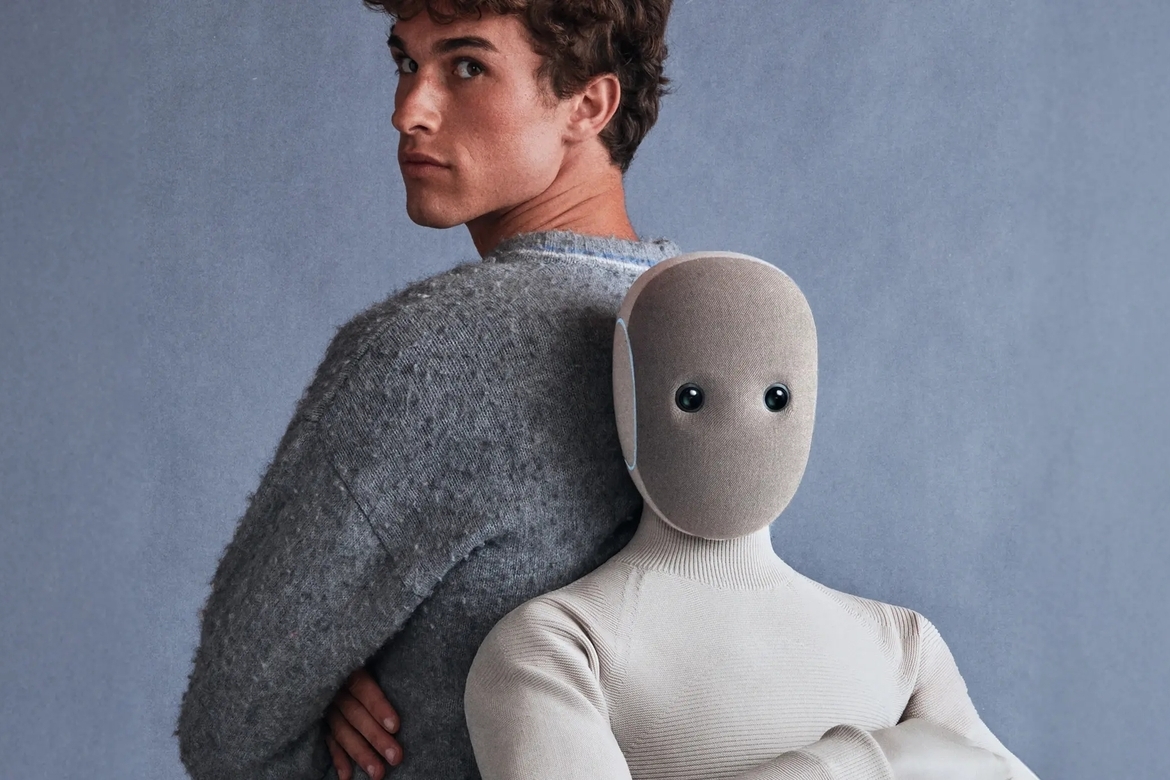


1X Technologies has launched full-scale production of its NEO humanoid robot at a new 58,000-square-foot facility in Hayward, California. The factory is the primary manufacturing hub for NEO, a home-focused humanoid designed to operate quietly – at a noise level below that of a modern refrigerator – while navigating domestic spaces. Consumer shipments are scheduled to begin in 2026, with the first year’s production allocation already sold out after pre-orders were taken in five days following the October launch.
The Hayward facility is vertically integrated, processing raw materials into finished components on-site rather than sourcing from global suppliers. 1X describes the operation as a “factory OS” – a real-time production management system covering every stage from raw input to completed robot.
What the Factory Produces
The production floor is organized around specialized zones. Copper coils are wound on automated lines to produce custom motors. A joint and limb assembly area constructs the robot’s tendon-driven actuators and 3D-lattice cushioned limbs. A final integration stage is where robots stand for the first time and receive their machine-washable nylon knit suits, available in tan, gray, and dark brown. A dedicated reliability lab subjects hardware to more than 20 million stress-test cycles to identify failure modes before units reach consumers.
Early NEO units are already operating inside the Hayward facility, handling internal logistics and stocking parts. The dual function is deliberate: the robots perform useful labor while generating real-world operational data that feeds back into training the NEO Cortex, the robot’s AI brain built on the NVIDIA Jetson Thor platform.
“Humanoid robots require high-performance, real-time AI inference and continuous training and testing in simulation for safe and reliable operation,” said Deepu Talla, Vice President of Robotics and Edge AI at NVIDIA. “By using NVIDIA Jetson Thor as the brain and the NVIDIA Isaac open robotics platform as its training ground, 1X is able to accelerate the development and deployment of intelligent robots like NEO that can work safely alongside humans.”
Strategic Positioning
1X Technologies, headquartered in Palo Alto and backed by Norwegian investors, is positioning the Hayward facility as evidence that consumer humanoid production can be built and scaled in the United States. The vertically integrated model gives 1X tighter control over component quality and supply chain risk than an assembly-only approach would allow, at the cost of higher capital requirements and operational complexity.
“This is more than just a factory opening – it’s proof that the future of humanoid robotics is being built right here in the U.S.,” said Bernt Børnich, founder and CEO of 1X. “We’re not dreaming about abundance; we’re manufacturing it.”
The consumer home robotics market that NEO is targeting remains largely unproven at scale. 1X is among the first companies globally to move a home humanoid from pre-order into production, placing it ahead of most competitors on manufacturing readiness while still carrying the uncertainty of whether consumer demand at the necessary price point will materialize as units reach homes later this year.
Disclaimer: RobotsBeat is an independent media brand owned and operated by NuvexMedia LLC, publishing news, research, and insights on artificial intelligence, emerging technologies, automation, and related industries. NuvexMedia LLC invests in and collaborates with companies across the AI, Robotics, technology, software, and digital innovation sectors. These relationships do not influence RobotsBeat's editorial coverage, and the publication maintains full editorial independence to provide accurate, timely, and objective information. © 2026 NuvexMedia LLC. All rights reserved. This content is for informational purposes only and should not be considered legal, tax, investment, financial, or other professional advice.