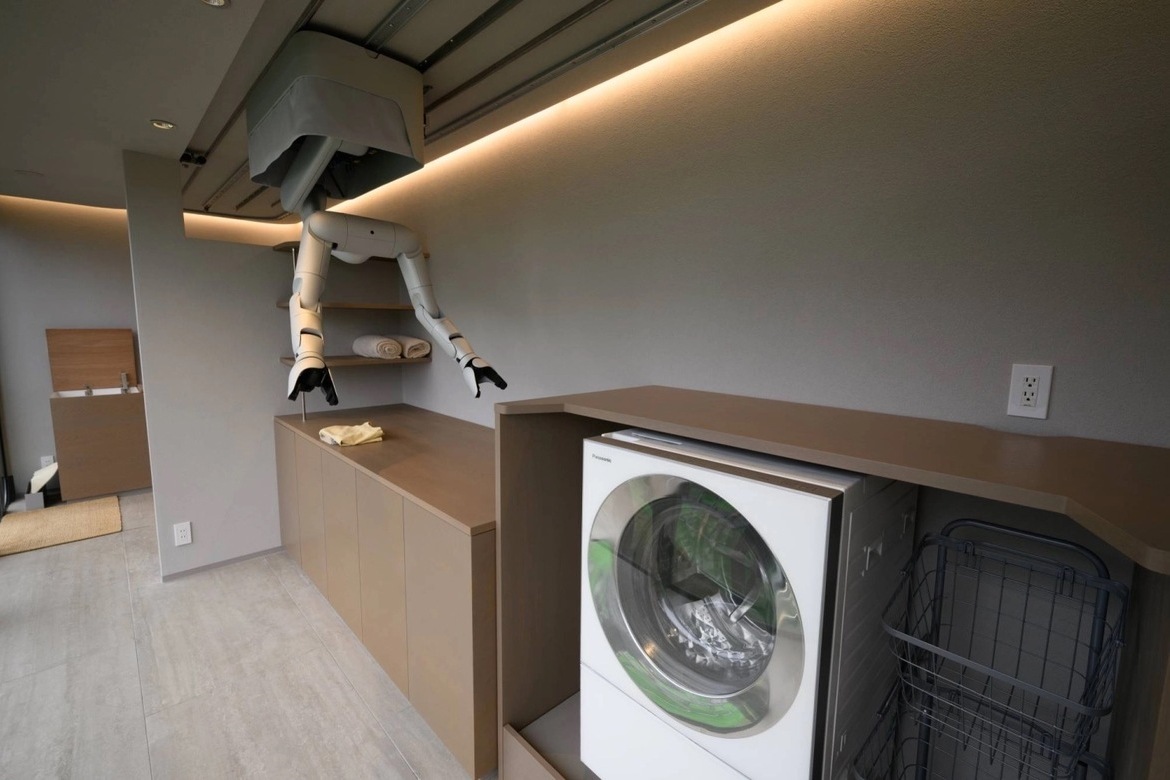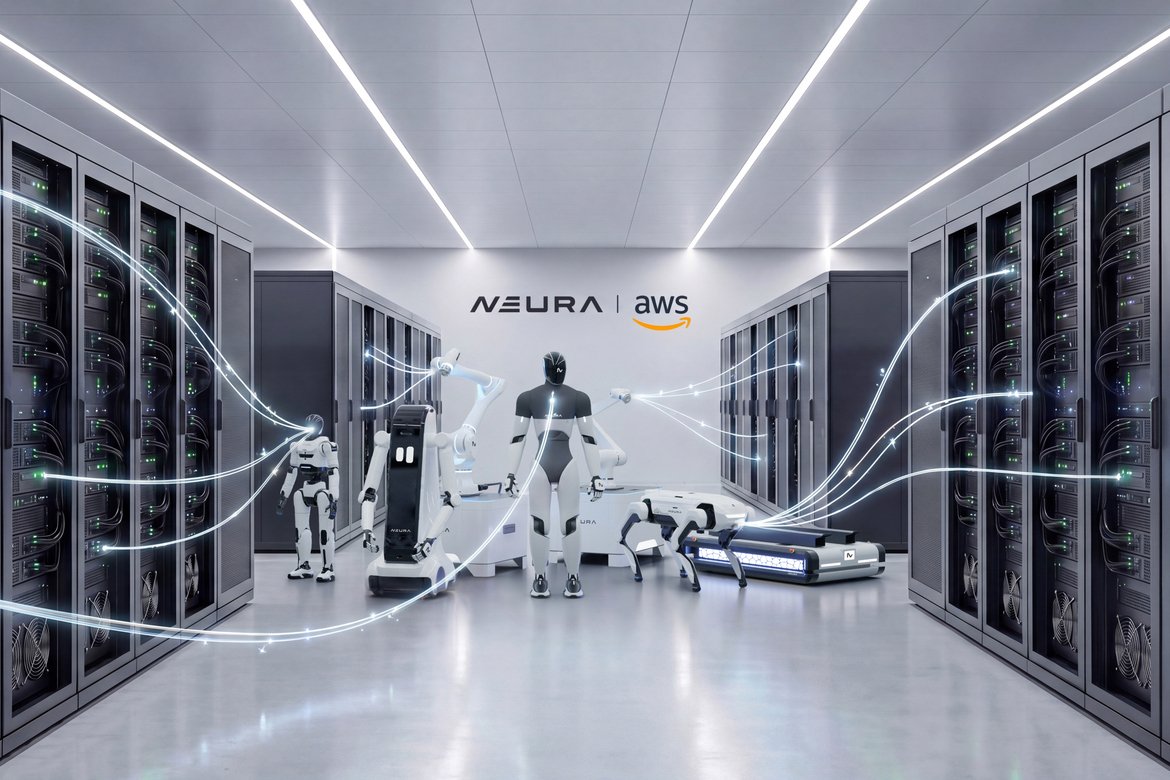


NEURA Robotics, the German cognitive robotics company, and Amazon Web Services have announced a strategic collaboration to accelerate the development and global deployment of physical AI systems. AWS will serve as the primary cloud provider for NEURA’s Neuraverse platform, handling AI training, real-world data processing, and shared intelligence across robot fleets. Amazon will separately explore deploying NEURA robotic systems in select fulfillment centers, providing production-environment data to accelerate the development of new robotic capabilities in logistics and warehouse operations.
The partnership addresses what both companies describe as the central constraint on physical AI progress: the data gap. Unlike large language models trained on trillions of internet-sourced data points, robotic AI systems have access to a fraction of that volume, and the data they need can only be generated through real-world operation.
Three Areas of Collaboration
The agreement spans cloud infrastructure, AI development, and real-world validation. AWS will provide the computational backbone for the Neuraverse, NEURA’s platform for training and sharing robotic intelligence across fleets. NEURA Gym – a purpose-built training environment where robots practice complex tasks in controlled settings alongside high-fidelity simulation – will integrate with Amazon SageMaker to accelerate joint training pipelines across NEURA and partner use cases.
The real-world validation component is the most strategically significant element. Amazon’s fulfillment centers represent one of the most operationally demanding and data-rich environments available for robotic deployment – high throughput, variable product mix, and continuous operation at global scale. Each deployment generates the kind of sensor data, task variety, and edge-case exposure that controlled training environments cannot replicate.
“Physical AI will only reach its full potential if intelligence can be trained, validated, and continuously improved in the real world,” said David Reger, CEO and founder of NEURA Robotics. “With AWS, we gain the infrastructure to scale the Neuraverse globally. With Amazon, we have the opportunity to bring Physical AI into one of the most advanced operational environments in the world.”
The Data Infrastructure Problem
The collaboration is built around a structural challenge that applies across the robotics sector. Simulation can approximate physical environments but cannot fully replicate the variability of real-world conditions – surface irregularities, lighting changes, unexpected object configurations, and human interaction patterns. Continuous feedback loops between simulation and real-world deployment are required to close that gap over time.
AWS’s role is to make those loops faster and more scalable. By running the Neuraverse on cloud infrastructure with global reach, NEURA can distribute trained intelligence across its entire robot fleet in near real time, so improvements derived from one deployment environment propagate across all systems.
Ecosystem and Scale
The AWS partnership extends a network NEURA has been assembling across cloud, semiconductors, and industrial deployment. The company’s existing partners include Kawasaki – one of the ten largest robotics companies globally – alongside Schaeffler, Bosch, and Qualcomm Technologies. The stated goal is to enable millions of cognitive robots by 2030.
NEURA has not disclosed the financial terms of the AWS agreement, the timeline for Amazon fulfillment center deployments, or the specific robotic systems under consideration for those pilots. The fulfillment center component is framed as exploratory, meaning commercial deployment at scale remains contingent on performance outcomes from the initial trials.
Disclaimer: RobotsBeat is an independent media brand owned and operated by NuvexMedia LLC, publishing news, research, and insights on artificial intelligence, emerging technologies, automation, and related industries. NuvexMedia LLC invests in and collaborates with companies across the AI, Robotics, technology, software, and digital innovation sectors. These relationships do not influence RobotsBeat's editorial coverage, and the publication maintains full editorial independence to provide accurate, timely, and objective information. © 2026 NuvexMedia LLC. All rights reserved. This content is for informational purposes only and should not be considered legal, tax, investment, financial, or other professional advice.