Qualcomm Bets on Robotics as Core Revenue Driver by 2028
Qualcomm CEO Cristiano Amon says robotics will become a major revenue stream by 2028, as the company positions its Dragonwing chip at the center of the physical AI market.
Xiaomi is preparing to release a new robotics product this year as the company deepens investment in AI, chips, and operating systems to compete in embodied intelligence.
Honor introduced a “Robot Phone” at MWC 2026 featuring a 200-megapixel AI tracking camera mounted on a miniature robotic gimbal arm designed for autonomous filming.
Samsung Electronics plans to convert its global manufacturing network into AI driven factories by 2030, integrating agentic AI, robotics, and digital twins across production.
Researchers at Osnabrück University are building an AI-powered robotic system to identify and sort smart textiles, aiming to make e-textile recycling scalable and sustainable.
Nvidia’s record revenue and growing physical AI segment highlight the expanding computing demand behind autonomous vehicles and humanoid robots such as Tesla’s Optimus.
Kyoto University researchers have introduced Buddharoid, a humanoid robot monk trained on Buddhist scriptures, as AI begins to expand into cultural and spiritual roles.
RLWRLD has raised $26 million in new funding to develop robotics foundation models trained in real industrial environments, accelerating deployment across logistics and manufacturing.
ZaiNar has raised more than $100 million and unveiled a physical AI platform that turns wireless networks into precise positioning systems for robots, devices, and autonomous systems.
AI robots could surpass the number of human workers within decades, driven by falling costs, rapid automation, and expanding adoption across industries.
Hyundai Motor Group plans to invest $6.9 billion in an AI, hydrogen, and robotics hub in South Korea, accelerating its transition into physical AI and advanced manufacturing.
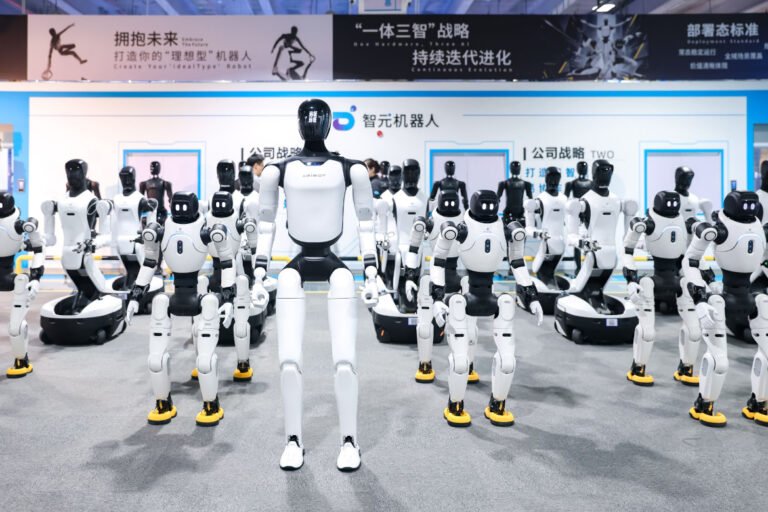
Unitree’s CEO says humanoid robots have reached the capability of a 10-year-old child but large-scale deployment remains three to five years away due to technical and manufacturing challenges.
Ottonomy has introduced Ottumn.AI, a cloud-based orchestration platform designed to coordinate robots, drones, and smart infrastructure across logistics, healthcare, and industrial environments.
NVIDIA has unveiled Cosmos Policy, a unified AI model for robot control and planning built on its world foundation models, improving manipulation performance and real-world task execution.
An Indian university was asked to vacate its booth at the India AI Impact Summit after presenting a Chinese-made Unitree robot dog as its own, raising questions about credibility and global competition in robotics.