Tennis Playing Humanoid Robot Learns from Imperfect Data and Beats Its Creator

Researchers from Tsinghua University and Galbot have developed a humanoid robot that learned to play tennis using imperfect human motion data. Within days of deployment, the robot improved enough to outperform its human creator.

By Daniel Krauss | Edited by Kseniia Klichova Published: Updated:
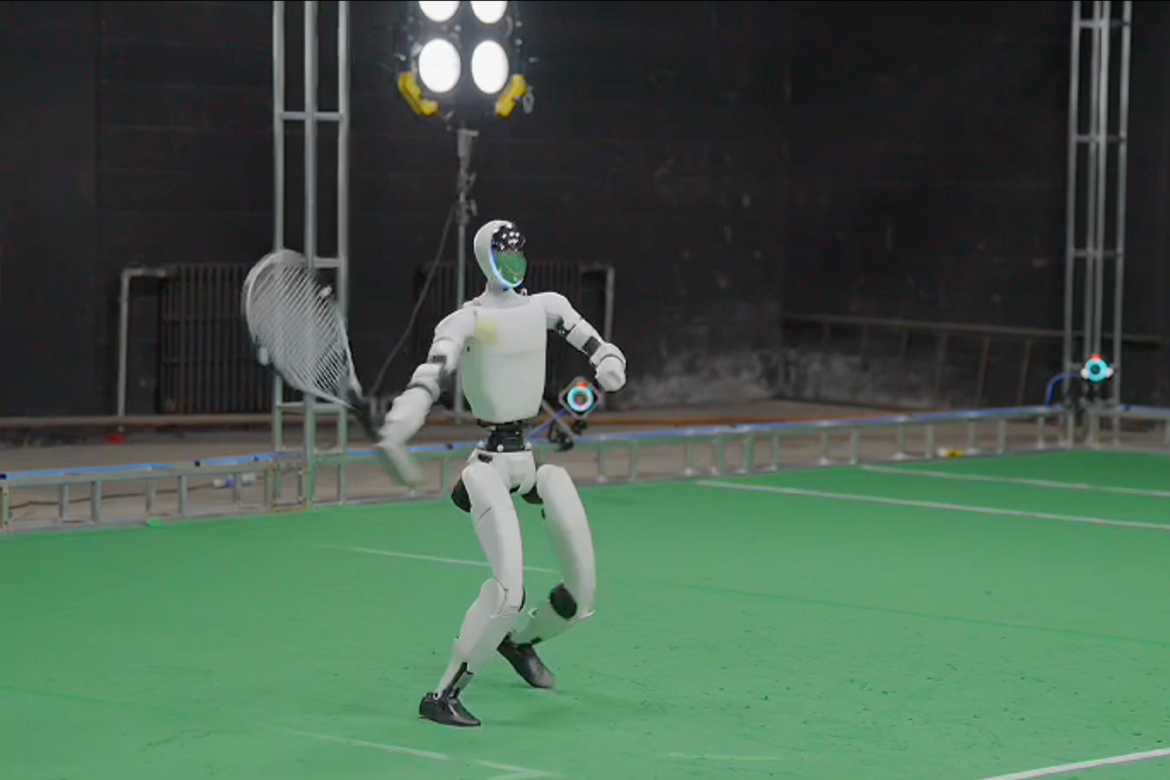
A Unitree G1 humanoid robot trained through the LATENT learning system returns a tennis ball during testing, demonstrating how robots can learn complex athletic motion from imperfect human data. Photo: Tsinghua University / Galbot

The ability to teach robots complex physical skills has long depended on carefully curated training data and highly controlled demonstrations. A new research project suggests that requirement may be loosening.

Researchers from Tsinghua University and robotics company Galbot have demonstrated a humanoid robot capable of learning tennis using imperfect human motion clips rather than idealized training data. The system, called LATENT, enabled a Unitree G1 humanoid robot to improve rapidly in real-world play – eventually defeating the researcher who trained it.

The project highlights a growing shift in robotics toward learning systems that can extract usable behaviors from messy, incomplete demonstrations. Instead of relying on precise instruction, the robot learns how to combine imperfect examples into effective motion strategies.

According to project lead Zhikai Zhang, the robot’s progress was strikingly fast. On its first day of real-world deployment it failed to return a single serve. By the final day of testing, Zhang reported that he could no longer beat the robot in rallies.

Teaching Robots with Imperfect Demonstrations

Traditional robotic skill learning typically requires large datasets of clean, carefully labeled demonstrations. Capturing these datasets can be expensive and time consuming, particularly for tasks involving dynamic whole-body motion such as sports.

The LATENT system approaches the problem differently. Instead of relying on perfect motion capture data, the system trains on fragmented human tennis clips that include errors, inconsistencies, and incomplete movements.

From these clips, the model constructs what the researchers call a latent action space – a structured representation of primitive movements extracted from imperfect examples. A higher-level AI policy then functions as a coordinating controller, selecting and refining those primitive actions to produce effective gameplay behavior.

The training process occurs first in simulation, where the robot practices thousands of interactions without risk. Once the controller stabilizes, the policy is transferred to a physical robot using sim-to-real techniques, allowing the learned behaviors to operate on the Unitree G1 humanoid platform.

This approach allows the robot to learn usable skills even when the input demonstrations are flawed, something that more traditional robotics pipelines struggle to accommodate.

Why Messy Data May Be the Future of Robot Training

While a tennis-playing robot may appear like a demonstration project, the underlying method addresses a broader challenge in robotics: scaling physical skill acquisition.

Most robots today still depend on highly structured environments and carefully engineered training pipelines. In real-world settings such as warehouses, construction sites, or disaster response zones, collecting perfect demonstrations is rarely practical.

Learning from imperfect data could significantly lower the barrier to training robots for complex tasks. Instead of requiring a flawless example every time, robots could observe ordinary human activity and gradually assemble functional behaviors.

This shift mirrors trends already underway in large-scale AI systems, where models increasingly learn from vast amounts of noisy real-world data rather than tightly curated datasets.

For robotics, the implications are particularly significant because physical tasks often involve unpredictable conditions, subtle motor control, and continuous feedback from the environment. Systems that can tolerate imperfect training signals may adapt more quickly to these realities.

A Testbed for Embodied AI

Sports have become a useful proving ground for embodied AI research because they combine perception, motion planning, balance control, and fast decision making.

Tennis, in particular, requires precise timing, whole-body coordination, and real-time reaction to an unpredictable opponent. Successfully sustaining rallies demonstrates that a robot can integrate visual perception with dynamic locomotion and arm control.

In this case, the tennis court served as a compact test environment for evaluating how well the LATENT system could convert imperfect demonstrations into coordinated action.

The research team has made the project details and code publicly available, allowing other researchers to replicate and extend the approach.

If the underlying method proves scalable, it could influence how robots are trained for tasks far beyond sports – from industrial manipulation to collaborative human-robot work. Instead of waiting for perfect datasets, robots may increasingly learn from the same imperfect movements humans produce every day.

News, Robots & Robotics, Science & Tech

Nvidia and Doosan Robotics to Develop AI-Powered Industrial Robot Platform

Nvidia and Doosan Robotics have announced plans to connect Doosan’s agentic robot operating system with Nvidia’s simulation and training infrastructure, targeting an intelligent robot solution launch in 2027 and an industrial humanoid by 2028.

By Daniel Krauss | Edited by Kseniia Klichova Published:
A collaborative robotic arm operating in an industrial setting, integrated with AI-powered control and simulation software for autonomous task execution. Photo: Doosan Robotics

Nvidia and Doosan Robotics have agreed to collaborate on physical AI for industrial robots, connecting Doosan’s agentic robot operating system with Nvidia’s AI simulation and training infrastructure. The announcement followed a visit by Madison Huang, Senior Director of Omniverse and Robotics Product Marketing at Nvidia and the eldest daughter of CEO Jensen Huang, to Doosan Robotics’ Innovation Center in Bundang-gu, Seongnam, South Korea, on Wednesday.

Huang met with Doosan Robotics CEO Kim Min-pyo to discuss the technical cooperation framework and outline a product roadmap built around the combined platform.

What the Partnership Will Build

The two companies plan to integrate Doosan’s agentic robot operating system – currently in development – with Nvidia’s Isaac simulation, reinforcement learning, and edge compute infrastructure to create a robot execution platform for industrial applications. The focus is on reliability in the field: the ability of a robot to carry out complex, adaptive tasks without errors in unstructured manufacturing environments.

Doosan Robotics plans to unveil an intelligent robot solution based on the agentic OS in 2027 and release an industrial humanoid by 2028. The companies intend to present the results of the collaboration at major global exhibitions including CES next year.

“The success of physical AI depends not only on the intelligence of AI models but also on the stability of the execution platform that drives them without errors in the field,” said Kim. “We will combine Doosan’s hardware manufacturing capabilities with Nvidia’s software ecosystem to commercialize intelligent robot solutions and industrial humanoids.”

A Pattern of Korean Outreach

The Doosan visit was part of a broader tour of South Korean technology companies by Huang, who also met with LG Electronics, Hyundai, Samsung Electronics, and SK Hynix in the same period. The visits reflect Nvidia’s active effort to build physical AI partnerships across South Korea’s industrial and semiconductor ecosystem – a market that combines advanced manufacturing capability, significant robotics investment, and chip production infrastructure relevant to edge AI deployment.

Doosan Robotics, listed on the Korea Exchange, is one of South Korea’s leading collaborative robot manufacturers, with a product line focused on industrial arms used in manufacturing and logistics. The agentic OS under development represents the company’s push to add AI-driven autonomy and decision-making capability to its existing hardware portfolio, moving from programmable cobots toward systems capable of adapting to task variation without explicit reprogramming.

Artificial Intelligence (AI), Business & Markets, News, Robots & Robotics

MagicLab Robotics Unveils MagicBot X1 and World Model at Silicon Valley Summit, Targets $14 Billion Revenue by 2036

MagicLab Robotics held its Global Embodied Intelligence Summit in Silicon Valley, unveiling the MagicBot X1 humanoid, the Magic-Mix world model, and a $1 billion developer ecosystem investment, as the company projects $14 billion in annual revenue by 2036.

By Rachel Whitman | Edited by Kseniia Klichova Published: Updated:
A full-sized humanoid robot demonstrated at a Silicon Valley robotics and embodied AI product summit alongside dexterous hand hardware and AI model infrastructure. Photo: MagicLab Robotics

MagicLab Robotics held its Global Embodied Intelligence Summit in Silicon Valley this week, unveiling a next-generation product portfolio and outlining a long-term commercial trajectory that targets $14 billion in annual revenue by 2036. The company presented MagicBot X1, its flagship humanoid robot; Magic-Mix, a foundational world model for embodied AI; and the H01 dexterous hand, designed for precise manipulation across service and industrial environments.

The summit served as MagicLab’s most significant public positioning event to date, combining product launches with a series of strategic partnership announcements and a major developer ecosystem commitment.

Product Portfolio

MagicLab describes itself as a full-stack embodied AI company, developing hardware and software in-house across humanoid robots, quadruped platforms, and the underlying AI models that power them. The MagicBot X1 is the company’s general-purpose humanoid, designed for deployment across manufacturing, commercial services, and home environments. The H01 dexterous hand is a standalone component targeting precision manipulation use cases. Magic-Mix is the foundational world model that underpins the company’s approach to robot intelligence – enabling systems to understand and interact with real-world environments across variable conditions.

The product ecosystem is organized around nine deployment scenarios: healthcare services, industrial manufacturing, inspection and security, smart guidance, public safety, smart logistics, events and entertainment, scientific research and education, and home living.

Developer Ecosystem and Silicon Valley Partnerships

MagicLab announced a $1 billion investment over five years to build a dedicated developer ecosystem for robotics, enabling third-party development on its platform and supporting a global network of partners. Under its Co-Create 1000 Initiative, the company has entered strategic collaborations with four Silicon Valley-based AI companies – Openmind, PrismaX AI, Cosmicbrain AI, and Physis – as initial ecosystem partners.

The initiative reflects a platform strategy: rather than building every vertical application internally, MagicLab is positioning its hardware and world model as a foundation that third-party developers can build on, extending its reach across industries and use cases faster than an integrated approach would allow.

Global Footprint and Revenue Trajectory

International markets accounted for 60% of MagicLab’s total sales in 2025, with operations spanning more than 50 countries and regions. The company did not disclose absolute revenue figures, making the $14 billion 2036 projection difficult to evaluate against current scale. The trajectory implies either a very large current revenue base or an expectation of extraordinary compound growth – or both – over a ten-year period.

The Silicon Valley location for the summit is itself a strategic signal. With Chinese humanoid manufacturers increasingly present in international markets, hosting a major product event in the center of the U.S. technology industry communicates a direct ambition to compete for enterprise customers, developer talent, and strategic partnerships on a global basis rather than from a China-first starting point.

News, Robots & Robotics, Science & Tech

Beeple Installs Robot Dogs with Musk and Zuckerberg Heads at Berlin’s Neue Nationalgalerie

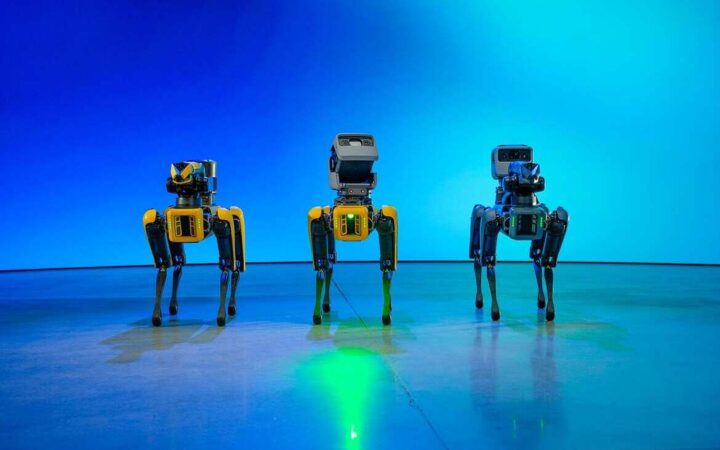
American digital artist Beeple has installed a group of robot dogs fitted with hyper-realistic silicone heads modeled after Elon Musk, Mark Zuckerberg, Jeff Bezos, Andy Warhol, and Pablo Picasso at Berlin’s Neue Nationalgalerie, where they roam freely and print AI-transformed images of their surroundings.

By Laura Bennett | Edited by Kseniia Klichova Published: Updated:

American digital artist Beeple, whose legal name is Mike Winkelmann, has opened an interactive installation at Berlin’s Neue Nationalgalerie featuring robot dogs fitted with hyper-realistic silicone heads modeled after some of the most recognizable figures in technology and cultural history. The dogs roam freely through the museum, carrying the likenesses of Elon Musk, Mark Zuckerberg, Jeff Bezos, Andy Warhol, and Pablo Picasso – as well as a head modeled after Beeple himself.

The work, entitled “Regular Animals”, was first shown at Art Basel Miami Beach in 2025 and is now on extended display in Berlin.

How the Installation Works

Each robot dog is equipped with integrated cameras that continuously capture images of its surroundings as it moves through the gallery. Those images are processed by AI and periodically printed – with the output filtered through the personality or aesthetic worldview of the figure each dog represents. The Picasso dog produces images in Cubist style. The Warhol dog outputs in pop art. The technology billionaire dogs reinterpret their surroundings through AI models conditioned on each figure’s public identity and worldview.

The printing mechanism is deliberately unglamorous: the dogs occasionally stop and produce the images in a manner the artist and press have described as defecating. The choice of delivery method is part of the work’s visual language.

The Commentary Behind the Hardware

Beeple has been direct about the installation’s intent. “In the past, our view of the world was shaped in part by how artists saw the world,” he told the Associated Press. “How Picasso painted changed how we saw the world, how Warhol talked about consumerism, pop culture, that changed how he saw those things.”

The figures who shape perception now, he argues, are not artists but technology executives controlling algorithmic platforms that determine what billions of people see and do not see. “That’s an immense amount of power that I don’t think we’ve fully understood, especially because when they want to make a change, they don’t need to lobby the U.N. They don’t need to get something through Congress or the EU – they just wake up and change these algorithms.”

By placing those figures’ faces on quadruped robots – hardware associated with surveillance, industrial automation, and military research – the installation draws a connection between algorithmic power and physical AI systems that is rarely made this explicitly in a public cultural setting.

Lisa Botti, the exhibition’s curator, said artificial intelligence is among the phenomena most significantly affecting daily life and that museums are the appropriate spaces for society to examine such shifts. Beeple, according to Christie’s, is the third most expensive living artist to sell at auction, after David Hockney and Jeff Koons.

Artificial Intelligence (AI), News, Robots & Robotics

LG Electronics and Nvidia in Talks on Robotics, AI Data Centers, and Mobility

LG Electronics has confirmed it is in discussions with Nvidia on potential cooperation spanning robotics, AI data center infrastructure, and mobility technologies, as both companies deepen their positions in physical AI.

By Daniel Krauss | Edited by Kseniia Klichova Published:
At CES 2026, LG introduced AI-powered living spaces spanning from homes to vehicles. Photo: LG Electronics

LG Electronics has confirmed it is in discussions with Nvidia on potential cooperation across three areas: robotics development, AI data center infrastructure, and future mobility applications. No formal agreement has been announced. The talks follow a visit by Madison Huang, a senior Nvidia executive focused on physical AI platforms, to LG Electronics and other major South Korean companies.

The confirmation positions LG as an active participant in the physical AI ecosystem at a moment when global hardware manufacturers are moving to align with leading AI platform providers across industrial, data infrastructure, and autonomous systems markets.

What Is Being Discussed

The three areas under discussion reflect distinct but converging priorities. In robotics, LG has been building out a service and commercial robotics business through its subsidiary LG Electronics Business Solutions, with cleaning, delivery, and guide robots already deployed in hotels, hospitals, and commercial buildings. A partnership with Nvidia’s physical AI stack – which includes Isaac simulation, Jetson edge compute modules, and Omniverse digital twin infrastructure – would give LG access to the training and deployment tools that are becoming standard across the humanoid and service robotics sector.

On data centers, Nvidia’s accelerated computing infrastructure is the dominant platform for AI model training and inference at scale. LG’s interest in AI data center cooperation reflects a broader shift among large electronics manufacturers toward providing AI-optimized infrastructure solutions to enterprise customers, rather than competing purely on consumer devices.

The mobility component aligns with LG’s existing investments in vehicle components and smart home-to-vehicle connectivity systems, areas where Nvidia’s DRIVE platform for autonomous vehicle computing has established significant market presence.

Strategic Context

The discussions gained public attention through the reported visit of Madison Huang to South Korean companies, a trip that signals Nvidia’s active effort to deepen physical AI partnerships in a country with significant electronics manufacturing capability and a growing robotics industry. South Korea’s government has identified robotics and AI as national strategic priorities, and companies including Samsung, Hyundai, and LG are all expanding their positions in the sector.

LG and Nvidia have not disclosed a timeline for reaching a formal agreement, the financial terms under discussion, or which specific product or platform areas any agreement would initially cover. The talks remain at an exploratory stage, though the combination of LG’s manufacturing scale and Nvidia’s AI infrastructure position would, if formalized, add a significant hardware partner to Nvidia’s physical AI ecosystem.

Kinetix AI Unveils KAI Humanoid with 115 Degrees of Freedom and 18,000-Sensor Tactile Skin

Shenzhen-based Kinetix AI has unveiled KAI, a full-sized humanoid robot with 115 degrees of freedom, a 36-DoF dexterous hand, and a full-body tactile skin system with 18,000 sensors, targeting service and home assistance applications at a sub-$40,000 price point.

By Rachel Whitman | Edited by Kseniia Klichova Published:

Shenzhen-based startup Kinetix AI held its GIFTED press conference on April 26 to unveil KAI, a full-sized humanoid robot designed for service and home assistance applications. The company, also operating as Kai Robotics, was founded by veterans of the original R&D team behind the XPENG Iron humanoid. KAI is targeting a sub-$40,000 price point and mass production in late 2026.

The platform’s specifications are ambitious across hardware, sensing, and AI architecture – though the gap between laboratory demonstration and reliable real-world deployment remains the central challenge the company will need to close before commercial scale is achievable.

115 Degrees of Freedom

The most distinctive technical claim is KAI’s 115 degrees of freedom across the full body – a figure substantially higher than the 20 to 45 DoF typical of most contemporary humanoid platforms. The articulation range includes shoulder movement, torso flexion to 75 degrees, and neck rotation across a 65-degree range, giving the robot a range of motion intended to closely approximate human flexibility.

The hands are the most mechanically complex element. Each features 36 DoF – 22 active and 14 passive joints. The passive joints act as mechanical buffers, allowing the hand to conform to objects and absorb impact forces without requiring immediate computational response. The company describes this as a safety feature for domestic use, where contact with objects and people is frequent and unpredictable.

Tactile Sensing and Battery Safety

KAI is covered in a synthetic tactile skin containing 18,000 sensing points capable of detecting forces as light as 0.1 newtons. The system enables what Kinetix AI calls haptic-aware manipulation – the ability to modulate grip force and contact behavior based on real-time pressure feedback across the robot’s surface.

Power is supplied by a 1.7 kWh semi-solid-state battery, a chemistry choice that reduces thermal runaway risk compared to conventional lithium-ion packs. The selection mirrors a broader trend among Chinese humanoid manufacturers, including XPENG Robotics, toward safer battery architectures for robots operating in proximity to people.

Data Strategy and AI Architecture

KAI’s intelligence layer is built around what Kinetix AI calls the KAI World Model, a closed-loop architecture comprising Base, Action, and Evaluation modules. The system is designed to predict environmental changes and assess the safety of candidate movement trajectories before executing them – a simulation-before-action approach that parallels techniques used across physical AI development more broadly.

To address the data scarcity problem that constrains most humanoid AI training, Kinetix AI developed the KAI Halo, a lightweight head-mounted device worn by human operators during normal daily routines. The device captures first-person video, body pose, and environmental point cloud data, generating training data from natural human behavior rather than structured motion-capture sessions. The company argues that this approach produces a more diverse and naturalistic dataset than traditional capture methods.

Market Positioning and the Reliability Question

KAI is positioned as a general-purpose helper for retail, concierge, and home assistance roles rather than heavy industrial applications. The sub-$40,000 target price is designed to be competitive within a segment where most platforms remain either significantly more expensive or more narrowly capable.

The architecture’s complexity – 115 DoF, 18,000 sensors, semi-solid-state batteries – introduces significant engineering challenges in maintaining system reliability outside laboratory conditions. XPENG’s own robotics leadership has publicly identified hardware reliability, including signal disconnection and mechanical failure rates, as a primary bottleneck for the industry. Whether KAI’s high-DoF design can sustain stable performance in the unstructured environments it targets will determine whether the platform reaches commercial deployment on its stated timeline.

News, Robots & Robotics, Startups & Venture
Exit mobile version