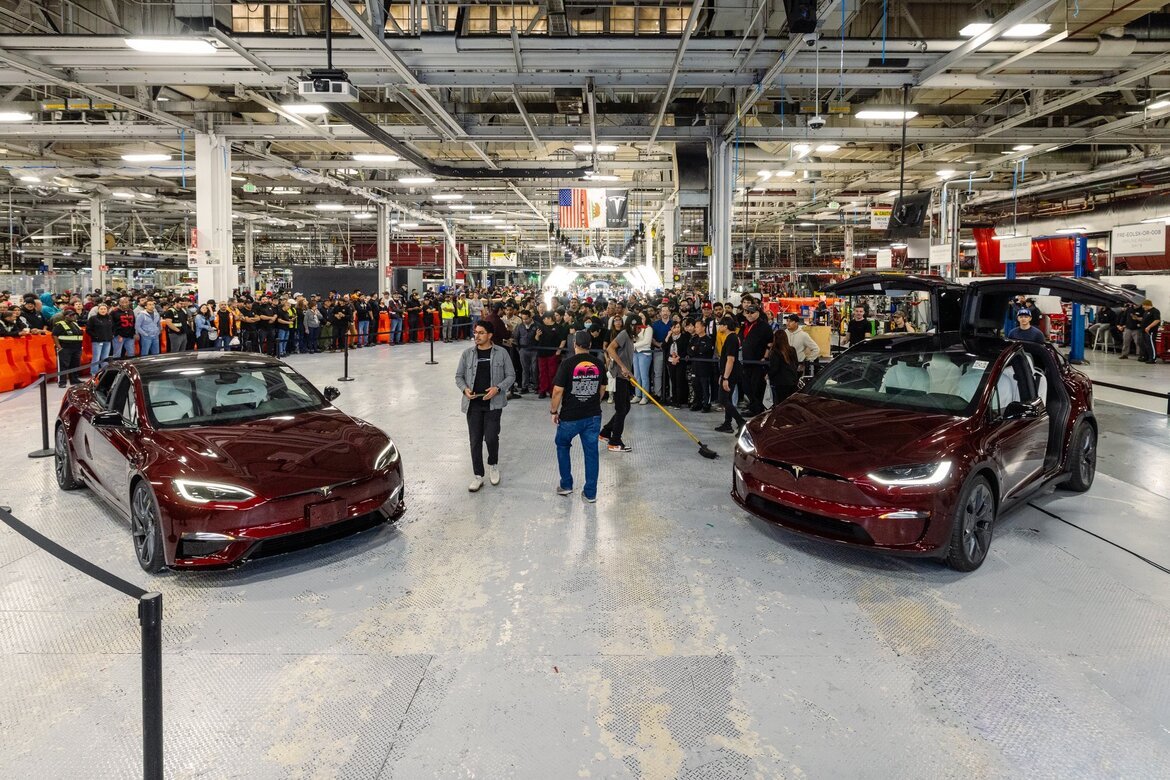

Tesla built its last Model S sedan and last Model X SUV at its Fremont, California factory on Saturday, May 9, ending a production run that spanned 14 years for the sedan and 11 for the SUV. The company announced the milestone on X, posting photos of the final vehicles surrounded by the workers who built them. The Fremont assembly space that produced both cars will now be converted to manufacture the Optimus humanoid robot.
CEO Elon Musk announced the wind-down on Tesla’s Q4 2025 earnings call in January, describing it as an “honorable discharge” for the two flagships and confirming the conversion to robot production with a target of one million Optimus units per year.
Why the Line Was Available
The commercial rationale for the shutdown is straightforward. Combined annual deliveries of the Model S and Model X fell to fewer than 19,000 units in 2025, leaving a line with roughly 100,000-unit annual capacity running at under 20% utilization. The two cars accounted for approximately 1% of Tesla’s total deliveries last year. Volume has long since shifted entirely to the Model 3 and Model Y.
Tesla closed custom orders for both models at the end of March 2026 and ended regular production in early April. A final invitation-only Signature Edition run of 350 cars – 250 Model S Plaid sedans and 100 Model X Plaid SUVs – is being produced for long-time customers, with a delivery ceremony scheduled for May 12 at the Fremont factory.
The Optimus Bet
Converting a 100,000-unit automotive line to humanoid robot production is among the most consequential manufacturing pivots in Tesla’s history. Musk’s stated target of one million Optimus units per year would, if achieved, represent a production scale no humanoid robot manufacturer has approached. The closest comparable figure in the current industry is Boston Dynamics’ stated capacity of 30,000 Atlas units annually from its new facility – itself a figure that has not yet been demonstrated in practice.
The practical challenges are significant. Tesla is currently producing Optimus at low volume as it works through manufacturing ramp-up on a new dedicated production line – separate from the Fremont conversion, which was previously used for Model S and X and is now being reconfigured. Supply chain complications including Chinese rare earth magnet export restrictions, in place since April 2025, affect the compact electric motors used at every robot joint.
Musk has set a July-August window for the Optimus V3 unveil, timed closer to production than previous demonstrations to limit competitor observation. The Q3 2026 production ramp will be the first real test of whether the Fremont conversion can produce robots at meaningful volume.
A Hinge Moment for Tesla’s Industrial Strategy
The end of Model S and Model X production closes the chapter in which Tesla established itself as an automaker. The Model S, launched in 2012 at around $60,000 with 265 miles of EPA range, is widely credited with demonstrating that electric vehicles could be desirable performance cars rather than compromise products. Its commercial legacy funded the infrastructure that made the Model 3 and Model Y possible.
What replaces it on the Fremont floor is a product with no commercial track record at scale, in a market that does not yet exist in the form Tesla’s valuation assumes. The Model S and Model X conversion is the clearest single expression of the strategic bet Tesla is asking shareholders to accept: that humanoid robotics revenue will eventually dwarf the automotive business, and that the transition costs are worth absorbing now.
Disclaimer: RobotsBeat is an independent media brand owned and operated by NuvexMedia LLC, publishing news, research, and insights on artificial intelligence, emerging technologies, automation, and related industries. NuvexMedia LLC invests in and collaborates with companies across the AI, Robotics, technology, software, and digital innovation sectors. These relationships do not influence RobotsBeat's editorial coverage, and the publication maintains full editorial independence to provide accurate, timely, and objective information. © 2026 NuvexMedia LLC. All rights reserved. This content is for informational purposes only and should not be considered legal, tax, investment, financial, or other professional advice.