
Researchers at the University of Basel have developed a modular nanorobot with a magnetic propulsion module and a detachable payload capsule that self-assemble autonomously through a DNA-based fastening system. The system, described in the journal Advanced Functional Materials, is designed to address a longstanding limitation of nanorobotics: most existing systems are built for a single, fixed application. The Basel team’s modular architecture allows the same propulsion hardware to be paired with different payload configurations depending on the task.
The research was led by Professor Cornelia Palivan and conducted within the National Center of Competence in Research for Molecular Systems Engineering and the Swiss Nanoscience Institute, in collaboration with Heidelberg University.
How the System Works
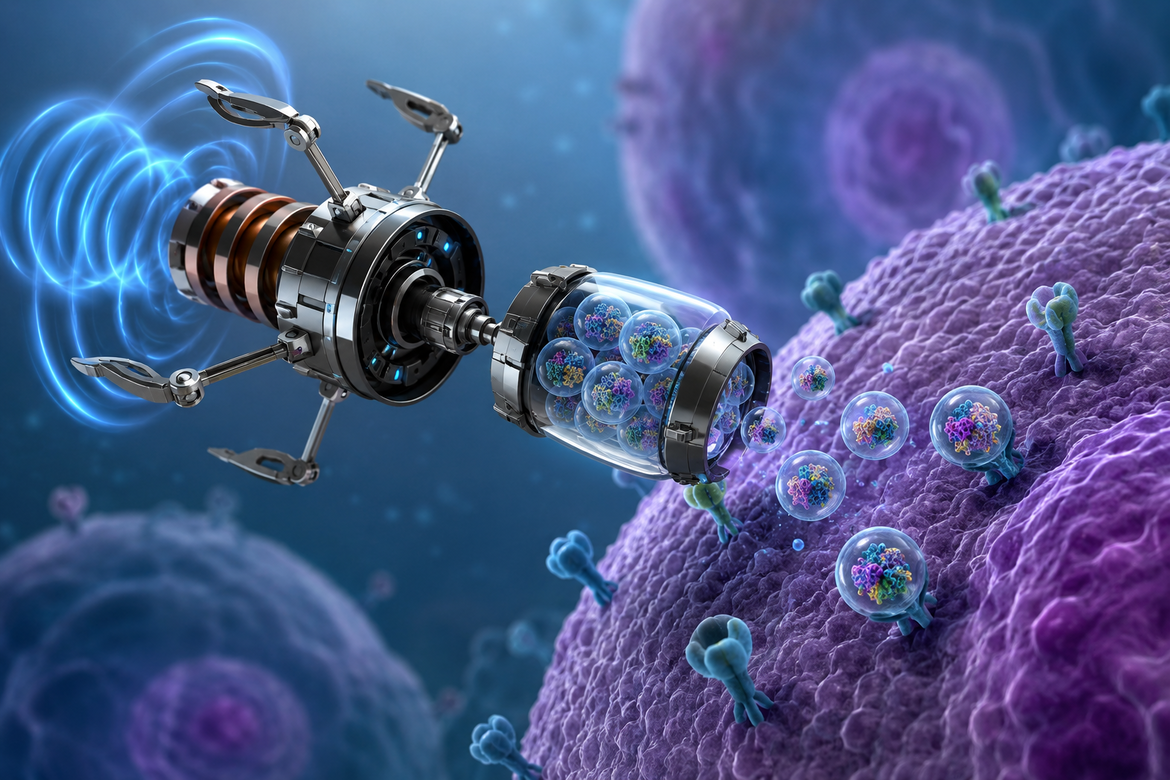
The nanorobot’s structure resembles a miniature rocket with separable stages. The magnetic propulsion module enables movement and allows the nanorobot to be guided externally and retrieved after use. The payload capsule contains four enzyme-loaded polymer vesicles – nanoscale structures developed in prior work by Palivan’s team. Molecules from the surrounding environment enter these vesicles through pores, are processed by the enclosed enzymes, and reaction products are released back into the environment. Depending on the design, the vesicles can also be selectively opened to release bioactive compounds directly.
The two modules are connected by complementary DNA strands on both surfaces – a molecular Velcro system that enables the propulsion module and payload capsule to self-assemble in a programmable manner and maintain a stable coupling during operation. To enable precise targeting, the payload capsule also carries additional biomolecules that facilitate docking onto specific cell types or materials.
Cancer Cell Results
In laboratory testing against HeLa human cancer cells, the team loaded nanorobots with fluorescent molecules and confirmed under microscopy that they accumulated on cell surfaces. When loaded with the necessary enzymes to produce an anticancer compound, the nanorobots reduced HeLa cell viability to 16% within 72 hours. “The drug can have a concentrated local effect if we use our nanorobot to specifically target it to the cancer cells,” said Dr. Voichita Mihali, first author of the study.
Reusability and Industrial Applications
The magnetic propulsion module enables a capability that is unusual in nanorobotics: retrieval and reuse after task completion. The research team demonstrated that the two modules can be separated, the payload capsule refilled with new enzymes or compounds, and then recombined with the propulsion module for subsequent deployment. This reusability is particularly relevant for industrial applications such as catalysis, where the nanorobot can be guided to a specific surface, perform enzymatic reactions, and then be recovered rather than consumed.
The modular architecture means the system can be adapted for different domains – medicine, environmental remediation, industrial catalysis – by modifying only the payload capsule while retaining the same propulsion infrastructure. Use in humans remains a long-term research goal, but the platform is described as ready for adaptation in non-medical contexts without requiring fundamental redesign.
Disclaimer: RobotsBeat is an independent media brand owned and operated by NuvexMedia LLC, publishing news, research, and insights on artificial intelligence, emerging technologies, automation, and related industries. NuvexMedia LLC invests in and collaborates with companies across the AI, Robotics, technology, software, and digital innovation sectors. These relationships do not influence RobotsBeat's editorial coverage, and the publication maintains full editorial independence to provide accurate, timely, and objective information. © 2026 NuvexMedia LLC. All rights reserved. This content is for informational purposes only and should not be considered legal, tax, investment, financial, or other professional advice.