
CES 2026: Boston Dynamics and Google Reunite to Power Next-Gen Atlas Humanoid

Boston Dynamics and Google have renewed their collaboration at CES 2026, combining advanced AI with the next generation of the Atlas humanoid robot.

By Kseniia Klichova Published: Updated:

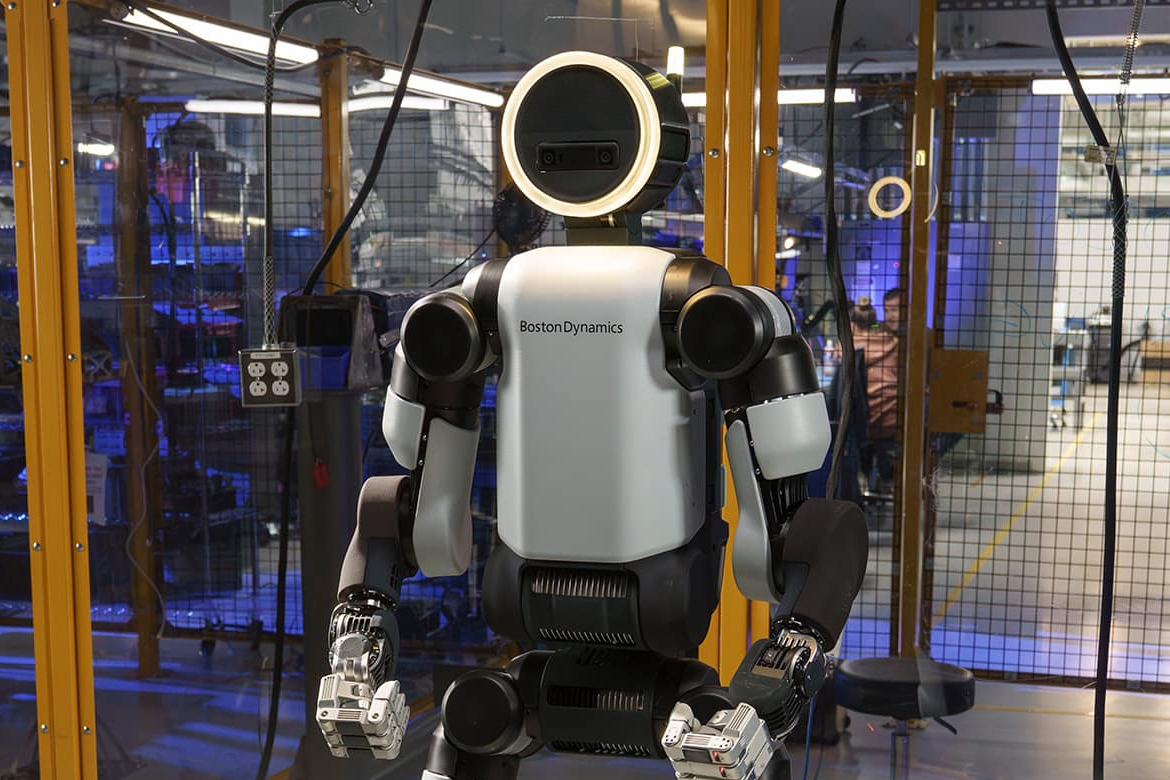
Boston Dynamics and Google have reunited to showcase a new phase in humanoid robotics, unveiling progress on the next-generation Atlas robot at CES 2026. The collaboration brings together Boston Dynamics’ expertise in dynamic robot hardware with Google’s latest advances in artificial intelligence, signaling a renewed push toward more capable, adaptable humanoid systems.

The updated Atlas platform reflects a shift away from purely mechanical demonstrations toward robots that can understand context, plan actions, and learn from experience. At CES, the companies highlighted how AI-driven perception and decision-making are being integrated directly into Atlas, moving the humanoid closer to real-world industrial and commercial applications.

A Humanoid Built for Industrial Tasks

The new Atlas stands approximately 6.2 feet tall and features a reach of about 7.5 feet, allowing it to operate effectively in warehouses, factories, and logistics facilities designed for human workers. Its fully electric architecture supports quieter operation and improved energy efficiency compared to earlier hydraulic designs.

Atlas is capable of lifting payloads of up to roughly 110 pounds, enabling it to handle heavy objects such as totes, containers, and industrial components. The robot incorporates fully rotational joints across its body and offers a total of 56 degrees of freedom, supporting complex, whole-body movements and precise manipulation.

A newly designed four-fingered hand improves dexterity and grasp versatility, allowing Atlas to interact with a wide range of objects. The system is sealed to an industrial IP67 standard, providing protection against dust and water and making it suitable for harsh operating environments.

Power, Autonomy, and Control

Battery life for the new Atlas is rated at approximately four hours under typical operation. The robot is designed to swap its own battery packs without human assistance, reducing downtime and enabling longer deployment cycles in industrial settings.

Boston Dynamics highlighted multiple modes of operation for Atlas. The robot can function fully autonomously using AI-driven perception and planning, be remotely operated through a virtual reality interface, or be supervised and controlled using a tablet-based system. This flexibility allows customers to choose different levels of autonomy depending on task complexity and operational requirements.

By integrating Google’s AI technologies, Atlas gains enhanced perception, object recognition, and decision-making capabilities. The robot can interpret complex environments, adjust its actions in real time, and learn from repeated interactions rather than relying solely on predefined scripts.

Renewed Partnership and Market Implications

The collaboration marks a symbolic reunion between Boston Dynamics and Google, which previously worked together during Google’s ownership of the robotics firm more than a decade ago. This time, the focus is firmly on combining mature hardware with scalable AI systems that can support sustained commercial deployment.

Boston Dynamics positioned Atlas as a platform designed to operate within existing human-built environments without requiring major infrastructure changes. The goal is to reduce friction between robots and real-world workplaces, accelerating adoption in logistics, manufacturing, and material handling.

While the companies did not announce deployment timelines or customers at CES, the presentation signaled confidence that humanoid robots are moving closer to practical use. Challenges remain around cost, long-term durability, and large-scale fleet management, but the updated Atlas reflects a clear shift toward production readiness.

The CES 2026 debut suggests that Boston Dynamics and Google see humanoid robots as a cornerstone technology for the next generation of automation. By combining advanced mechanics with AI-driven autonomy, the partners aim to move Atlas beyond spectacle and into everyday industrial operations.

Artificial Intelligence (AI), Business & Markets, News, Robots & Robotics

Unitree and EngineAI Robots Square Off in First Public Inter-Brand Robot Fight in San Francisco

A video of a Unitree humanoid and an EngineAI robot trading punches and kicks in a San Francisco Bay Area storefront has gone viral, billed by organizers as the first public fight between robots from two different manufacturers.

By Rachel Whitman | Edited by Kseniia Klichova Published:
Two bipedal humanoid robots squaring off in a makeshift ring at a San Francisco storefront, with a human referee officiating and a crowd watching the match. Photo: CIX / Twitter

A video of two humanoid robots trading punches and kicks in a Bay Area storefront has gone viral across social media platforms, billed by organizers as the first public fight between a Unitree robot and an EngineAI model. The footage, shared on X by virtual-reality innovator Cix Liv, shows two bipedal robots in a makeshift ring with a human referee, while a small crowd cheers as the machines punch, dodge, and circle each other.

The caption described it as “the first fight ever between an Engine and a Unitree robot at our new store space in SF”. The video accumulated thousands of views and likes across platforms, with viewer reaction ranging from amazement to practical frustration – one commenter noting they would prefer robots that could load a dishwasher over ones that can fight.

The Two Platforms

Unitree’s G1 humanoid, priced at approximately $16,000, has become one of the more commercially accessible full-size humanoid platforms available. The company drew global attention after its robot won the world’s first robot combat competition last year, and the G1 is now being deployed across contexts ranging from Haneda Airport’s baggage handling trial to Seoul’s Jogyesa Temple ordination ceremony. Unitree also showed its H2 humanoid at CES 2026.

EngineAI’s T800, which debuted at CES 2026, stands 1.73 meters tall and weighs 75 kilograms. The company has positioned it around stability and durability, with a starting price of $25,000 and first shipments scheduled for mid-2026.

What the Fight Actually Shows

Several commenters noted that the robots in the video appear to be remotely controlled rather than fighting autonomously – a distinction that matters for assessing what the footage demonstrates about AI capability versus hardware performance. Remote-controlled robot combat has existed for decades in formats like BattleBots. What is new here is the use of full-size bipedal humanoid platforms in an unstructured public environment, with human-scale proportions and movement.

The viral reach of the clip reflects both genuine public fascination with humanoid robot capability and the role of social media in amplifying robot demonstrations that would previously have been confined to trade show floors and research facilities. Whether robot combat develops into a structured commercial format – as Unitree’s earlier competition win suggests it might – or remains a demonstration category will depend on whether organizers can build repeatable event infrastructure around it.

For both companies, the attention generated by a single informal storefront fight represents free market validation that the hardware is visually compelling enough to capture mass audiences without a formal launch event.

News, Robots & Robotics

Unitree Unveils GD01 Manned Mecha at $650,000, Claims World’s First Production-Ready Model

Unitree Robotics has unveiled the GD01, a manned mecha the company describes as the world’s first production-ready civilian mecha vehicle, weighing approximately 500 kilograms including the driver and starting at 3.9 million yuan ($650,000).

By Laura Bennett | Edited by Kseniia Klichova Published:

Unitree Robotics has unveiled the GD01, a manned mecha the company describes as the world’s first production-ready civilian mecha vehicle. The announcement was made on May 12 via a video release, with retail pricing starting at 3.9 million yuan, equivalent to approximately $650,000. The GD01 weighs approximately 500 kilograms including the driver.

Unitree describes the GD01 as a civilian vehicle capable of transformation – a piloted platform that extends the company’s product line well beyond the humanoid and quadruped robots it has become known for internationally.

A New Product Category

The GD01 represents a distinct category from Unitree’s existing lineup. The company’s G1 and H1 humanoid platforms are autonomous or semi-autonomous systems designed to operate without a human pilot. The B2 quadruped and Go2 robot dog are remote-controlled or programmed platforms. The GD01 places a human operator inside the machine itself, in a cockpit-style configuration that draws on the visual language of industrial exoskeletons and science fiction mecha – large piloted robotic suits – while positioning itself as a civilian product with a stated production-ready status.

The 500-kilogram total weight including the driver gives the GD01 a significant physical footprint relative to Unitree’s other platforms. Transformation capability, referenced in Unitree’s description of the vehicle, suggests the system can reconfigure between modes – though the specific transformation mechanism and operational configurations were not detailed in the initial announcement.

Commercial and Strategic Context

The $650,000 starting price positions the GD01 well above consumer robotics but within the range of specialized industrial equipment, military-adjacent hardware, and premium experiential vehicles. At that price point, the initial market is likely limited to well-capitalized institutional buyers, entertainment operators, research institutions, and high-net-worth individuals – categories where novelty and capability matter more than unit economics.

The announcement extends a pattern Unitree has established in 2026 of moving across multiple product categories simultaneously: the G1 humanoid deployed at Haneda Airport’s baggage handling trial, the UniStore robot app store launched last week, a Shanghai IPO filing targeting a $7 billion valuation, and now a manned mecha platform. The breadth of the product strategy signals an ambition to define Unitree as a platform company across the full spectrum of physical AI hardware rather than a single-category robotics manufacturer.

Unitree has not disclosed production volume targets, delivery timelines, or technical specifications beyond the weight and price for the GD01.

News, Robots & Robotics, Science & Tech

EU-Funded PROBOSCIS Project Develops Elephant Trunk-Inspired Soft Robot Gripper

Researchers at the Italian Institute of Technology have developed a soft robotic arm modeled on the elephant trunk’s muscular architecture, capable of handling fragile objects and heavy loads with the same system, using 3D-printed pneumatic actuators and integrated optical sensing.

By Daniel Krauss | Edited by Kseniia Klichova Published:
A soft robotic arm with pneumatic actuators performing a gentle grasping motion on an irregularly shaped object, mimicking the continuous structure and sensory feedback of an elephant trunk. Photo: Waldemar Brandt / Unsplash

Researchers at the Italian Institute of Technology in Genoa have developed a soft robotic arm that moves like an elephant’s trunk, capable of elongating, compressing, bending, pinching, scooping, and reaching – all using a single continuous structure with no hard joints or separate gripper. The prototype emerges from PROBOSCIS, a five-year EU-funded research initiative bringing together biologists, engineers, and materials scientists to decode the mechanics of elephant trunk movement and translate them into robotic hardware.

The project was initiated by Lucia Beccai, a soft robotics researcher at IIT, who identified the elephant trunk as the closest natural analog to what robotics has been missing: a single structure that can handle a grape and lift a heavy load with the same physical system.

Why the Trunk Is Difficult to Replicate

The elephant trunk is a muscular hydrostat – the same structural category as an octopus tentacle or a human tongue. It contains more than 100,000 individual muscles and no skeleton, allowing it to extend, contract, bend, and twist in any direction simultaneously. Critically, there is no distinction between arm and gripper: the entire trunk is one continuous structure capable of whole-body manipulation.

To study trunk mechanics, Professor Michel Milinkovitch at the University of Geneva led a team using motion-capture techniques borrowed from film production – placing reflective marker spots on elephant trunks and recording movement with high-speed cameras. The analysis revealed that elephants combine a small set of fundamental behaviors – shortening, elongating, and bending different sections – to achieve complex manipulation tasks. One particularly unexpected finding was that when reaching behind their heads, elephants create temporary pseudo-joints by stiffening sections of the trunk, effectively generating a shoulder and elbow structure on demand.

The Engineering Solution

Beccai’s team translated these biological findings into a 3D-printed soft robotic system. The prototype uses pneumatic actuators – balloon-like structures that extend and contract as they are inflated and deflated with air – combined with a mesh-like lattice structure that can deform in multiple directions. The entire device, including optical sensors that provide real-time feedback on touch and bending, is printed in a single continuous process from the same soft resin.

The single-material approach is central to the design’s performance. By eliminating the material and mechanical interfaces between components, the system achieves continuity of motion combined with integrated sensory feedback – a combination that conventional rigid-arm robotics with separate sensing systems cannot replicate.

The control architecture draws on Milinkovitch’s biological finding about muscle synergies. Rather than controlling each actuator individually, the system manages a small number of coordinated muscle group patterns, with the physical structure handling the mechanical complexity. This approach reduces computational demand and energy consumption, making battery-powered deployment outside laboratory conditions more viable.

Applications and Limitations

The research project wrapped up in April 2025, and the prototype remains a laboratory demonstrator. The team says it already addresses most of the design constraints limiting today’s robotic arms in unstructured environments. Potential applications identified by the researchers include soft fruit harvesting, domestic tasks such as sorting laundry and handling fragile dishes, environmental operations in fragile ecosystems, and search and rescue in rubble environments where a soft arm can navigate gaps and use touch sensing to locate people.

Beccai’s primary target is assistive robotics. “My dream is to build a system in healthcare that can help a disabled or elderly person by lifting them, but at the same time hand over a fork or a fresh piece of fruit,” she said. A robot strong enough for patient transfers yet gentle enough for daily object handling could meaningfully extend independent living for people with mobility limitations – and its softness, she argues, means it need not feel intimidating to be around.

News, Robots & Robotics, Science & Tech

UBTECH and Hitachi Partner to Deploy Walker S2 Humanoid Robots in Elevator and Smart Manufacturing

UBTECH Robotics and Hitachi China have signed a strategic cooperation agreement to deploy Walker S2 humanoid robots across Hitachi’s manufacturing operations, with elevator production already in active testing at Hitachi Elevator’s facility.

By Rachel Whitman | Edited by Kseniia Klichova Published:
A humanoid robot performing precision assembly tasks on an elevator manufacturing line, integrated into a smart manufacturing environment alongside existing production systems. Photo: UBTECH Robotics

UBTECH Robotics and Hitachi China have signed a strategic cooperation agreement to jointly develop and deploy humanoid robot applications across Hitachi’s manufacturing operations in China. The partnership focuses on sectors where Hitachi holds established market positions – elevators, building systems, healthcare, industrial equipment, and semiconductor manufacturing equipment – and is already in active deployment testing with UBTECH’s Walker S2 industrial humanoid.

The agreement moves beyond a memorandum of understanding stage. Both companies confirmed that cooperation has entered what they describe as the substantive verification stage, with Walker S2 units introduced into Hitachi manufacturing scenarios and on-site operation testing underway.

Elevator Manufacturing as the Initial Focus

The most developed application is at Hitachi Elevator’s manufacturing site, where Hitachi China Research Institute, UBTECH Robotics, and Hitachi Elevator are conducting secondary development of humanoid robot applications. The work targets full-process flexible intelligent flow and data integration across key elevator production processes – tasks that require the high precision and adaptability that fixed automation has historically struggled to deliver in low-volume, high-mix manufacturing environments.

Elevator manufacturing presents a relevant test case for humanoid deployment. The components are large, varied, and assembled in configurations that change between product types, creating the kind of flexible production demand that humanoid robots are specifically designed to address. Successfully automating key processes here would provide a replicable model for Hitachi’s other manufacturing segments.

The Broader Scope

The agreement covers the full range of Hitachi Group’s competitive markets in China. Healthcare and semiconductor manufacturing equipment represent the other near-term targets alongside elevators – both sectors where precision requirements are high, labor costs are rising, and production flexibility is commercially valuable.

UBTECH brings Walker S2 hardware and its software stack for industrial humanoid deployment. Hitachi brings system integration experience, existing manufacturing infrastructure, and a customer base across the sectors the partnership is targeting. The combination follows a pattern emerging across the humanoid industry: established industrial operators providing the deployment context and domain knowledge, while robotics companies provide the hardware and AI capability.

The partnership also extends UBTECH’s international footprint beyond its existing European presence through Terra Robotics in the DACH region, adding a major Japanese industrial partner with operations across Asia to its commercial network.

Business & Markets, News, Robots & Robotics

Unitree Launches UniStore, a Robot App Store for Its Humanoid and Quadruped Platforms

Unitree Robotics has launched UniStore, described as the world’s first humanoid robot application store, allowing users to browse, download, and install motion and task packages onto Unitree robots with a single tap from a smartphone app.

By Daniel Krauss | Edited by Kseniia Klichova Published:
A humanoid robot executing a downloaded motion skill in a consumer environment, with a smartphone app store interface used to browse and install new robot capabilities. Photo: Unitree

Unitree Robotics has officially launched UniStore, a task and motion application store for its robot lineup, enabling users to download and install new robot capabilities directly from a smartphone app. The platform covers Unitree’s G1 and H1 humanoid robots, the B2 quadruped, and the Go2 robot dog. The company describes it as the world’s first humanoid robot application store.

The launch introduces a consumer-facing software distribution model to humanoid robotics – one that mirrors the UX structure of smartphone app stores but applies it to physical robot behavior.

What UniStore Offers at Launch

UniStore opens with four core modules: User Square, a community and discovery layer; Motion Library, a catalog of downloadable execution actions; Dataset, a repository of robot interaction data; and Developer Center, a third-party publishing environment for developers building new motion and task packages.

The Motion Library launches with 24 available actions, currently offered on a limited-time free trial. These include Jackson-style dance moves, Charleston, jump-dancing, cheering sequences, Mantis Boxing, and a category the company describes as meme or “整活” actions – playful, culturally referential motion packages designed for entertainment and social sharing. Users install packages directly from the phone app with a single tap.

The Platform and Ecosystem Strategy

The Developer Center is the structurally significant component. By opening a publishing pathway for third-party developers, Unitree is building the infrastructure for an external ecosystem to grow around its hardware – a model that has proven durable in smartphones, gaming consoles, and enterprise software, but has not previously been applied to consumer and prosumer robotics at this scale.

The implication is a platform dynamic: as Unitree’s installed base of G1, H1, B2, and Go2 units grows, the addressable audience for third-party developers increases, which attracts more developers, which increases the platform’s value to hardware buyers. The Motion Library at launch is primarily entertainment-oriented, but the Developer Center is designed to support the full range of task and motion packages a developer might build – including functional applications for logistics, inspection, and service environments as the hardware deployment base matures.

The launch positions Unitree in contrast to proprietary robotics platforms where capabilities are controlled by the manufacturer. It also arrives as Unitree is preparing for a Shanghai IPO targeting a valuation of up to $7 billion, filed in March, making the ecosystem announcement a relevant signal to potential investors about the company’s platform ambitions beyond hardware sales.

Business & Markets, News, Robots & Robotics
Exit mobile version