China is developing an autonomous operation robot for the Chang’e-8 lunar mission, planned for around 2028, designed to work near the Moon’s south pole under conditions that would be lethal to human operators. The Hong Kong University of Science and Technology is leading an international effort to build the system, which will be responsible for instrument deployment and sample collection in the extreme thermal and radiation environment of the lunar surface.
The machine is not a conventional rover. It has a roughly 100-kilogram chassis with four wheels and a humanoid torso fitted with two arms for handling equipment – a configuration closer to an autonomous field technician than a mobile science platform. The robot is solar-powered and built to hibernate through lunar nights, periods of approximately two weeks in which temperatures plunge and sunlight disappears entirely.
Why the South Pole
China’s National Space Administration has designated the lunar south pole as the operational zone for Chang’e-8. The region has become a priority for multiple space agencies because permanently shadowed craters are cold enough to have preserved water ice over billions of years. That ice could eventually be converted into rocket propellant and drinking water on-site – resources that would dramatically reduce the cost and complexity of sustained lunar operations by replacing material that would otherwise need to be launched from Earth.
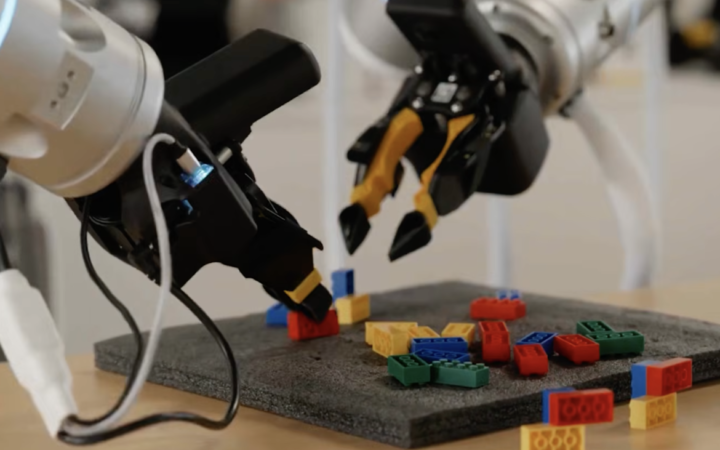
The operation robot’s dual-arm configuration is designed to handle the physical tasks required to establish infrastructure in this environment: deploying scientific instruments, collecting samples, and supporting the 3D printing experiments that China has linked directly to the mission. In 2023, China’s chief lunar programme planner said Chang’e-8 would test the use of lunar soil as 3D printing feedstock, reducing the volume of material that future missions need to transport from Earth.
From Engineering Demonstration to Commercial Platform
The Chang’e-8 mission structure includes a lander, a rover, and the operation robot working in coordinated deployment. CNSA’s cooperation framework opens payload slots to outside partners, creating a pathway for the operation robot to evolve from a government engineering demonstration into a platform that commercial entities could use for future lunar operations – a dynamic that mirrors how terrestrial robotics platforms have attracted third-party development through open ecosystem strategies.
Environmental and Legal Context
The ambition carries external costs that the mission planning does not fully resolve. Research published in Geophysical Research Letters found that high rocket launch volumes could warm parts of the stratosphere by up to 1.5 kelvin, while a 2025 study linked frequent launches to delayed ozone recovery. The Moon’s polar zones also carry planetary protection obligations under the Outer Space Treaty. With multiple agencies – including NASA’s Artemis program and various commercial operators – targeting the same south polar terrain, the legal frameworks governing territorial use and environmental protection will be tested alongside the hardware being developed to exploit the region.
Disclaimer: RobotsBeat is an independent media brand owned and operated by NuvexMedia LLC, publishing news, research, and insights on artificial intelligence, emerging technologies, automation, and related industries. NuvexMedia LLC invests in and collaborates with companies across the AI, Robotics, technology, software, and digital innovation sectors. These relationships do not influence RobotsBeat's editorial coverage, and the publication maintains full editorial independence to provide accurate, timely, and objective information. © 2026 NuvexMedia LLC. All rights reserved. This content is for informational purposes only and should not be considered legal, tax, investment, financial, or other professional advice.