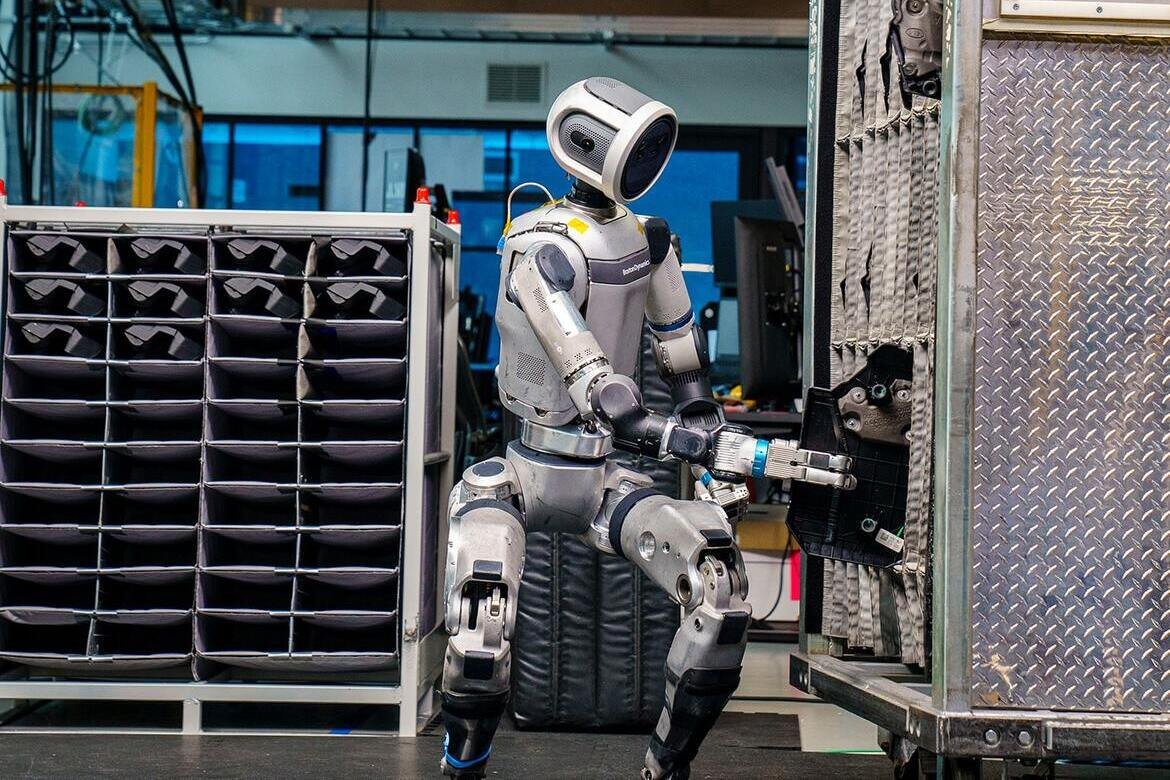
Hyundai Motor Group’s humanoid robot Atlas, developed by its robotics subsidiary Boston Dynamics, is expected to be priced at approximately $130,000 per unit, according to a new report from the Export-Import Bank of Korea. The projected price point places Atlas among the first humanoid robots approaching economic viability for industrial deployment.
The estimate reflects growing confidence that humanoid robots are transitioning from research prototypes into commercial systems capable of performing productive work in manufacturing environments.
From Research Platform to Industrial Asset
Atlas has long been known for its advanced mobility, including the ability to perform aerial maneuvers, recover balance on slippery surfaces, and execute complex full-body movements. These capabilities are enabled by reinforcement learning and whole-body control systems developed through extensive training and real-world testing.
While such demonstrations highlight engineering progress, Hyundai’s strategy is focused on industrial deployment. The company plans to introduce Atlas robots into its manufacturing operations, beginning with logistics and sequencing tasks before expanding to assembly functions.
The report suggests that Atlas could significantly improve factory productivity if deployed effectively. By automating repetitive and physically demanding tasks, humanoid robots could accelerate production workflows while reducing worker fatigue.
Analysts estimate that investment in humanoid robots could pay for itself within approximately two years under favorable deployment conditions, assuming sufficient utilization and productivity gains.
A Strategic Bet on Physical AI
Hyundai’s robotics ambitions reflect a broader transformation underway across the automotive industry. Automakers are increasingly investing in robotics and artificial intelligence as core components of future industrial strategy.
Hyundai acquired Boston Dynamics in 2021 for approximately $1.1 billion, a move widely seen as a long-term investment in robotics and automation capabilities. At the time, the acquisition faced skepticism due to Boston Dynamics’ history of high research costs and limited commercial revenue.
However, Atlas has since emerged as a central component of Hyundai’s future robotics roadmap. The company has announced plans to deploy Atlas robots at its manufacturing facilities, including its advanced production sites in the United States.
Hyundai’s strategy positions robotics as a key pillar of its transformation from a traditional automaker into a broader mobility and automation company.
Growing Competition in Humanoid Robotics
Atlas is entering a rapidly expanding humanoid robotics market, where companies including Tesla, Figure AI, and Agility Robotics are developing competing platforms.
Industry forecasts suggest the global humanoid robot market could grow dramatically over the coming decade, driven by demand for automation in manufacturing, logistics, and service sectors.
Boston Dynamics itself is emerging as a major strategic asset within Hyundai Motor Group. Analysts estimate that the robotics subsidiary could achieve a valuation exceeding $70 billion, reflecting expectations of large-scale commercialization.
The development of Atlas also highlights broader supply chain implications. Humanoid robots require complex integration of actuators, sensors, computing systems, and software, creating opportunities for component suppliers and robotics ecosystem partners.
Commercialization Challenges Ahead
Despite growing optimism, significant challenges remain. Humanoid robots must demonstrate consistent reliability in real-world industrial environments, where safety, predictability, and uptime are critical.
The report noted that additional data collection and operational validation will be necessary to ensure safe and effective collaboration between robots and human workers.
Legal and regulatory frameworks also remain under development. Questions surrounding liability, safety standards, and operational accountability will need to be addressed as humanoid robots become more widely deployed.
Even so, Atlas represents a major milestone in humanoid robotics commercialization. With a projected price point approaching industrial viability and deployment plans underway, the robot signals a broader shift in robotics development.
Humanoid robots are no longer purely experimental machines. They are increasingly becoming industrial tools designed to perform productive work, marking a turning point in the evolution of physical AI.