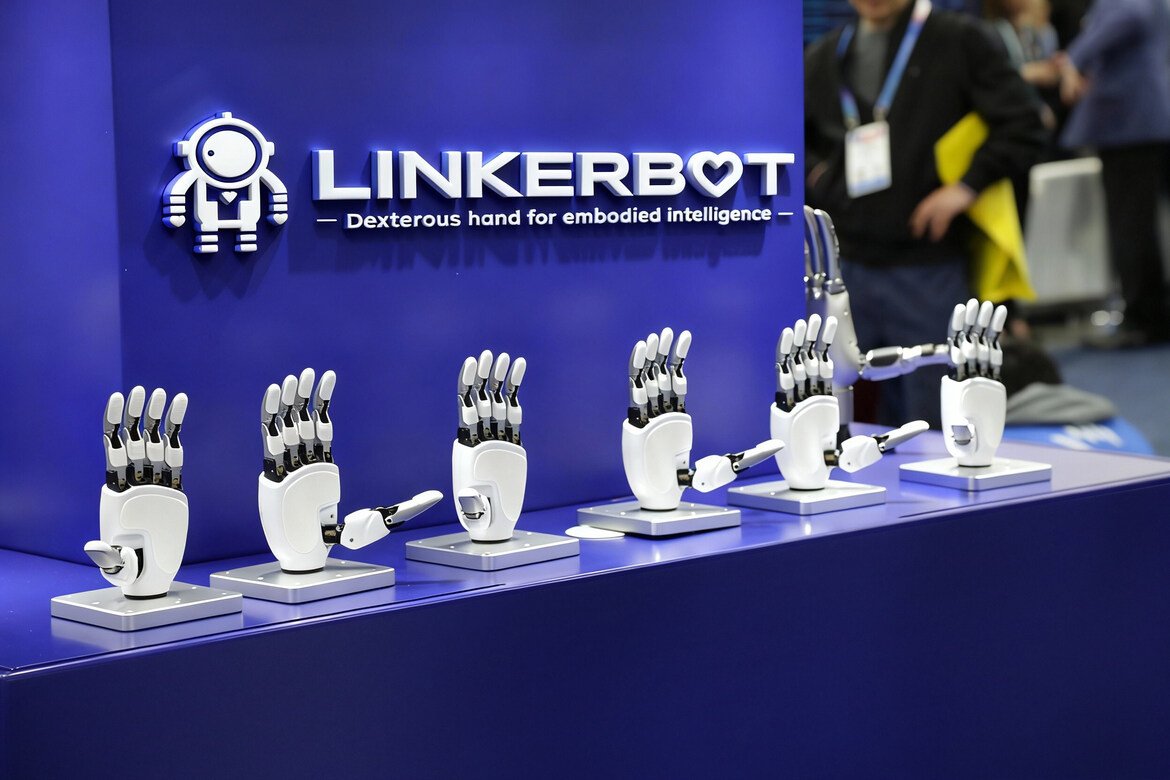

Linkerbot, a Beijing-based robotics startup specializing in dexterous robotic hands for humanoid platforms, is targeting a $6 billion valuation in its next financing round – double the $3 billion valuation established in a Series B+ round closed last week. The two-year-old company currently claims over 80% of the global market for high-degree-of-freedom robotic hands and is producing approximately 5,000 units per month, with plans to scale to 10,000 monthly units soon.
The latest funding round drew participation from state-backed Zhongguancun Science Park Fund, Bank of China Asset Management, and Fosun Capital, alongside existing backers Alibaba’s Ant Group and Sequoia spin-off HongShan Group. The company has not disclosed when the next round will launch or whether the $6 billion target is being pursued through private investment or an IPO.
Why Hands Are the Hard Problem
The robotic hand is widely regarded as the most mechanically and computationally demanding component in a humanoid robot. “The hand is the most complex part of the whole humanoid robot,” said Georg Stieler, head of robotics and automation at technology consultancy Stieler. “Elon Musk described on several occasions that the part was taking more than half of their whole engineering effort for Tesla’s Optimus.”
Linkerbot’s hands can thread a needle, turn screws rapidly, grasp deformable soft objects, and perform high-precision manufacturing tasks. Its O6 lightweight model can carry a 50-kilogram load despite weighing only 370 grams – a strength-to-weight ratio the company describes as a key advantage for industrial applications where miniaturization matters. Key components including joint modules, motors, and reducers are manufactured in-house, using specialized self-lubricating and corrosion-resistant polymers.
The LinkerSkillNet Platform
Beyond hardware, Linkerbot has built LinkerSkillNet, a multimodal data collection platform that converts human dexterous skills into standardized, reusable robotic capabilities. The platform currently contains over 500 skills and functions as what the company claims is the world’s largest real-world dexterous manipulation dataset – a training resource that gives its hands a software advantage alongside the mechanical one.
“We aren’t just making hands. Our goal is to replicate the entire library of human dexterous skills within our hardware,” said CEO Alex Zhou.
A More Pragmatic Deployment Path
Linkerbot is also addressing the cost barrier that has slowed humanoid adoption in factories. Leading industrial humanoid platforms from Unitree, Agibot, and UBTECH currently cost between $100,000 and $150,000 per unit. Linkerbot’s hands can be mounted directly onto existing robotic arms, allowing manufacturers to add dexterous manipulation capability to infrastructure they already own rather than purchasing a complete humanoid system.
“Chinese factory owners are extremely pragmatic. They’ve realised that for most factory work, two arms and a pair of dexterous hands are enough,” said Zhou. “Currently, many of our customers simply mount our hands onto existing robotic arms rather than buying a full humanoid.”
The company supplies leading Chinese humanoid manufacturers as well as foreign industrial clients operating under nondisclosure agreements. It has over 400 employees and five factories across Beijing and Shenzhen, and is developing intelligent production lines where robotic hands are used to manufacture other robotic hands.
Investor interest in the Chinese humanoid supply chain has accelerated significantly following Unitree’s widely viewed Spring Festival performance and the Beijing half-marathon in April. Unitree filed for a Shanghai IPO in March targeting a valuation of up to $7 billion, and Linkerbot’s trajectory suggests the supply chain layer is attracting comparable capital at comparable speed.
Disclaimer: RobotsBeat is an independent media brand owned and operated by NuvexMedia LLC, publishing news, research, and insights on artificial intelligence, emerging technologies, automation, and related industries. NuvexMedia LLC invests in and collaborates with companies across the AI, Robotics, technology, software, and digital innovation sectors. These relationships do not influence RobotsBeat's editorial coverage, and the publication maintains full editorial independence to provide accurate, timely, and objective information. © 2026 NuvexMedia LLC. All rights reserved. This content is for informational purposes only and should not be considered legal, tax, investment, financial, or other professional advice.