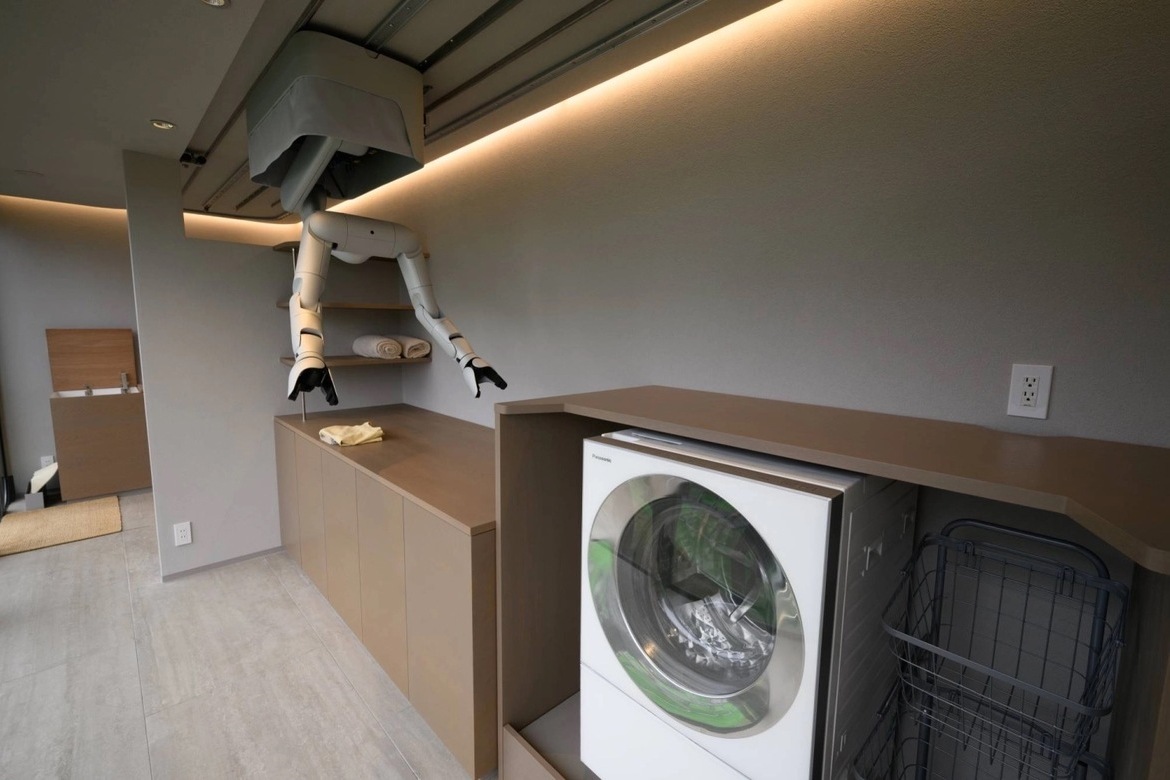

Tokyo-based startup MW is developing homes with built-in robotic arms as a deliberate alternative to the humanoid robot boom sweeping China and the rest of the global robotics industry. The company’s system features two robotic arms with claw-like hands that move along ceiling-mounted rails, performing household tasks including folding laundry, carrying groceries, and distinguishing between pantry items – demonstrating the system’s object recognition capability during a live showcase in Tokyo’s Toyosu waterfront district.
MW aims to sell its first robot-equipped home in Tokyo by 2028, and scale to as many as 10,000 robot-equipped homes annually by 2035 – equivalent to approximately 5% of Japan’s current new home construction volume. The company has raised ¥3 billion (approximately $20 million) via a seed round with participation from Spiral Innovation Partners and the venture capital arms of Sumitomo Mitsui Banking, Fukuoka Financial Group, and Mitsubishi UFJ Financial Group. A Series A round of approximately ¥10 billion is planned within the next two years to fund AI and hardware development.
The Design Philosophy
MW’s CEO Shuzo Narita, 37, described the architecture as inspired by Tony Stark’s fictional Iron Man home – specifically the AI butler J.A.R.V.I.S. and Stark’s built-in robotic infrastructure. The company positions itself as a physical AI startup whose current revenue base is real estate.
The rejection of the humanoid form factor is deliberate and grounded in specific constraints. Japanese homes are significantly more compact than American ones, making a free-standing bipedal robot that navigates occupied space a more challenging and dangerous proposition. Rail-mounted arms that move along fixed tracks eliminate the balance and navigation uncertainty of bipedal locomotion, are easier to contain within defined operational zones, and are inherently safer in the confined spaces of a typical Japanese residence.
“Safety was also a key consideration in rejecting the humanoid: Because MW bots need to move along tracks, they are easier to contain and control,” Narita said.
The demonstration revealed the system’s current capability range honestly: the robot successfully sorted pantry items and neatly folded a hand towel, but its attempt to fold a t-shirt was less successful – a concise illustration of where dexterous manipulation in variable textile conditions remains technically challenging regardless of platform.
The Business Model
MW is building the homes before the robots are ready. The company has sold a three-story house in Tokyo’s Meguro Ward and has four additional properties selling in Yokohama and Fukuoka, with prices ranging from ¥200 million to ¥400 million. The homes are being built with the infrastructure to retrofit the robotic system when it is ready – currently projected for 2028.
Revenue from the robots themselves will come through a monthly service fee expected at ¥5,000 to ¥10,000 per household. Additional projects in the pipeline include larger residences in Futtsu in Chiba Prefecture and Karuizawa in Nagano Prefecture. International expansion is planned from 2029. MW has made no decision regarding an IPO.
The 50-person startup handles robot design, home design, construction, and software development in-house – a vertically integrated model that allows tight integration between the robotic system specifications and the architectural infrastructure it runs on, while creating a complex operational scope for a company at seed stage.
Disclaimer: RobotsBeat is an independent media brand owned and operated by NuvexMedia LLC, publishing news, research, and insights on artificial intelligence, emerging technologies, automation, and related industries. NuvexMedia LLC invests in and collaborates with companies across the AI, Robotics, technology, software, and digital innovation sectors. These relationships do not influence RobotsBeat's editorial coverage, and the publication maintains full editorial independence to provide accurate, timely, and objective information. © 2026 NuvexMedia LLC. All rights reserved. This content is for informational purposes only and should not be considered legal, tax, investment, financial, or other professional advice.