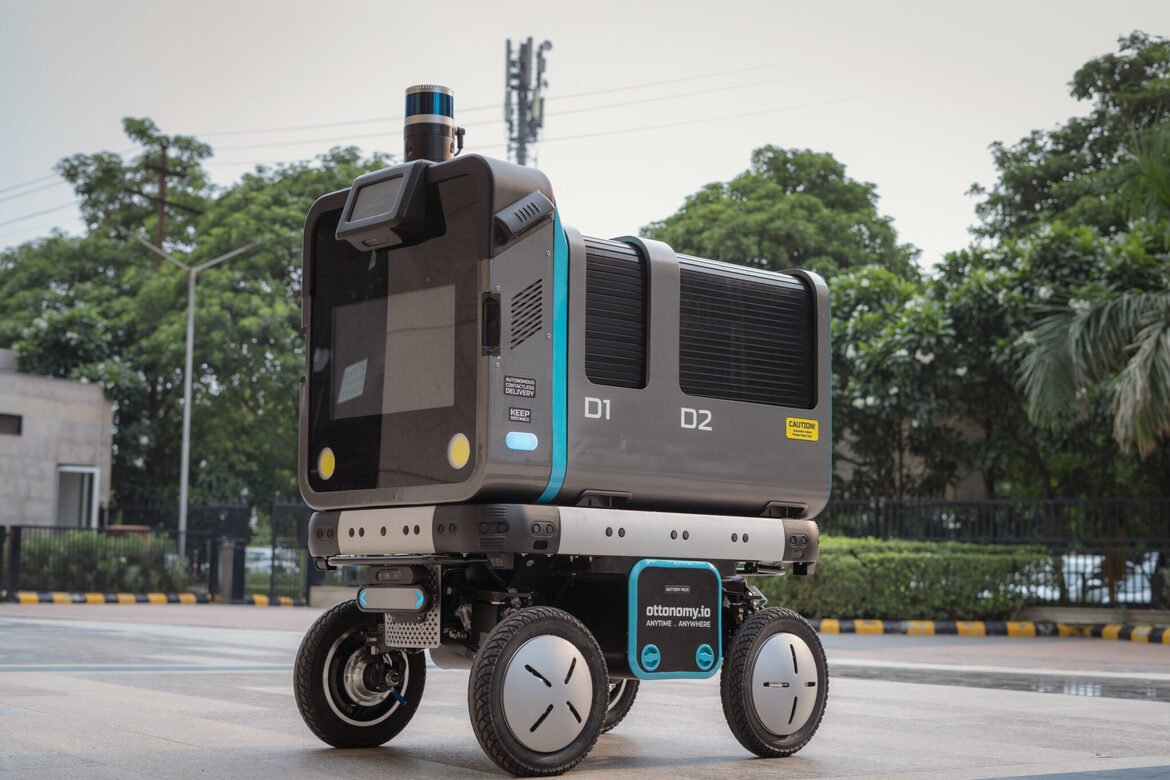
Ottonomy.IO has launched Ottumn.AI, a cloud-based orchestration platform designed to coordinate robots, drones, and smart infrastructure as part of a unified physical AI ecosystem. The platform, introduced at the India AI Impact Summit 2026, reflects a shift in robotics development from isolated automation toward networked autonomy across entire operational environments.
Built on AI infrastructure from NVIDIA, Ottumn.AI connects diverse robotic systems, including delivery robots, drones, and facility-integrated devices such as elevators and secure access points. The goal is to enable robots to operate as part of coordinated workflows rather than as standalone machines.
This approach addresses a fundamental challenge in robotics deployment: scaling beyond individual robots to manage fleets operating across complex environments.
From Individual Machines to Coordinated Systems
Historically, robotics deployments have focused on individual devices performing specific tasks, such as delivery or inspection. Ottumn.AI introduces an orchestration layer that manages multiple robots and infrastructure components simultaneously.
The platform enables asynchronous operations, allowing robots and drones to hand off tasks without direct human involvement. For example, in healthcare settings, autonomous systems can transport medical samples using secure exchange points integrated with building infrastructure.
This orchestration capability depends on a multi-layer architecture combining edge computing, cloud infrastructure, and AI models. Local processing enables real-time decision-making, while cloud systems manage fleet coordination, simulation, and optimization.
The system also incorporates digital twin simulations, allowing operators to test and refine robotic workflows in virtual environments before deployment.
Combining Neural AI with Symbolic Reasoning
Ottumn.AI uses a neurosymbolic approach that integrates neural networks with symbolic logic. Neural AI models enable perception, allowing robots to interpret visual and environmental data. Symbolic reasoning ensures compliance with operational rules, safety requirements, and workflow constraints.
This hybrid architecture addresses one of the limitations of purely neural AI systems: the difficulty of ensuring predictable behavior in safety-critical environments.
The platform also supports interoperability across multiple robot vendors through compliance with the VDA 5050 standard, enabling businesses to integrate heterogeneous fleets without being locked into a single hardware provider.
By providing a unified control layer, Ottumn.AI allows organizations to deploy robots, drones, and infrastructure as part of a cohesive system rather than isolated automation tools.
Infrastructure as the Next Layer of Physical AI
The launch reflects a broader evolution in robotics, where infrastructure integration is becoming as important as individual robot capability.
Autonomous systems increasingly rely on coordinated interactions with their environment. Smart receptacles, automated access points, and building management systems enable robots to complete tasks without human intervention.
Ottonomy has partnered with logistics and infrastructure providers to enable this ecosystem. These integrations allow robots to deposit and retrieve items securely, while drones and ground robots coordinate deliveries across urban environments.
The company also plans to use emerging AI foundation models, including NVIDIA’s Cosmos platform, to improve robotic perception and planning capabilities.
Scaling Physical AI Deployment
As robotics adoption accelerates, orchestration platforms are emerging as critical infrastructure for scaling automation. Managing individual robots manually becomes impractical as deployments expand to dozens or hundreds of units.
Cloud-based orchestration systems enable centralized management, remote assistance, and continuous optimization, allowing robotic fleets to operate efficiently across large geographic areas.
The launch of Ottumn.AI highlights how robotics is evolving from hardware-centric development toward full-stack ecosystems combining hardware, software, and infrastructure.
As embodied AI moves into real-world deployment across healthcare, logistics, and manufacturing, orchestration platforms like Ottumn.AI could play a central role in enabling robots to function as coordinated systems rather than isolated machines.
This transition marks a key step toward scalable physical AI, where automation is defined not by individual robots, but by interconnected autonomous networks.