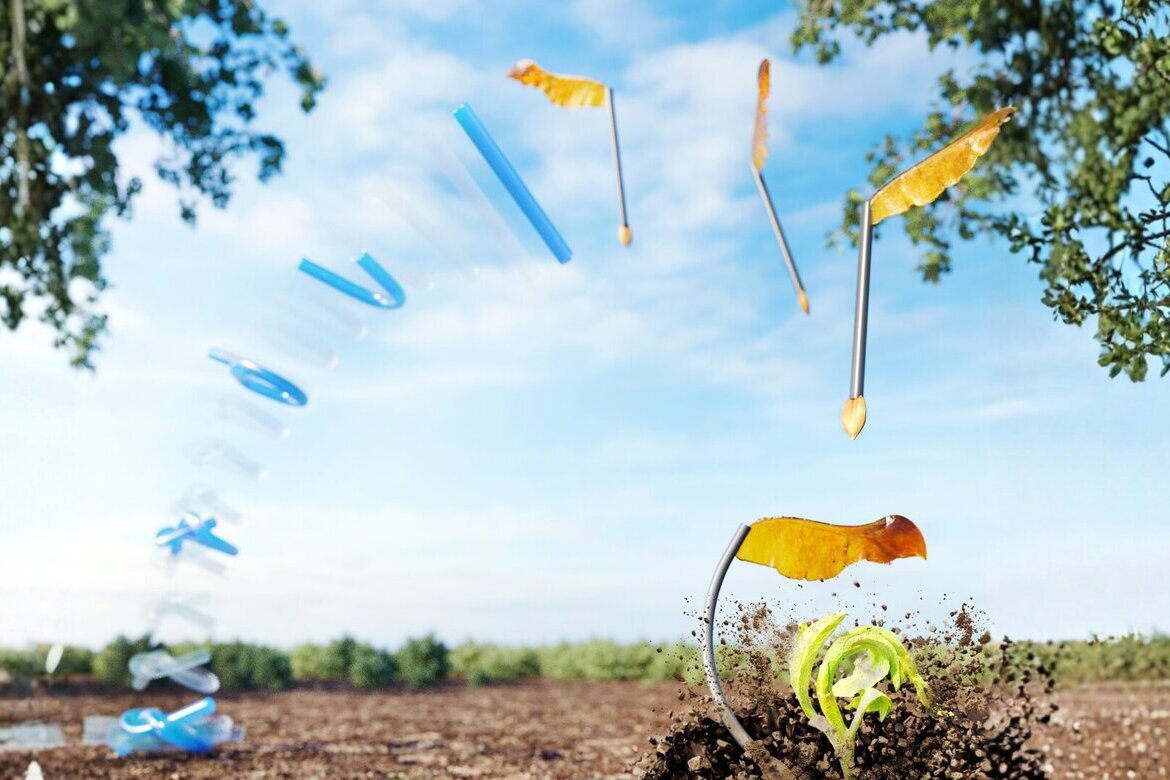


Researchers at the University of Pennsylvania’s School of Engineering have developed a class of tiny soft robots constructed from knotted fibers capable of jumping nearly two meters into the air, controlling their mid-flight behavior, and driving seeds into soil on landing. The work, led by materials science professor Shu Yang and postdoctoral associate Yaoye Hong, was published in Science this week.
The robots require no electronics, batteries, or external control systems. They are triggered by heat and powered entirely by elastic energy stored in the structure of the knot itself.
The Material System
Each robot is built from a fiber no thicker than a millimeter, combining two materials with opposing properties. A Kevlar core provides stiffness and strength, while a surrounding shell of liquid crystal elastomer – a soft, thermally responsive polymer – provides flexibility and programmability. When twisted and knotted, the fiber stores elastic energy. When heated to between 60 and 90 degrees Celsius, the elastomer shell contracts, loosening the knot just enough to trigger an abrupt untying. The stored energy releases in a fraction of a second.
The addition of the Kevlar core was a turning point in the research. The increased stiffness roughly doubled jumping height from approximately one meter to nearly two – a scale comparable to the jumping capability of a springtail, a soil-dwelling insect that uses a similar snap mechanism for locomotion.
Programmable Motion Through Knot Topology
The behavior of the robot after release is determined by the topology of the knot – its mathematical structure in three dimensions. A simple overhand knot produces a flipping motion. A figure-eight knot generates spinning. More complex knot configurations untie in stages, producing sequential movements during flight.
Attaching a thin wing to the fiber, inspired by the autorotation descent of maple seeds, extends that control. Depending on wing placement, the robot either arcs forward and lands at a distance or curves back toward its starting point. The wing stabilizes the structure during descent and maintains continuous rotation, allowing the researchers to tune both range and landing trajectory.
Seed Planting as an Application
The researchers attached pine and arugula seeds to the jumping robots and tested them in soil. The kinetic energy carried through the jump drives the fiber nearly vertically into the ground on landing, generating penetration pressures approximately 30 times greater than previous rain-activated seed-carrier systems developed by the same group. The seeds germinated successfully in early experiments.
The heat-activation mechanism is central to the application’s practicality. Earlier seed-carrier designs relied on rainfall to trigger a slow burrowing motion – an approach that produced inconsistent results in dry environments and risked washing seeds away in heavy rain. The new system uses sunlight as its energy source, which is more reliably available across the hot, arid environments where reforestation and agricultural seeding are most needed.
Scope and Limitations
The current design is described by the researchers as a model system built to study the underlying physics of knotted-fiber energy storage and release. Future development will focus on lowering the activation temperature, improving environmental compatibility of the materials for outdoor deployment, and refining soil interaction behavior. The broader program aims to develop a suite of small, adaptive machines capable of operating in complex outdoor environments without electronics or external power infrastructure.
The work sits at an intersection of materials science, soft robotics, and ecological engineering – a combination that reflects a growing research interest in deployable, autonomous systems designed to operate at scales and in environments where conventional robotics cannot easily reach.
Disclaimer: RobotsBeat is an independent media brand owned and operated by NuvexMedia LLC, publishing news, research, and insights on artificial intelligence, emerging technologies, automation, and related industries. NuvexMedia LLC invests in and collaborates with companies across the AI, Robotics, technology, software, and digital innovation sectors. These relationships do not influence RobotsBeat's editorial coverage, and the publication maintains full editorial independence to provide accurate, timely, and objective information. © 2026 NuvexMedia LLC. All rights reserved. This content is for informational purposes only and should not be considered legal, tax, investment, financial, or other professional advice.