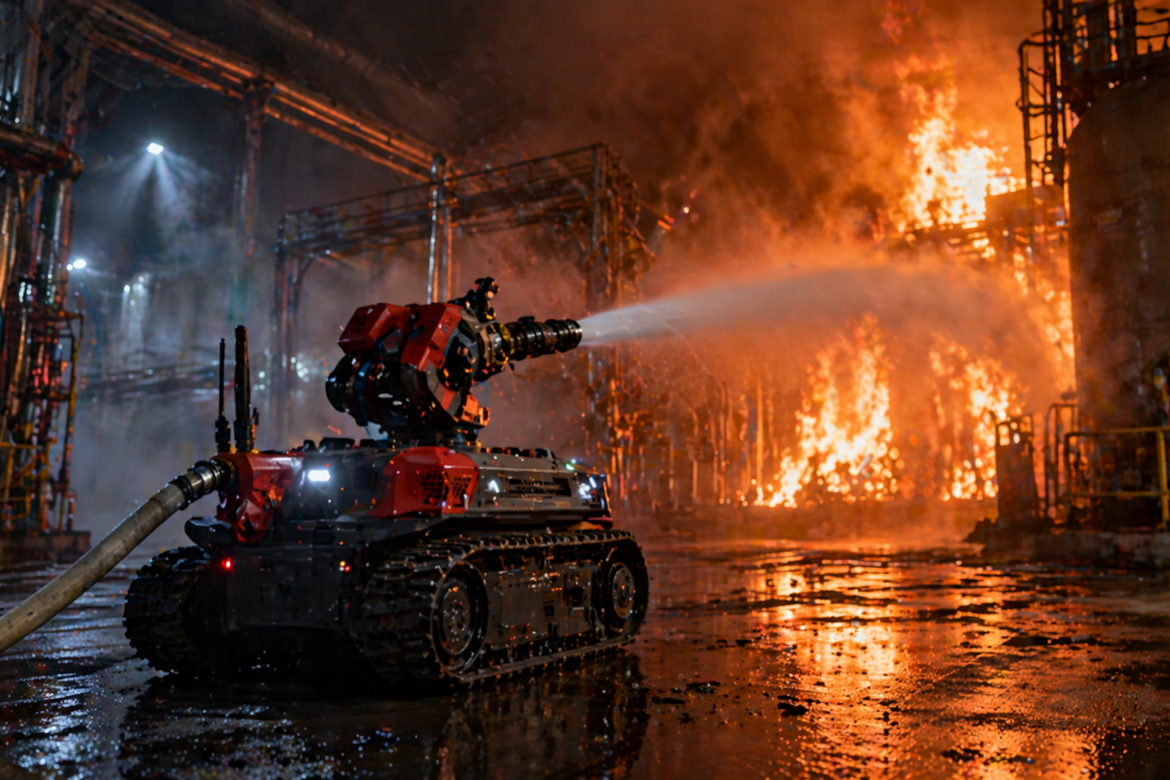


South Korea’s National Fire Agency has announced a comprehensive overhaul of its disaster response system, with unmanned firefighting robots at the center of its near-term equipment expansion. The agency plans to add 18 robots over the next two years, bringing the total fleet from four to 22 units, before gradually extending deployment to fire headquarters across cities and provinces nationwide.
NFA Commissioner Kim Seung-ryong outlined the plan at a press briefing in Sejong on Thursday, his first public statement since taking office in October. The measures respond to an increase in large-scale, hard-to-access disasters – including fires at logistics facilities involving toxic gases and explosion risks – where personnel safety constraints limit how close human firefighters can operate.
Shifting to a Robot-Centered Response Model
The agency’s stated objective is to transition from a personnel-dependent response model to one centered on AI and robotics, reducing exposure of on-site staff in the most hazardous scenarios. Unmanned firefighting robots are designed to enter environments that would require human crews to operate at unsafe proximity to flames, structural collapse risk, or chemical hazard zones.
Alongside the robot expansion, the NFA will extend its high-capacity foam discharge system – used for large-scale incidents such as oil tank fires – to the Honam and metropolitan regions, adding geographic coverage for a class of industrial fire that has grown more common as logistics and warehousing infrastructure has expanded.
The preventive inspection system is also being strengthened. The agency is evaluating a shift from fire-station-only inspections to a government-wide joint system involving agencies responsible for construction, electricity, and gas. High-risk facilities with repeated fire incidents will be designated as key fire safety management targets and subjected to intensified public oversight through joint drills and safety investigations.
Emergency Transport Reform
The overhaul extends beyond firefighting into emergency patient transport. The NFA plans to strengthen the Central Emergency Medical Situation Control Center’s authority to intervene directly when regional centers cannot place patients, arranging hospital admissions nationwide rather than within regional boundaries. For high-risk cases including emergency obstetric patients, 119 emergency services will transport directly to facilities with neonatal intensive care capacity regardless of provincial jurisdiction.
For long-distance transport, the agency intends to expand use of its 33 air ambulances currently operating nationally.
Regulatory Reform
The agency is also initiating a regulatory overhaul of the firefighting industry. It will shift to a negative regulatory framework – permitting everything not explicitly prohibited by law – and has announced a Fire Prevention Regulation Rationalization Task Force combining industry, academic, and research expertise. Major firefighting laws including the Fire Facilities Act and the Hazardous Substances Safety Management Act will be reviewed from the ground up to remove unnecessary administrative constraints.
The announcement follows a line-of-duty deaths investigation stemming from a fire at a seafood processing facility in South Jeolla Province. A 26-member joint fire investigation team is conducting a detailed analysis, with institutional reforms to follow based on its findings.
Disclaimer: RobotsBeat is an independent media brand owned and operated by NuvexMedia LLC, publishing news, research, and insights on artificial intelligence, emerging technologies, automation, and related industries. NuvexMedia LLC invests in and collaborates with companies across the AI, Robotics, technology, software, and digital innovation sectors. These relationships do not influence RobotsBeat's editorial coverage, and the publication maintains full editorial independence to provide accurate, timely, and objective information. © 2026 NuvexMedia LLC. All rights reserved. This content is for informational purposes only and should not be considered legal, tax, investment, financial, or other professional advice.