The global market for reception robots is expected to expand rapidly over the coming decade, growing from $1.2 billion in 2023 to $6.8 billion by 2032. The surge reflects rising demand for automated customer service across hospitality, healthcare, and corporate sectors, as advances in artificial intelligence make service robots more capable and economically viable.
The projected growth represents a compound annual rate of more than 21%, positioning reception robots as one of the fastest-growing segments within the broader service robotics industry.
AI Advances Transform Customer-Facing Robotics
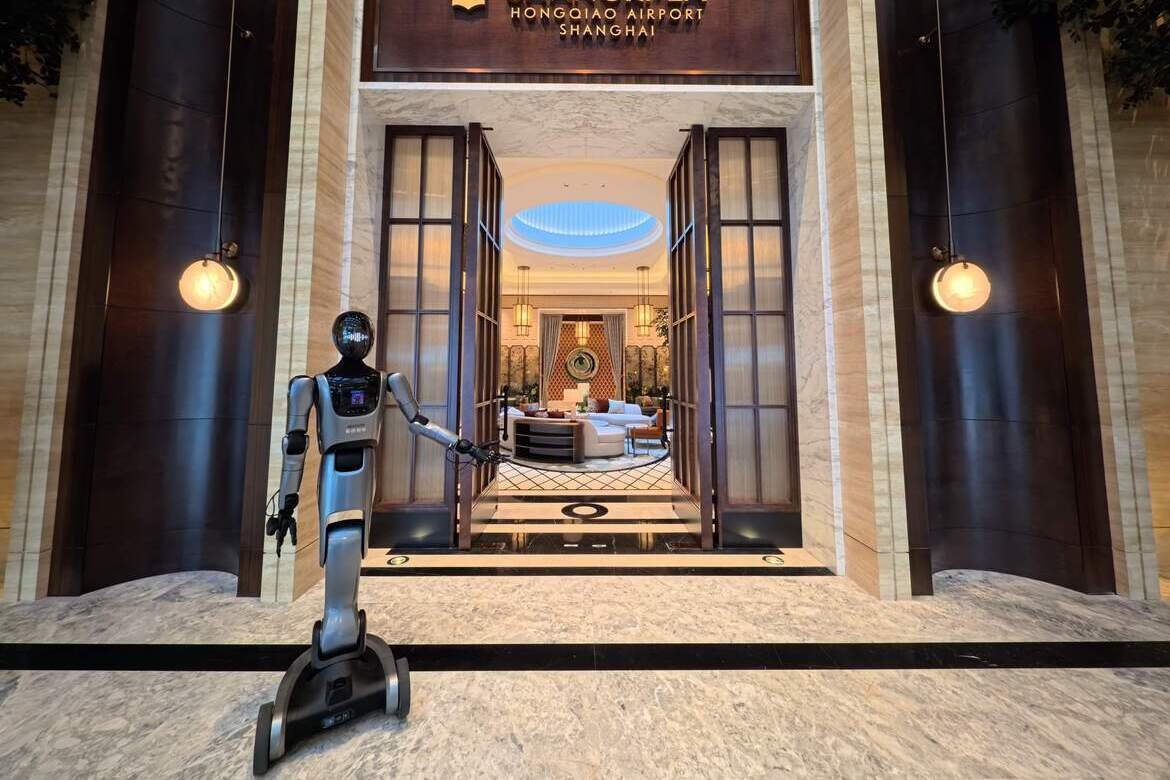
Recent improvements in AI, particularly natural language processing and computer vision, have significantly expanded the capabilities of reception robots. Modern systems can greet visitors, answer questions, verify identities, and provide directions, tasks that previously required human staff.
Unlike earlier automation systems limited to scripted interactions, AI-enabled reception robots can interpret spoken language, respond dynamically, and improve performance over time through machine learning.
Companies such as SoftBank Robotics and Keenon Robotics have already deployed reception robots in hotels, hospitals, and retail environments. These robots can provide consistent service 24 hours a day, helping organizations maintain customer engagement while reducing operational costs.
Cloud connectivity and edge computing are further enhancing capabilities, allowing robots to access centralized knowledge bases and continuously update their performance.
Labor Shortages and Cost Pressures Accelerate Adoption
One of the primary drivers behind reception robot adoption is the growing shortage of service workers. Businesses in hospitality, healthcare, and corporate environments face increasing difficulty recruiting and retaining staff for routine customer service roles.
Reception robots offer a practical solution by automating repetitive tasks such as visitor registration, information assistance, and basic security screening. This allows human workers to focus on more complex or personalized interactions.
Economic considerations also play a key role. While initial deployment costs can be significant, robots offer long-term savings through reduced labor expenses and continuous availability.
Hospitals are increasingly deploying reception robots to assist with patient check-in and navigation, reducing wait times and improving operational efficiency. Corporate offices are using robots to streamline visitor management and enhance security procedures.
Transportation hubs, including airports and train stations, are also adopting reception robots to improve passenger experience and reduce congestion.
Asia Leads Global Growth in Service Robotics
Asia Pacific is emerging as the fastest-growing region for reception robot adoption, driven by strong investment in automation and robotics. Countries such as China, Japan, and South Korea are at the forefront of deploying service robots across public and commercial environments.
Government initiatives promoting smart cities and digital infrastructure are accelerating adoption. The region also benefits from a strong robotics manufacturing ecosystem, enabling faster development and deployment.
North America and Europe remain important markets as well, particularly in corporate and healthcare applications where automation can improve operational efficiency and address labor shortages.
Reception Robots as a Gateway to Physical AI
Reception robots represent an early form of embodied AI in customer-facing roles. Unlike industrial robots confined to factories, these systems interact directly with people, requiring advanced perception, communication, and decision-making capabilities.
The segment serves as a testing ground for broader physical AI deployment. Improvements in perception, mobility, and conversational ability developed for reception robots can later be applied to more complex robotic systems.
Competition in the market is intensifying as robotics companies continue to improve hardware and software capabilities. Advances in sensors, processors, and AI models are enabling more natural interactions and expanding potential applications.
The growth of reception robots reflects a broader shift toward automation in service industries. As AI capabilities continue to improve and costs decline, robots are expected to become a more common presence in public-facing roles.
Reception robots may not replace human workers entirely, but they are increasingly becoming part of hybrid human-robot service environments. Their rapid market growth signals how embodied AI is moving beyond industrial settings into everyday customer interactions.