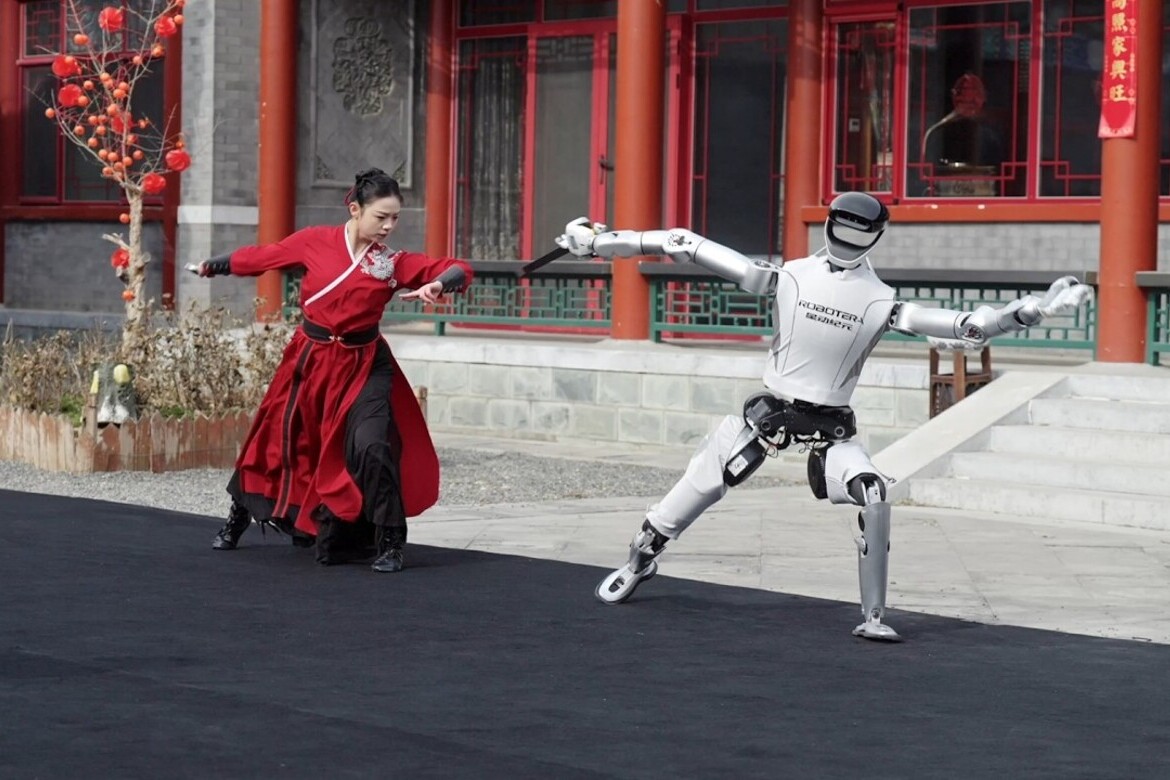


As humanoid robotics advances beyond basic locomotion, companies are increasingly using dynamic demonstrations to validate real-world capabilities. Chinese robotics firm Robotera recently released footage of its L7 humanoid robot performing a traditional sword dance, highlighting improvements in balance control, manipulation, and whole-body coordination.
The demonstration, released during Lunar New Year celebrations, reflects broader momentum in embodied AI development. Rather than showcasing isolated movements, the sword routine required synchronized coordination across dozens of joints, continuous feedback-driven adjustment, and precise torque control under rapidly changing physical conditions.
Dynamic Manipulation as a Technical Benchmark
The L7 humanoid platform measures approximately 171 centimeters tall and weighs around 65 kilograms. Built using titanium and carbon fiber components, the robot combines structural strength with weight efficiency, enabling faster and more stable movement.
With 55 independently controlled joints, including multiple degrees of freedom in the arms, hands, waist, and legs, the robot is designed for high-precision manipulation. These joints allow complex actions such as wrist rotation, grip adjustment, and multi-axis balance corrections.
Sword dancing presents a particularly demanding control problem. The robot must continuously account for shifting inertia caused by the swinging blade, while maintaining balance during rotational and jumping movements. This requires real-time calculation of center-of-mass position, joint torque limits, and ground contact forces.
The ability to execute such maneuvers without instability indicates highly responsive feedback loops and tightly integrated motion planning systems. Whole-body coordination at this level depends on embedded AI models that can translate perception and physical state estimation into immediate control adjustments.
From Demonstration to Deployment
While visually striking, the sword dance serves a practical purpose. Dynamic demonstrations provide measurable indicators of physical intelligence, especially in areas such as manipulation precision, balance recovery, and coordinated movement.
These capabilities directly translate to industrial and service applications. The L7 is designed to operate in logistics and factory environments, with the ability to move at speeds of up to 4 meters per second and carry payloads of approximately 20 kilograms. Its wide field of view and extended arm reach support object handling and interaction tasks.
The technical foundation enabling the performance – real-time motion planning, multi-axis balance control, and adaptive torque management – is the same infrastructure required for deployment in unpredictable real-world environments.
China’s Accelerating Humanoid Development Cycle
Robotera developed the L7 in collaboration with Tsinghua University, reflecting the close integration between academic research and commercial robotics development in China.
The demonstration highlights a broader industry pattern. Chinese robotics firms are rapidly iterating humanoid platforms, emphasizing dynamic mobility, manipulation capability, and embodied AI integration. These advances are narrowing the gap between research demonstrations and practical automation systems.
Public demonstrations increasingly serve as proxies for engineering maturity. Executing coordinated, high-speed movements under load requires robust actuator design, precise sensing, and reliable AI control systems. These are foundational elements for real-world deployment in manufacturing, logistics, and service sectors.
While sword dancing itself is not an industrial task, the underlying technical achievement represents a meaningful step forward. It demonstrates that humanoid robots are developing the physical coordination necessary to operate beyond structured environments and into complex, real-world settings.
As embodied AI systems become more capable, the distinction between demonstration and deployment continues to narrow. The L7’s performance signals that humanoid robotics is progressing from controlled motion toward adaptive, physically expressive automation platforms.
Disclaimer: RobotsBeat is an independent media brand owned and operated by NuvexMedia LLC, publishing news, research, and insights on artificial intelligence, emerging technologies, automation, and related industries. NuvexMedia LLC invests in and collaborates with companies across the AI, Robotics, technology, software, and digital innovation sectors. These relationships do not influence RobotsBeat's editorial coverage, and the publication maintains full editorial independence to provide accurate, timely, and objective information. © 2026 NuvexMedia LLC. All rights reserved. This content is for informational purposes only and should not be considered legal, tax, investment, financial, or other professional advice.