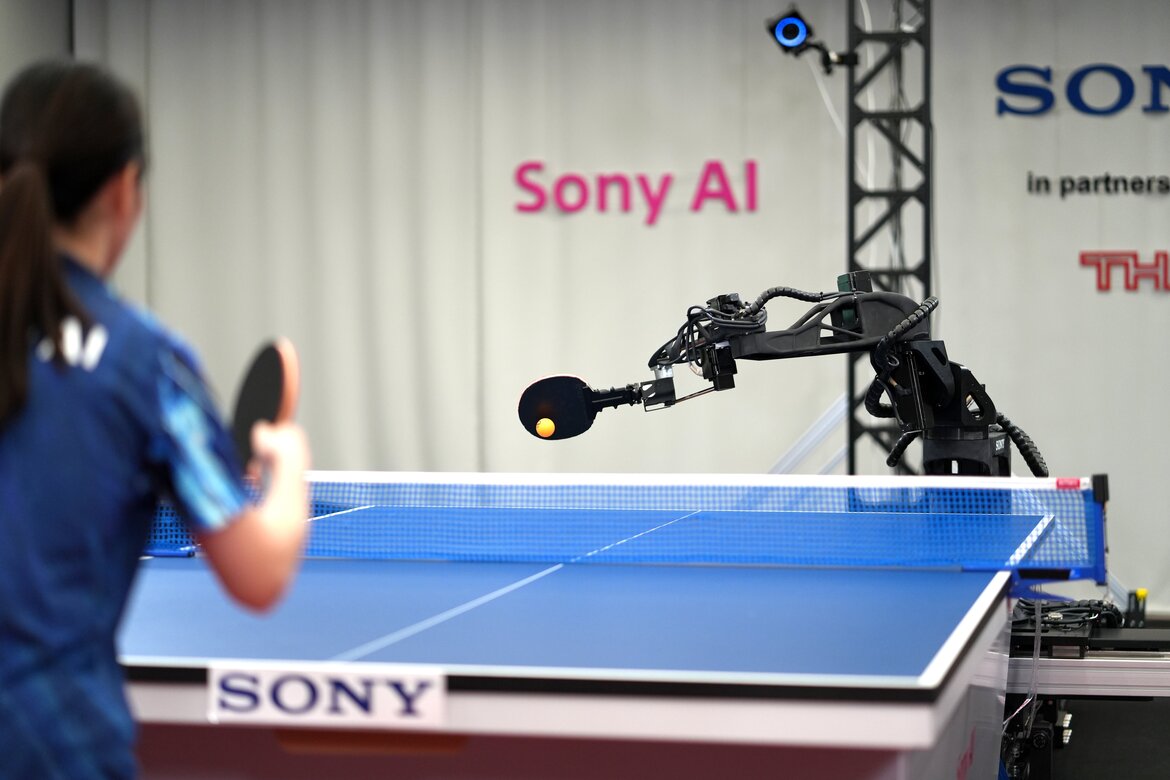


Sony has published research in Nature describing Ace, an eight-jointed robotic arm that has become the first autonomous system demonstrated to be competitive with elite human table tennis players. The system won matches against top-ranked players at Sony’s headquarters in Tokyo, using an AI model fed real-time data from nine cameras to make split-second decisions with 10 milliseconds of latency – more than ten times faster than the human brain’s response threshold.
The study positions Ace as a milestone in physical AI: a system capable of operating at speeds and reaction times that exceed human capability in a domain characterized by high-velocity ball tracking, real-time strategic adaptation, and continuous environmental variability.
How Ace Was Built
Ace’s striking capabilities were developed entirely through simulation-based reinforcement learning and transferred directly to physical hardware without additional retraining. Sony described the approach as analogous to a player who practices in a virtual training environment and then competes on a real court without needing to relearn anything from scratch. The simulation-to-reality transfer is a central technical achievement: ping-pong involves ball spin, bounce variation, and opponent positioning changes that are difficult to fully replicate in synthetic environments.
The arm’s tracking system processes visual data from nine cameras simultaneously, enabling it to compute return trajectories and execute shots within the reaction window that competitive table tennis demands. At 10 milliseconds of latency end-to-end, the system operates well within margins that human players cannot match on pure reaction speed alone.
Where Human Players Found the Edge
The competitive picture is more nuanced than a straight performance comparison. Human players initially struggled to read Ace because the robot’s mechanical consistency offered no readable tells – no shifts in posture, no hesitation, no recoverable momentum that a trained opponent could exploit. “Because you can’t read its reactions, it’s impossible to sense what kind of shots it dislikes or struggles with,” said Mayuka Taira, a professional player who lost a match to Ace.
But Rui Takenaka, who both lost and won against Ace, identified a strategic vulnerability. When using a simple knuckle serve – one with minimal spin – Ace returned a simpler ball that was easier to attack on the third shot. The robot’s response quality was directly correlated with the complexity of the input it received. Against sophisticated spin, it produced sophisticated returns. Against simple serves, it became predictable.
“Professional human athletes are very good at adapting to their opponent and finding weaknesses, which is an area that we are working on,” said Peter Dürr, Ace project leader at Sony, in comments to Reuters.
Implications Beyond the Table
Sony’s stated interest in Ace centers on advancing physical AI research – specifically, high-speed perception, real-time decision-making, and sim-to-real transfer in dynamic environments. Table tennis serves as a demanding benchmark because it compresses the full stack of physical AI challenges into a single, measurable competitive format: perceive, decide, act, and repeat at sub-human latency.
The capabilities demonstrated – fast visual tracking, rapid trajectory computation, and reliable physical execution under variable conditions – have direct applicability in industrial quality control, precision assembly, and other domains where speed and repeatability matter. The study’s publication in Nature reflects both the technical significance of the result and the broader scientific interest in robotic systems that can operate at or above human performance thresholds in real-time physical tasks.
Disclaimer: RobotsBeat is an independent media brand owned and operated by NuvexMedia LLC, publishing news, research, and insights on artificial intelligence, emerging technologies, automation, and related industries. NuvexMedia LLC invests in and collaborates with companies across the AI, Robotics, technology, software, and digital innovation sectors. These relationships do not influence RobotsBeat's editorial coverage, and the publication maintains full editorial independence to provide accurate, timely, and objective information. © 2026 NuvexMedia LLC. All rights reserved. This content is for informational purposes only and should not be considered legal, tax, investment, financial, or other professional advice.