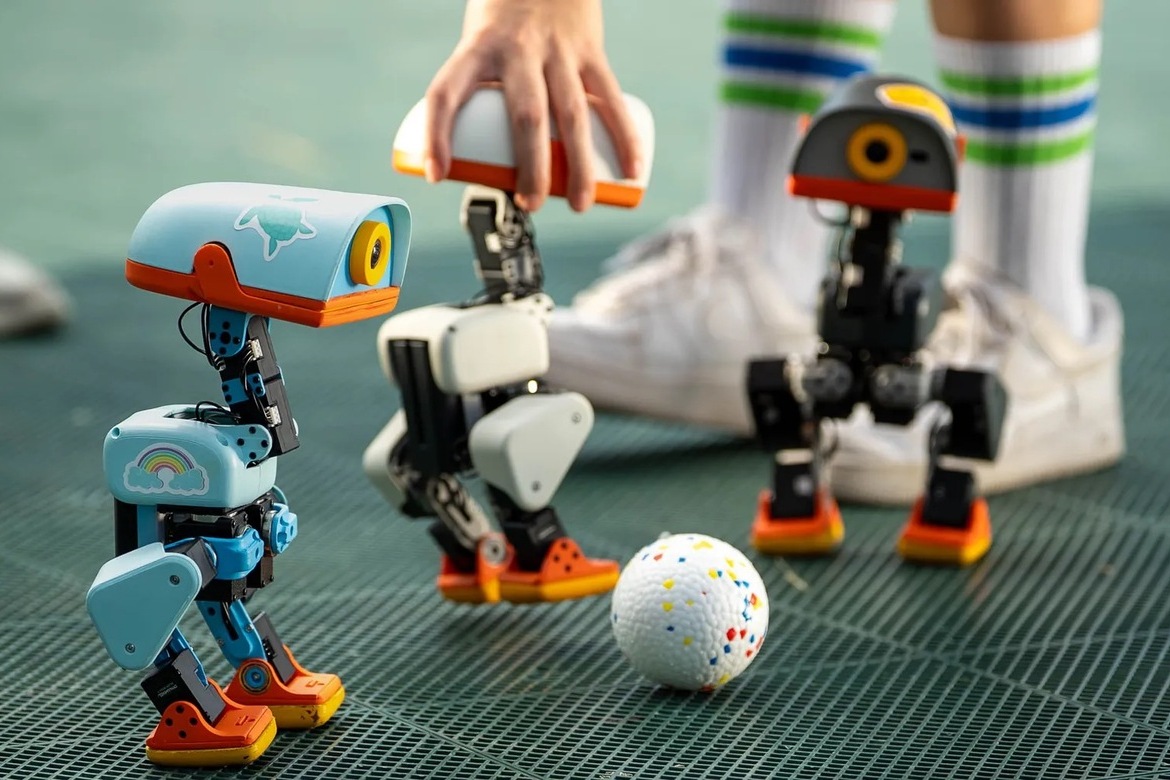

Pollen Robotics and Hugging Face have unveiled Microduck, a $399 open-source robot designed for accessible physical AI development. Standing 25 centimeters tall and weighing 800 grams, the robot contains 15 motors, an onboard camera, LiDAR, and motion sensors. Pre-orders are open. The robot can walk, recover from falls autonomously, kick and pick up objects, and – notably – rollerblade.
The most technically significant aspect of Microduck is its training architecture. New movement skills can be developed in simulation using reinforcement learning and then transferred directly to the physical robot, without requiring users to collect real-world demonstration data or access expensive compute resources for on-hardware training. The sim-to-real transfer capability means the community of Hugging Face developers can contribute, share, and download new skills through a model-sharing workflow analogous to how AI models are shared on the Hugging Face Hub.
Why $399 and Open-Source Matters
The price point and open-source design are deliberate choices that address the primary barriers to widespread physical AI research: hardware cost and proprietary software lock-in. Most capable robot platforms with similar sensor and actuator density cost thousands to tens of thousands of dollars, placing them out of reach for individual researchers, students, and developers who are not affiliated with well-funded institutions.
At $399, Microduck occupies a similar market position to what the Raspberry Pi did for computing and what Arduino did for embedded electronics – a capable, affordable, community-modifiable platform that lowers the barrier to hands-on physical AI experimentation. The integration with Hugging Face’s existing model distribution infrastructure means skill development and sharing can happen within the same ecosystem that the AI research community already uses for language and vision models.
The Sim-to-Real Training Model
The reinforcement learning-to-physical transfer workflow is the capability that differentiates Microduck from fixed-behavior educational robots. Rather than executing pre-programmed routines, the platform is designed to be taught. A developer can design and train a new movement behavior in a simulated Microduck environment, validate it against physics constraints, and deploy it to physical hardware – following the same sim-to-real pipeline used by research groups at Boston Dynamics, Google DeepMind, and NVIDIA’s Isaac Lab, but accessible at a fraction of the cost and hardware complexity.
The rollerblading capability is a demonstration of that pipeline’s range: a behavior that requires continuous dynamic balance adjustment across a surface with rolling contact is not trivially programmable but can be developed through reinforcement learning in simulation and transferred to hardware.
Pollen Robotics, the French robotics company behind the Reachy open-source humanoid robot, has been building toward accessible physical AI platforms since its founding. The Microduck collaboration with Hugging Face extends that philosophy to a lower cost point and a broader potential user base, while Hugging Face’s platform provides the distribution infrastructure that turns a capable robot into a community development ecosystem.
Disclaimer: RobotsBeat is an independent media brand owned and operated by NuvexMedia LLC, publishing news, research, and insights on artificial intelligence, emerging technologies, automation, and related industries. NuvexMedia LLC invests in and collaborates with companies across the AI, Robotics, technology, software, and digital innovation sectors. These relationships do not influence RobotsBeat's editorial coverage, and the publication maintains full editorial independence to provide accurate, timely, and objective information. © 2026 NuvexMedia LLC. All rights reserved. This content is for informational purposes only and should not be considered legal, tax, investment, financial, or other professional advice.