Industrial robotics has long been constrained by rigid programming models that limit machines to narrowly defined, repetitive tasks. Last week, Trener Robotics announced a $32 million Series A round aimed at changing that equation with a robot-agnostic AI skills platform designed to make industrial automation more adaptable and accessible.
The funding, co-led by Engine Ventures and IAG Capital Partners, brings the company’s total capital raised to more than $38 million. Strategic investors including Cadence and Geodesic Capital, through Nikon’s NFocus Fund, also participated.
Replacing Procedural Code with Skills
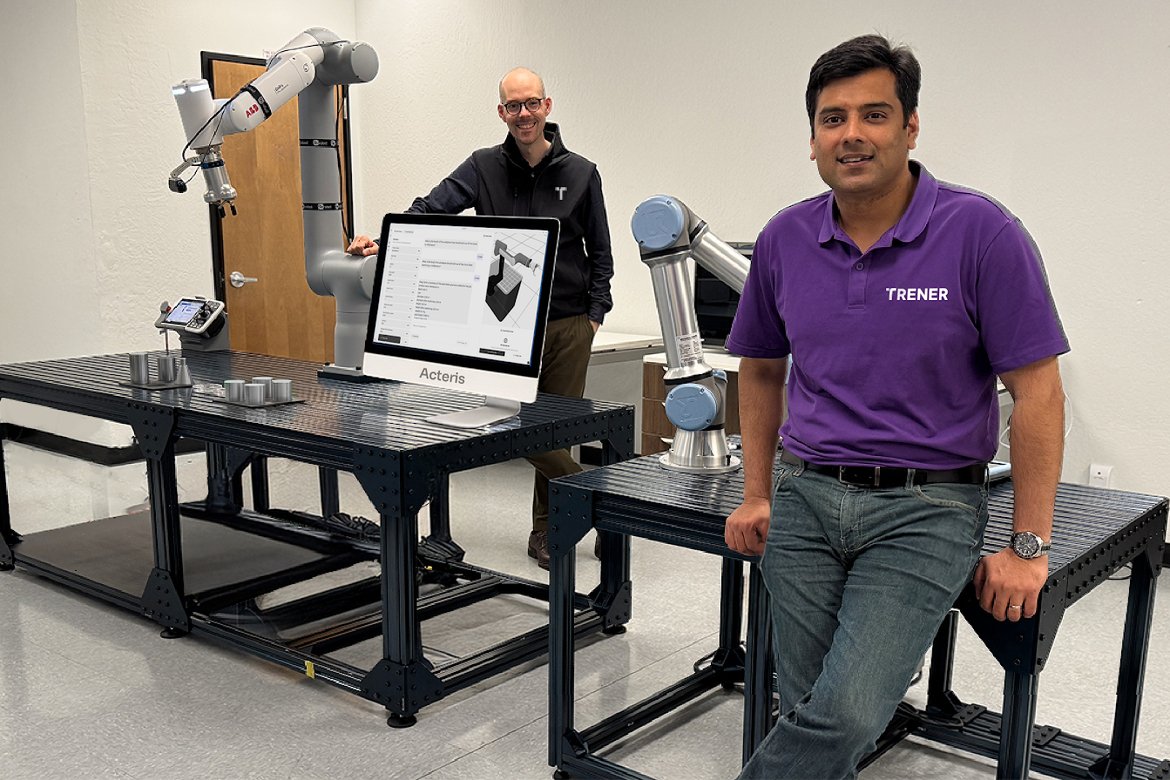
Founded in 2024 and headquartered in San Francisco and Trondheim, Norway, Trener Robotics is building Acteris, a control layer that abstracts away vendor-specific robot programming. Instead of writing custom code for each robotic arm, operators can describe tasks in natural language. The platform translates conversational input into executable automation sequences.
“For decades, industrial robotics has been limited by dynamic complexity, confining millions of robotic arms to repetitive, single-purpose tasks in highly controlled environments,” said Dr. Asad Tirmizi, co-founder and CEO of Trener Robotics. He argues that replacing procedural programming with a reusable skills library enables robots to operate more like adaptable teammates than fixed-function tools.
Acteris is trained on visual, haptic, language, and action data, allowing it to adapt to variable parts and semi-structured production settings. The company says the system supports part identification through machine vision, motion optimization that responds to environmental changes, collision avoidance, and real-time production monitoring dashboards.
Crucially, the platform integrates with existing hardware. In 2025, Trener worked with more than 15 systems integrators across Europe and the U.S., integrating robot brands including ABB, Universal Robots, and FANUC.
A Control Layer for Physical AI
The broader significance lies in where automation is heading. Industrial robotics adoption is expanding beyond high-volume, low-variability production into high-mix environments that demand flexibility. According to Mordor Intelligence, the market for flexible automation is growing at a 14.3 percent compound annual growth rate, driven by labor shortages and cost pressures.
Historically, reprogramming a robot cell for a new product run required specialized engineers and downtime that eroded return on investment. By abstracting control into a generalized AI skills layer, Trener is positioning Acteris as infrastructure rather than an application.
Investors describe the company as building an intelligence layer for physical automation. Reed Sturtevant, general partner at Engine Ventures, said the firm saw an opportunity to address one of automation’s structural bottlenecks. Dennis Sacha, partner at IAG Capital Partners, characterized industrial automation as being at an inflection point, particularly for small and mid-sized manufacturers seeking scalable AI capabilities.
The Competitive Context
Trener is entering a crowded but evolving landscape. Traditional robot manufacturers have introduced proprietary low-code interfaces, while research-focused generalist AI robotics platforms promise broad adaptability but often lack production validation.
Acteris attempts to bridge that gap. The company emphasizes that its system runs on equipment manufacturers already own, differentiating itself from research-first generalist systems that may not yet be shop-floor proven.
The central question for the sector is whether AI-driven abstraction layers can meaningfully reduce integration complexity while maintaining safety, reliability, and deterministic performance. If successful, such platforms could lower the barrier to entry for automation and expand robotics deployment beyond specialized factories into mainstream manufacturing.
With fresh capital earmarked for research and development, talent acquisition, and partner expansion, Trener Robotics is betting that the future of industrial automation will not be defined by individual robot brands, but by the intelligence layer that orchestrates them.