UBTECH and Hitachi Partner to Deploy Walker S2 Humanoid Robots in Elevator and Smart Manufacturing

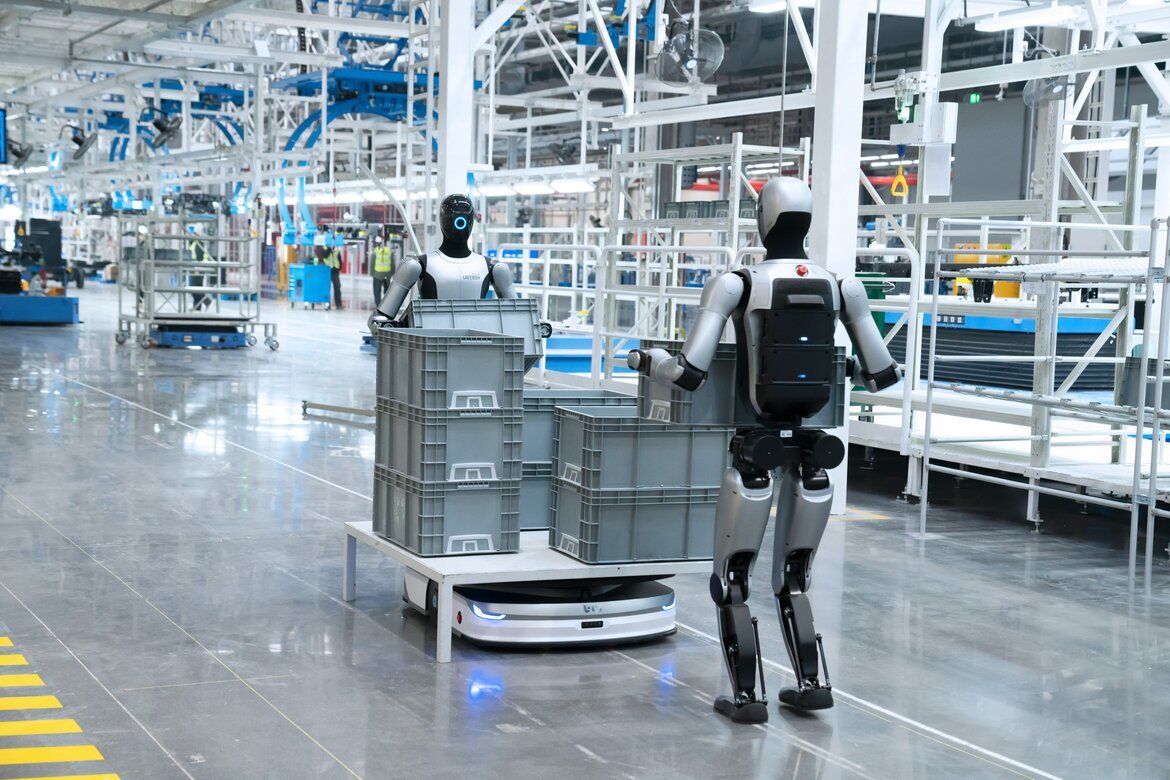
UBTECH Robotics and Hitachi China have signed a strategic cooperation agreement to deploy Walker S2 humanoid robots across Hitachi’s manufacturing operations, with elevator production already in active testing at Hitachi Elevator’s facility.

By Rachel Whitman | Edited by Kseniia Klichova Published:
A humanoid robot performing precision assembly tasks on an elevator manufacturing line, integrated into a smart manufacturing environment alongside existing production systems. Photo: UBTECH Robotics

UBTECH Robotics and Hitachi China have signed a strategic cooperation agreement to jointly develop and deploy humanoid robot applications across Hitachi’s manufacturing operations in China. The partnership focuses on sectors where Hitachi holds established market positions – elevators, building systems, healthcare, industrial equipment, and semiconductor manufacturing equipment – and is already in active deployment testing with UBTECH’s Walker S2 industrial humanoid.

The agreement moves beyond a memorandum of understanding stage. Both companies confirmed that cooperation has entered what they describe as the substantive verification stage, with Walker S2 units introduced into Hitachi manufacturing scenarios and on-site operation testing underway.

Elevator Manufacturing as the Initial Focus

The most developed application is at Hitachi Elevator’s manufacturing site, where Hitachi China Research Institute, UBTECH Robotics, and Hitachi Elevator are conducting secondary development of humanoid robot applications. The work targets full-process flexible intelligent flow and data integration across key elevator production processes – tasks that require the high precision and adaptability that fixed automation has historically struggled to deliver in low-volume, high-mix manufacturing environments.

Elevator manufacturing presents a relevant test case for humanoid deployment. The components are large, varied, and assembled in configurations that change between product types, creating the kind of flexible production demand that humanoid robots are specifically designed to address. Successfully automating key processes here would provide a replicable model for Hitachi’s other manufacturing segments.

The Broader Scope

The agreement covers the full range of Hitachi Group’s competitive markets in China. Healthcare and semiconductor manufacturing equipment represent the other near-term targets alongside elevators – both sectors where precision requirements are high, labor costs are rising, and production flexibility is commercially valuable.

UBTECH brings Walker S2 hardware and its software stack for industrial humanoid deployment. Hitachi brings system integration experience, existing manufacturing infrastructure, and a customer base across the sectors the partnership is targeting. The combination follows a pattern emerging across the humanoid industry: established industrial operators providing the deployment context and domain knowledge, while robotics companies provide the hardware and AI capability.

The partnership also extends UBTECH’s international footprint beyond its existing European presence through Terra Robotics in the DACH region, adding a major Japanese industrial partner with operations across Asia to its commercial network.

Business & Markets, News, Robots & Robotics

Unitree Launches UniStore, a Robot App Store for Its Humanoid and Quadruped Platforms

Unitree Robotics has launched UniStore, described as the world’s first humanoid robot application store, allowing users to browse, download, and install motion and task packages onto Unitree robots with a single tap from a smartphone app.

By Daniel Krauss | Edited by Kseniia Klichova Published:
A humanoid robot executing a downloaded motion skill in a consumer environment, with a smartphone app store interface used to browse and install new robot capabilities. Photo: Unitree

Unitree Robotics has officially launched UniStore, a task and motion application store for its robot lineup, enabling users to download and install new robot capabilities directly from a smartphone app. The platform covers Unitree’s G1 and H1 humanoid robots, the B2 quadruped, and the Go2 robot dog. The company describes it as the world’s first humanoid robot application store.

The launch introduces a consumer-facing software distribution model to humanoid robotics – one that mirrors the UX structure of smartphone app stores but applies it to physical robot behavior.

What UniStore Offers at Launch

UniStore opens with four core modules: User Square, a community and discovery layer; Motion Library, a catalog of downloadable execution actions; Dataset, a repository of robot interaction data; and Developer Center, a third-party publishing environment for developers building new motion and task packages.

The Motion Library launches with 24 available actions, currently offered on a limited-time free trial. These include Jackson-style dance moves, Charleston, jump-dancing, cheering sequences, Mantis Boxing, and a category the company describes as meme or “整活” actions – playful, culturally referential motion packages designed for entertainment and social sharing. Users install packages directly from the phone app with a single tap.

The Platform and Ecosystem Strategy

The Developer Center is the structurally significant component. By opening a publishing pathway for third-party developers, Unitree is building the infrastructure for an external ecosystem to grow around its hardware – a model that has proven durable in smartphones, gaming consoles, and enterprise software, but has not previously been applied to consumer and prosumer robotics at this scale.

The implication is a platform dynamic: as Unitree’s installed base of G1, H1, B2, and Go2 units grows, the addressable audience for third-party developers increases, which attracts more developers, which increases the platform’s value to hardware buyers. The Motion Library at launch is primarily entertainment-oriented, but the Developer Center is designed to support the full range of task and motion packages a developer might build – including functional applications for logistics, inspection, and service environments as the hardware deployment base matures.

The launch positions Unitree in contrast to proprietary robotics platforms where capabilities are controlled by the manufacturer. It also arrives as Unitree is preparing for a Shanghai IPO targeting a valuation of up to $7 billion, filed in March, making the ecosystem announcement a relevant signal to potential investors about the company’s platform ambitions beyond hardware sales.

Business & Markets, News, Robots & Robotics

Tesla Ends Model S and Model X Production at Fremont, Converting Line to Optimus Manufacturing

Tesla built its last Model S and Model X at Fremont on May 9, ending a combined 14-year production run as the company converts the assembly space to manufacture Optimus humanoid robots, targeting one million units per year.

By Laura Bennett | Edited by Kseniia Klichova Published: Updated:
The final Tesla Model S and Model X vehicles on the Fremont assembly line, surrounded by production workers who signed the last cars before the line was converted to humanoid robot manufacturing. Photo: Tesla

Tesla built its last Model S sedan and last Model X SUV at its Fremont, California factory on Saturday, May 9, ending a production run that spanned 14 years for the sedan and 11 for the SUV. The company announced the milestone on X, posting photos of the final vehicles surrounded by the workers who built them. The Fremont assembly space that produced both cars will now be converted to manufacture the Optimus humanoid robot.

CEO Elon Musk announced the wind-down on Tesla’s Q4 2025 earnings call in January, describing it as an “honorable discharge” for the two flagships and confirming the conversion to robot production with a target of one million Optimus units per year.

Why the Line Was Available

The commercial rationale for the shutdown is straightforward. Combined annual deliveries of the Model S and Model X fell to fewer than 19,000 units in 2025, leaving a line with roughly 100,000-unit annual capacity running at under 20% utilization. The two cars accounted for approximately 1% of Tesla’s total deliveries last year. Volume has long since shifted entirely to the Model 3 and Model Y.

Tesla closed custom orders for both models at the end of March 2026 and ended regular production in early April. A final invitation-only Signature Edition run of 350 cars – 250 Model S Plaid sedans and 100 Model X Plaid SUVs – is being produced for long-time customers, with a delivery ceremony scheduled for May 12 at the Fremont factory.

The Optimus Bet

Converting a 100,000-unit automotive line to humanoid robot production is among the most consequential manufacturing pivots in Tesla’s history. Musk’s stated target of one million Optimus units per year would, if achieved, represent a production scale no humanoid robot manufacturer has approached. The closest comparable figure in the current industry is Boston Dynamics’ stated capacity of 30,000 Atlas units annually from its new facility – itself a figure that has not yet been demonstrated in practice.

The practical challenges are significant. Tesla is currently producing Optimus at low volume as it works through manufacturing ramp-up on a new dedicated production line – separate from the Fremont conversion, which was previously used for Model S and X and is now being reconfigured. Supply chain complications including Chinese rare earth magnet export restrictions, in place since April 2025, affect the compact electric motors used at every robot joint.

Musk has set a July-August window for the Optimus V3 unveil, timed closer to production than previous demonstrations to limit competitor observation. The Q3 2026 production ramp will be the first real test of whether the Fremont conversion can produce robots at meaningful volume.

A Hinge Moment for Tesla’s Industrial Strategy

The end of Model S and Model X production closes the chapter in which Tesla established itself as an automaker. The Model S, launched in 2012 at around $60,000 with 265 miles of EPA range, is widely credited with demonstrating that electric vehicles could be desirable performance cars rather than compromise products. Its commercial legacy funded the infrastructure that made the Model 3 and Model Y possible.

What replaces it on the Fremont floor is a product with no commercial track record at scale, in a market that does not yet exist in the form Tesla’s valuation assumes. The Model S and Model X conversion is the clearest single expression of the strategic bet Tesla is asking shareholders to accept: that humanoid robotics revenue will eventually dwarf the automotive business, and that the transition costs are worth absorbing now.

Business & Markets, News, Robots & Robotics

HD Hyundai Robotics Secures First U.S. Shipyard Order with ArcLift GO Welding System

HD Hyundai Robotics has secured its first robotic welding order from a U.S. shipyard operator, supplying its ArcLift GO system to three Chouest Group facilities in North America and one in Brazil, as skilled welder shortages drive automation demand in American shipbuilding.

By Daniel Krauss | Edited by Kseniia Klichova Published:
A robotic welding system operating on a shipyard production floor, performing automated arc welding on large structural components alongside skilled workers. Photo:

HD Hyundai Robotics has secured its first robotic welding order from the U.S. shipbuilding industry, supplying its ArcLift GO system to Chouest Group Shipyards. The contract covers three Chouest facilities in North America, including locations in Louisiana, and one shipyard in Brazil. The order was coordinated through HD Hyundai Robotics USA, the company’s subsidiary based in Duluth, Georgia.

The deal marks HD Hyundai Robotics’ formal entry into the U.S. shipyard automation market and establishes a commercial reference point for further expansion across North American shipbuilding – a sector that has identified skilled welder shortages as a structural constraint on productivity and competitiveness.

The Problem ArcLift GO Addresses

The shortage of skilled welders in U.S. shipyards has moved beyond a cyclical labor issue into a long-term structural challenge. Welding is among the most technically demanding tasks in shipbuilding, and the workforce capable of performing it to the tolerances required for marine construction has been declining for years. Automation that can replicate consistent weld quality without depending on a shrinking pool of credentialed workers addresses a direct operational bottleneck.

ArcLift GO is designed around a Plug-in & Play architecture with intuitive operating software, allowing operators with limited robotics experience to run two to three units simultaneously. The system is built to handle diverse geometries and variable working environments – conditions that are characteristic of shipyard production floors, where part configurations change frequently and standardization is limited compared to automotive or electronics manufacturing.

HD Hyundai brings shipbuilding process knowledge accumulated across years of Korean industrial production to the system’s design, which the company says differentiates ArcLift GO from general-purpose welding robots applied to marine contexts.

Policy Tailwinds and Strategic Context

The timing of the order aligns with a shifting U.S. policy environment. A proposed Robot Security Act in the United States aims to strengthen supply chain resilience and technological sovereignty in shipbuilding and manufacturing – a direction HD Hyundai Robotics anticipated by building its U.S. subsidiary presence and developing customer relationships with American shipyards ahead of the regulatory shift.

The Chouest order is also connected to the broader MASGA initiative, a Korean-U.S. shipbuilding cooperation framework through which HD Korea Shipbuilding and Offshore Engineering is exploring joint vessel construction and integrated automation collaboration. HD Hyundai Robotics plans to leverage the U.S. reference deployments from the Chouest contract to expand its position across the North American shipbuilding market as a validated domestic supplier within the U.S. shipbuilding supply chain.

Business & Markets, News, Robots & Robotics

Seoul Deploys AI and Robotics Across Six Nursing Facilities to Address Elder Care Labor Crisis

The Seoul Welfare Foundation has selected six nursing facilities to receive AI and robotics technology under a pilot program targeting the physical burden of caregiving, as South Korea’s demographic shift accelerates pressure on its senior care workforce.

By Laura Bennett | Edited by Kseniia Klichova Published:
A caregiver assisted by a wearable robotic exoskeleton during a patient transfer at a senior care facility, reducing physical strain on nursing staff. Photo: Kseniia Klichova / RobotsBeat

The Seoul Welfare Foundation has announced a pilot program deploying AI monitoring systems, robotic exoskeletons, and smart care equipment across six nursing facilities in the city, targeting the physical demands that drive high staff turnover in South Korea’s elder care sector. The initiative, called the 2026 Care Service Digital Transformation Support, provides each selected facility with approximately 7 million won in project funding and specialized technical consulting.

The six facilities were chosen from a pool of 40 applicants and represent a range of care environments and technology approaches. The program focuses on what the foundation calls “care burden areas” – tasks that are both physically taxing for staff and high-risk for residents, including patient repositioning, fall prevention, and pressure ulcer monitoring.

What Each Facility Will Deploy

The deployments vary by institution and identified need. Gangbuk Haru Jeong and Balgeunssal nursing homes will introduce motorized repositioning beds that reduce the musculoskeletal strain on workers required to regularly turn bedridden patients – one of the most physically demanding and injury-prone tasks in residential care.

Yongsan Senior Nursing Home will install noncontact radar sensors to monitor resident movement patterns and detect pre-fall behavior, shifting the facility from reactive to predictive safety monitoring. Seoul Senior Town and the Yeomin Welfare Cooperative will use electric patient lifts and wearable robotic exoskeletons to assist with safe transfers. Songpa Senior Nursing Home will trial bowel sensors that alert staff only when intervention is needed, eliminating the repetitive manual checks that consume significant nursing time.

The Demographic Pressure Behind the Program

South Korea is among the fastest-aging societies in the world. The country is entering what officials describe as a super-aged society phase, in which more than 20% of the population is over 65 – a threshold that creates sustained structural demand for care services that the existing workforce cannot meet at current staffing levels. Elder care in Korea is characterized by high physical intensity, comparatively low wages, and turnover rates that compound the labor shortage over time.

The Seoul pilot is a direct response to that structural mismatch. By automating routine monitoring tasks and providing mechanical assistance for heavy physical work, the program aims to stabilize a workforce increasingly unable to keep pace with demand – without requiring a proportional increase in headcount.

“This project goes beyond the mere introduction of technology. It is a process of establishing an execution-oriented model for digital transformation that addresses the practical challenges of caregiving,” said Yoo Yeon-hee, head of the Social Service Support Center at the Seoul Welfare Foundation. “Our goal is to identify models with proven field effectiveness and expand their reach in the future.”

The foundation has framed the pilot explicitly as a precursor to broader rollout, with the six facilities intended to generate performance data that can support scaling decisions across Seoul’s wider network of senior care institutions.

Artificial Intelligence (AI), News, Robots & Robotics, Science & Tech

South Korea’s Jogyesa Temple Ordains Unitree G1 Humanoid Robot as Buddhist Monk

A Unitree G1 humanoid robot named Gabi was ordained as a Buddhist monk at Seoul’s Jogyesa Temple in a ceremony hosted by the Jogye Order of Korean Buddhism, pledging devotion to the Buddha and committing to a set of vows adapted for an AI system.

By Daniel Krauss | Edited by Kseniia Klichova Published:
A humanoid robot dressed in traditional Buddhist monk robes standing before a panel of monks during an ordination ceremony at a major South Korean temple. Photo: Kseniia Klichova / RobotsBeat

A Unitree G1 humanoid robot was ordained as a Buddhist monk at Seoul’s Jogyesa Temple on Wednesday, in a ceremony hosted by the Jogye Order of Korean Buddhism – South Korea’s largest Buddhist sect. The robot, priced at approximately $13,500 and standing just over four feet tall, was given the name Gabi and dressed in traditional brown robes, plain shoes, and gloves designed to approximate the appearance of human hands.

During the ceremony, a monk asked Gabi whether it would devote itself to the holy Buddha. “Yes, I will devote myself,” the robot responded, drawing cheers from the crowd. The event is believed to be the first Buddhist ordination of an AI-powered humanoid robot.

Vows Adapted for a Digital System

Traditional Buddhist ordination vows require practitioners to abstain from killing, stealing, and intoxicating substances. Gabi’s vows were reformulated for an artificial system. The robot pledged to respect and follow humans, refrain from damaging property or other robots, abstain from deceptive behavior, and conserve energy by not overcharging.

The Jogye Order framed the reformulation as consistent with Buddhist values rather than a departure from them. “The ordination of a robot signifies that technology must be used in accordance with the values of compassion, wisdom, and responsibility,” the order said in a statement. Officials described the ceremony as symbolizing “new possibilities for the coexistence of humans and technology,” and suggested that robots are “destined to collaborate with humans in every field,” including religious festivals.

Audience and Criticism

A video of Gabi’s pledge surpassed one million views online, with reaction split between curiosity and objection. Critics questioned whether a machine can meaningfully participate in religious practice, with some Buddhist observers describing the ceremony as trivializing a tradition with centuries of doctrinal and spiritual weight. “As a Buddhist, I find this ridiculous and insulting,” one user wrote on X.

The Jogye Order has positioned the event as an outreach effort targeting younger, technology-oriented audiences for whom the visual language of robotics carries cultural currency. Whether that framing succeeds in bridging religious tradition and technological novelty – or whether it reads as institutional spectacle – is a question the response is already surfacing.

Gabi is scheduled to appear next at Seoul’s Lantern Festival on May 16 and 17, celebrating the Buddha’s birthday. The Unitree G1 platform underlying the installation is the same hardware being deployed in a range of commercial and research contexts globally, including Japan Airlines’ baggage handling trial at Haneda Airport announced last month – a juxtaposition that illustrates how rapidly the same robotic hardware is finding its way into contexts its designers likely did not anticipate.

News, Robots & Robotics
Exit mobile version