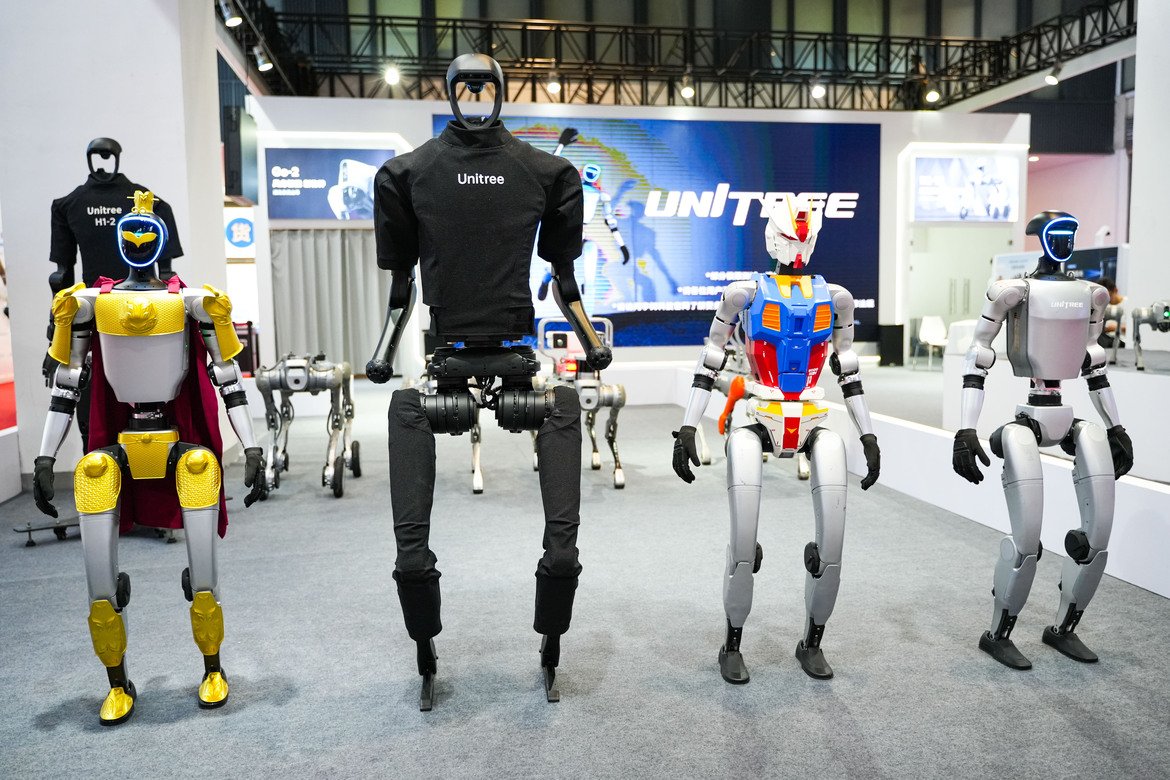
Humanoid robots have reached a level comparable to a 10-year-old child in physical and cognitive capability, according to Wang Xingxing, founder and CEO of Unitree Robotics. Despite rapid advances, Wang said large-scale commercial deployment is still three to five years away, reflecting the gap between demonstration capability and industrial-scale adoption.
The assessment highlights a pivotal moment for embodied AI. While humanoid robots are progressing quickly in mobility, perception, and task execution, fundamental technical and manufacturing challenges continue to limit widespread deployment.
Progress in Capability, Limits in Generalization
Recent humanoid robots have demonstrated increasingly sophisticated abilities, including coordinated locomotion, manipulation, and dynamic movement. These capabilities reflect significant advances in actuators, sensors, and AI-based control systems.
However, Wang emphasized that generalization remains a core limitation. Current robots can perform tasks they have been trained extensively on, but struggle to adapt reliably to unfamiliar environments or unexpected scenarios.
This limitation stems from the nature of embodied AI, which must integrate perception, decision-making, and physical action in real time. Unlike software-based AI systems that operate in controlled digital environments, physical robots must contend with unpredictable physical conditions.
Improving generalization requires large volumes of real-world training data, along with more advanced models capable of understanding physical environments and adapting dynamically.
Manufacturing and Infrastructure Challenges
Beyond AI limitations, scaling humanoid robots presents major manufacturing challenges. Wang identified production yield rates for critical components as a key constraint.
Humanoid robots require complex assemblies involving actuators, sensors, processors, and structural components. Maintaining consistent quality across large production volumes remains difficult, particularly for emerging robotics platforms.
Standardization is another barrier. Unlike industrial robot arms, which operate in highly structured environments, humanoid robots are designed for broader use cases. The lack of standardized deployment scenarios complicates integration and slows adoption.
Despite these challenges, Unitree plans to significantly expand production. The company expects humanoid robot shipments to reach between 10,000 and 20,000 units in 2026, reflecting growing demand and improving manufacturing capacity.
A Timeline for Commercial Deployment
Wang’s projection that large-scale adoption is three to five years away aligns with broader industry expectations. Robotics companies are increasingly transitioning from research prototypes toward commercial deployment, particularly in manufacturing and logistics.
Initial deployments are likely to focus on repetitive and structured tasks, where reliability requirements are easier to meet. As hardware and AI systems improve, humanoid robots will expand into more complex environments.
Unitree’s roadmap reflects a phased approach. The company is expanding deployment in industrial and service sectors, using real-world applications to improve performance and gather operational data.
Such deployments serve as both commercial operations and training environments, accelerating improvement through real-world experience.
The Path Toward Industrial-Scale Physical AI
The comparison to a 10-year-old child highlights both the progress and limitations of humanoid robotics. Like a child, humanoid robots can perform a range of tasks and learn from experience, but still lack the consistency and adaptability required for independent operation in complex environments.
Advances in AI models, computing infrastructure, and hardware manufacturing are expected to drive continued progress. Improvements in simulation, training data collection, and foundation models are helping robots learn more efficiently.
At the same time, scaling production will reduce costs and improve reliability, making humanoid robots more economically viable.
Wang’s timeline suggests that humanoid robots are approaching a tipping point. While widespread adoption may not be immediate, the underlying technology is advancing steadily toward commercial readiness.
As embodied AI continues to mature, humanoid robots are likely to transition from experimental systems into industrial tools, marking a significant shift in the evolution of automation.