
Universal Robots has launched Gen 7, its seventh-generation robotics platform, at the IMTS trade show in Chicago, presenting a unified system upgrade across controller, tool flange, teach pendant, and robot arm lineup designed to make the company’s collaborative robots the preferred deployment platform for industrial physical AI applications. The launch is anchored by PolyScope X, the robot operating system introduced in previous generations, now paired with fully re-engineered hardware throughout.
“Our vision as a whole at the Teradyne Robotics Group is really to be this destination platform for physical AI,” said Will Healy, director of product and industry marketing. “You can do research in a lab, but ultimately you have to deploy it. Our robots are absolutely uniquely suited to deploy for these companies that are trying to actually do AI in a factory.”
CB7 Controller: More Compute, Smaller Footprint
The new CB7 core controller delivers 40% more compute power in a 30% smaller footprint than the previous generation. The design enables multi-network communication across modern industrial architectures – connecting to PLCs, HMIs, MES platforms, IPCs, and vision systems through a managed Ethernet switch built into the robot, reducing the need for external network hardware.
The managed switch capability addresses a specific enterprise IT requirement: controlling which data flows where in the network architecture. “This is something IT people really want and love. It allows them to control what traffic shows up where in the network,” Healy said. CB7 is available at launch in standalone and cabinet-integrated compact versions, and is compatible with existing e-Series and UR Series robot arms.
The g-Series Tool Flange: Built for AI
The new g-Series tool flange is the component Universal Robots describes as most directly enabling physical AI deployment. It eliminates cabling complexity for wrist-mounted cameras and high-bandwidth sensors, integrating built-in force-torque sensing, impedance control, and RTDE real-time data exchange.
“Nearly every application in robotics is moving towards having a camera at the wrist,” Healy said. “In Asia, nearly every robot has a camera on the end effector. In Europe, probably half. So it’s coming our way, whether we’re ready for it or not.” The tool flange is designed to make wrist camera integration a standard rather than a complex add-on – a design decision that reflects where AI-powered robot vision is heading in commercial industrial automation.
The SP7 Smart Panel tool flange interface adds safety-compliant freedrive functionality, configurable input buttons, and LED feedback for operator interaction in high-mix, low-volume production settings where touch-to-teach programming is important.
New Robot Arms and Teach Pendant
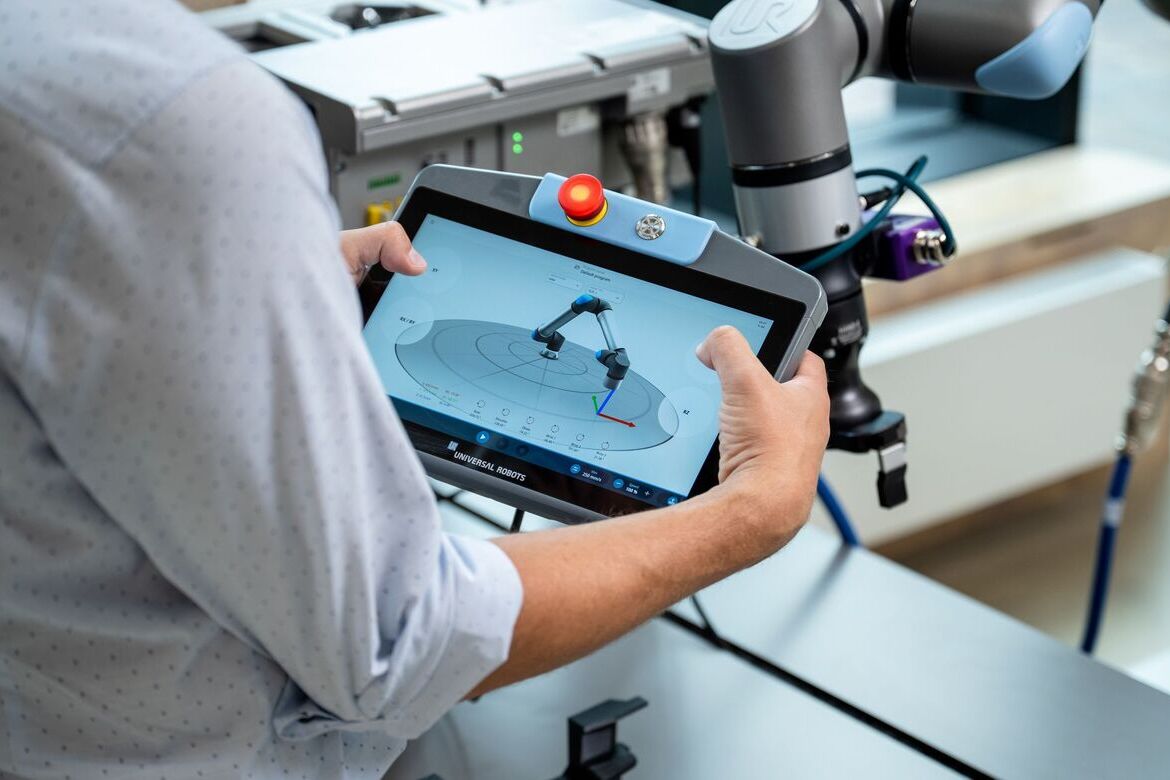
Gen 7 adds three new robot arms to the g-Series lineup: the UR10g-1750 (10kg payload, 1,750mm reach), UR17g-1300 (17kg, 1,300mm), and UR18g-950 (18kg, 950mm). The new TP7 Core teach pendant is more than 20% lighter than previous generations, with multiple grip positions, configurable smart buttons, a full HD display, and a virtual joystick designed for comfort during long shifts.
Safety Architecture for AI-Controlled Robots
Gen 7 maintains PLd, Category 3 ISO 13849-1 certified safety architecture across all g-Series robots, with TÜV certification to ISO10218-1 and UL1740. Teradyne Robotics holds IEC 62443-4-1 ML3 cybersecurity certification. The safety system is designed to remain in control even when an AI model is commanding the robot: the robot’s safety controller evaluates every AI-generated command against its configured safety rules and retains the authority to reject instructions that violate those parameters. “The robot will reject commands from the AI that don’t play nicely with the safety settings,” Healy said.
Disclaimer: RobotsBeat is an independent media brand owned and operated by NuvexMedia LLC, publishing news, research, and insights on artificial intelligence, emerging technologies, automation, and related industries. NuvexMedia LLC invests in and collaborates with companies across the AI, Robotics, technology, software, and digital innovation sectors. These relationships do not influence RobotsBeat's editorial coverage, and the publication maintains full editorial independence to provide accurate, timely, and objective information. © 2026 NuvexMedia LLC. All rights reserved. This content is for informational purposes only and should not be considered legal, tax, investment, financial, or other professional advice.