
Germany’s VDMA, the network organization representing Europe’s machinery and equipment manufacturing industry, has published a futures study outlining four scenarios for humanoid robotics by 2040. Developed with strategy consultancy Z_Punkt and contributions from robotics associations, research institutes, academia, and end users, the study is not a market forecast but a structured framework for industry dialogue about how the humanoid sector might develop across different regulatory, economic, and technological trajectories.
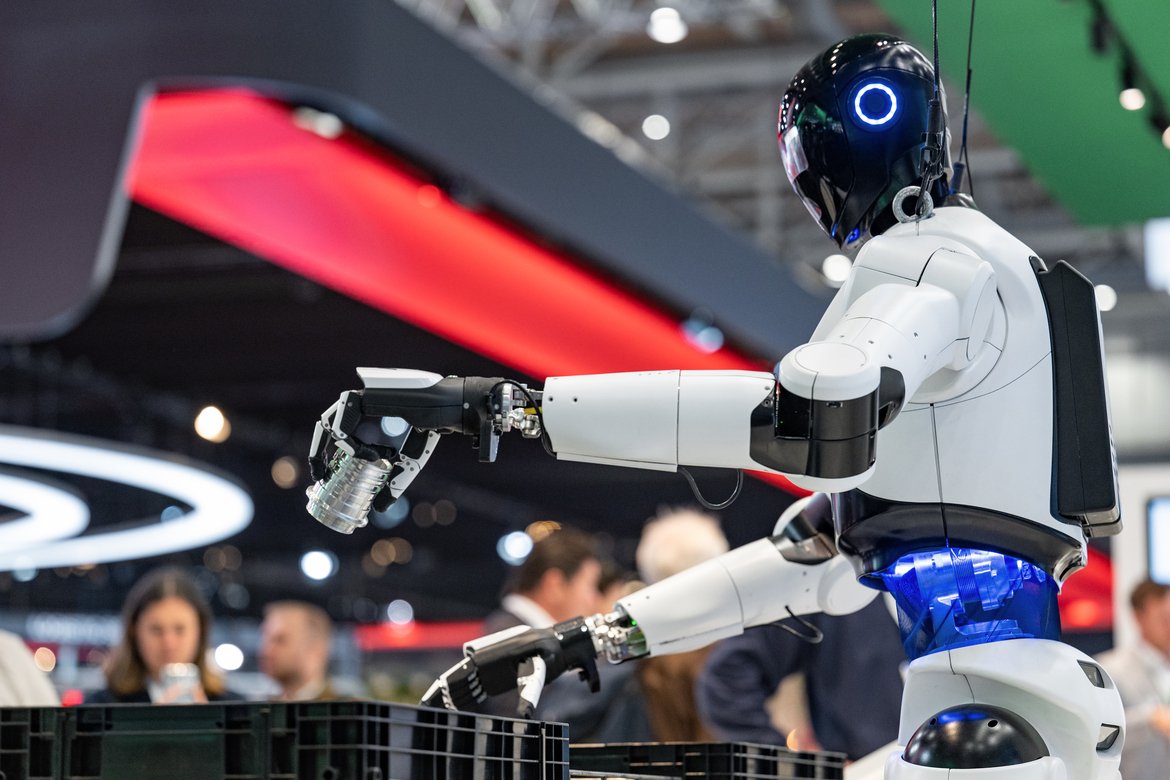
Anne Wendel, Director of Robotics, Automation and Machine Vision at VDMA, told RobotsBeat that most participants in the process expect the industry to land in one of two scenarios – widespread everyday deployment or certified B2B service robots – rather than remaining confined to a niche. But she added a grounding note: “We hear a lot about pilot projects and impressive videos from U.S. or Chinese manufacturers. But let’s be honest: I haven’t seen any humanoid robot truly interacting with people in industry yet. Carrying empty baskets is one thing; deploying them in real, unfixed industrial environments is another.”
The Four Scenarios
The first scenario, Trustworthy Helpers, describes a 2040 in which humanoid robots are affordable, certified, and present in homes and workplaces at scale, operating under strict data protection and safety standards. Europe’s opportunity in this future lies in certification, safety services, and scalable production. The risk is platform dependency – becoming a sales market for AI ecosystems developed elsewhere.
The second scenario, Premium Niche, sees humanoids as high-margin status goods with limited volumes. Europe’s component excellence in precision drives, dexterous hands, and advanced perception would be advantageous, but without AI investment the continent risks being reduced to a hardware supplier for foreign-controlled platforms.
The third scenario, B2B Bot, envisions humanoids as certified workers in logistics, healthcare, and industry, deployed selectively in labor-shortage environments. Europe’s regulatory tradition and integration capability are assets here, but high liability exposure in human-proximity settings is a structural risk.
The fourth scenario, Humanoid Winter, describes a market confined to industrial niches by safety incidents, fragmented standards, and weak public acceptance. Growth stalls, and Europe’s cautious regulatory culture – an asset in the B2B Bot scenario – becomes a liability that accelerates falling behind in physical AI capability.
Europe’s Structural Position
Wendel identified labor shortage as the primary demand driver for humanoids across both Europe and the U.S., and framed the automation question in terms of industrial competitiveness rather than job displacement. “It’s not about killing jobs – we’re beyond that discussion. It’s about keeping jobs in Europe. Without investment in robotics and automation, we will keep losing competitiveness.”
Europe’s structural advantages are real: a full value chain from components to integration, around 3,400 specialized manufacturers in the VDMA network, and existing leadership in safety standards and data protection frameworks that could become global benchmarks. The gap is capital. “China and the U.S. are investing massively. China already scales production at lower costs, and the U.S. has venture capital and AI giants like Nvidia driving expectations. Europe has the technology, the research, and the component manufacturers, but we lack venture capital,” Wendel said.
The VDMA study recommends five actions for Europe: investing in physical AI and cross-industry ecosystems, creating regulatory sandboxes to accelerate real-world testing, strengthening safety standards to avoid incidents that could set back the entire sector, mobilizing private capital through tax incentives and simplified SME access to funding, and leveraging existing component strengths to establish positions in the higher-margin subsystems of the humanoid stack.
The window for European manufacturers to establish competitive positions in humanoid robotics is open, but the study’s framing implies it will not remain so indefinitely.
Disclaimer: RobotsBeat is an independent media brand owned and operated by NuvexMedia LLC, publishing news, research, and insights on artificial intelligence, emerging technologies, automation, and related industries. NuvexMedia LLC invests in and collaborates with companies across the AI, Robotics, technology, software, and digital innovation sectors. These relationships do not influence RobotsBeat's editorial coverage, and the publication maintains full editorial independence to provide accurate, timely, and objective information. © 2026 NuvexMedia LLC. All rights reserved. This content is for informational purposes only and should not be considered legal, tax, investment, financial, or other professional advice.